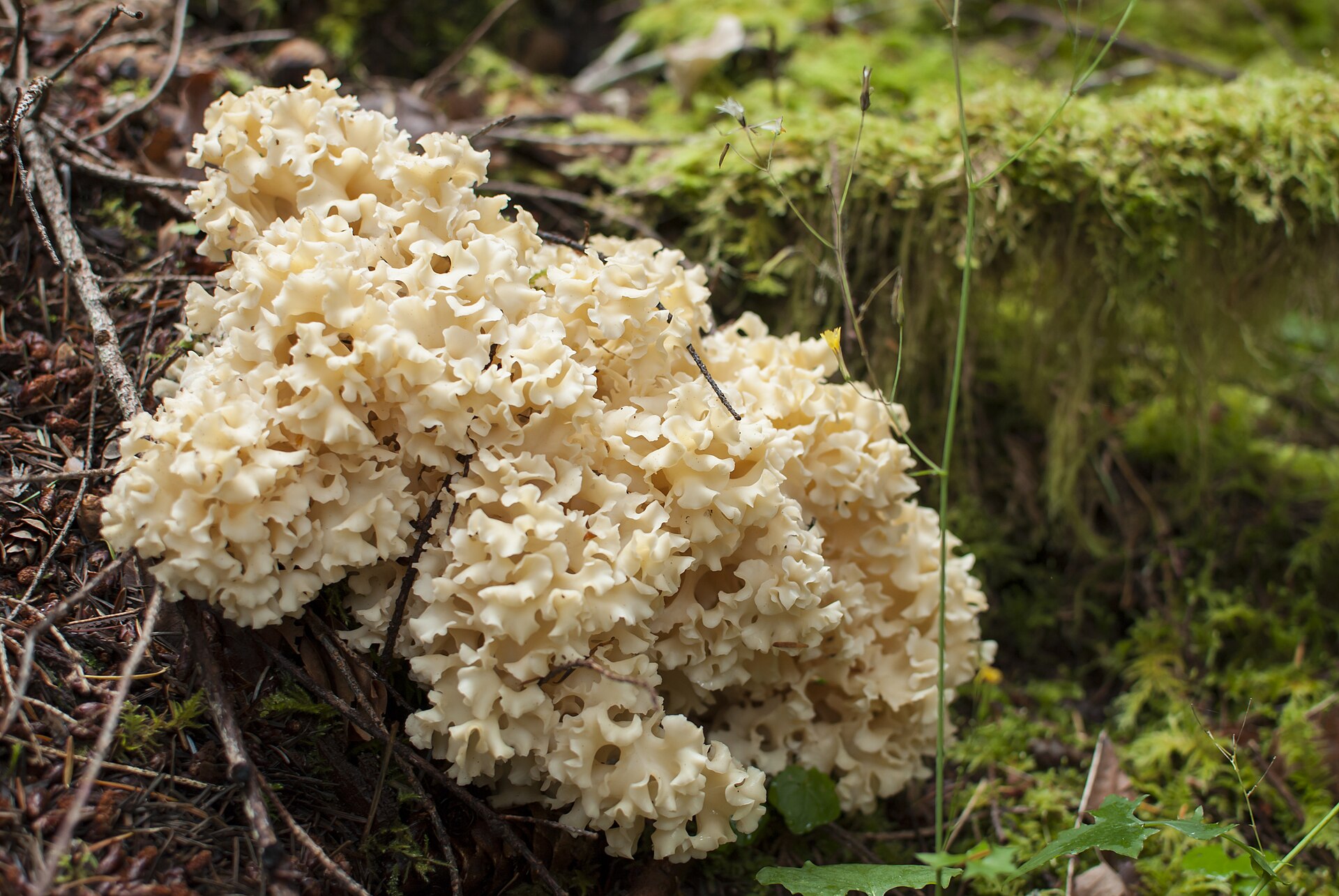
Sparassis radicata, commonly called the Western Cauliflower Mushroom or simply Cauliflower Mushroom, is a large, pale, highly branched fungus found mainly in western North America. It grows at the base of conifers or from buried roots and can form an enormous mass of thin, wavy, leaf-like lobes.
The most useful field pattern is large cream-colored cauliflower-like mass + flattened frilly lobes + thick root-like base + growth near conifers. Mature fruit bodies can become very large, sometimes reaching tens of pounds.
⚠️ Important: Do not identify a cauliflower mushroom from shape alone. Several Sparassis species look similar, and older North American literature often used the European name Sparassis crispa for western collections.
Quick Identification
| Feature | Sparassis radicata |
|---|---|
| Common name | Western Cauliflower Mushroom |
| Shape | Large rounded mass of frilly lobes |
| Color | White, cream, pale yellow |
| Lobes | Flattened, thin, wavy |
| Stem/base | Thick, root-like, persistent |
| Gills | Absent |
| Pores | Absent |
| Spore print | White to cream |
| Flesh | White, firm when young |
| Odor | Fragrant, somewhat spicy |
| Ecology | Root-associated wood-decay fungus |
| Main hosts | Douglas fir, spruce, pine and other conifers |
| Growth | Usually solitary |
| Season | Fall to early winter |
| Distribution | Mainly western North America |
| Edibility | Considered edible when young and correctly identified |
| Main look-alikes | Sparassis crispa, S. spathulata, S. latifolia |
What Does Sparassis radicata Look Like?
The fruit body resembles a giant head of cauliflower or a bowl filled with curled egg noodles. It is made of hundreds of flattened, branching lobes with wavy or crisped margins.
Fresh specimens are white to cream or pale yellow. With age, the lobes can become more yellowish or brown around the edges.
Size
Sparassis radicata can become enormous. Typical fruit bodies may be 10–50 cm across, but much larger specimens are documented.
E-Flora BC notes that some fruit bodies can exceed 50 pounds. This makes the species one of the largest conspicuous fleshy fungi encountered in western conifer forests.
Lobes
The individual branches are flattened rather than cylindrical. Their edges are thin, wavy, and irregularly curled.
This leafy structure distinguishes Sparassis from many coral fungi, which tend to have upright cylindrical or club-shaped branches.
Color
Young mushrooms are generally white or cream. Pale yellow tones become more obvious as the fruit body matures.
The margins may darken or become brown with age. Strongly browned, soft, or decomposing specimens are no longer in ideal condition for culinary use.
Base
One of the most important characters is the thick, root-like sterile base beneath the frilly upper portion. This structure can extend into the soil and connect with a conifer root.
The upper part of the base may appear chambered when cut, while the lower portion is more solid.
Why Is It Called radicata?
The species epithet radicata refers to the conspicuous root-like base. This feature is especially useful when separating it from some superficially similar branched fungi.
The base can remain attached to underground roots and may produce new fruit bodies in later years. Some Pacific Northwest sources describe the central basal structure as persistent or perennial.
Flesh
The flesh is white and firm when young. Individual lobes are relatively thin but retain a crisp texture.
Older specimens become softer, more fragile, and less appealing. Dirt and forest debris can also become deeply trapped between the folds.
Odor
The odor is often described as fragrant or spicy rather than strongly mushroom-like. This can be a useful supporting character.
Odor varies between specimens and should not be used by itself. Shape, base structure, host tree, and geography are more important.
Spore Print
The spore print is white to cream. This is consistent with the pale spores typical of Sparassis.
Spore color is not usually necessary for a typical large cauliflower-like specimen, but it helps confirm the broader group.
Where Does Sparassis radicata Grow?
Sparassis radicata usually appears at the base of conifers, near stumps, or from buried roots. It can seem to grow directly from soil even though the fungus is connected to woody roots below ground.
Western records include Douglas fir, spruce, and pine. California collections are often associated with Bishop pine and Monterey pine, while Pacific Northwest records frequently involve Douglas fir and Sitka spruce.
Douglas Fir
Douglas fir is one of the characteristic western hosts. Fruiting bodies may emerge beside living, dying, or dead trees and can recur in approximately the same location over multiple years.
The fungus is associated with root and lower-trunk decay. This means the visible cauliflower-like structure is only the reproductive portion of a much larger fungal organism inside or around the root system.
Pine
In coastal California, Sparassis radicata is often found near pines. Bishop pine and Monterey pine are especially noted in California records.
This association helps distinguish the species ecologically from similar Sparassis in other regions.
Spruce
Spruce is another documented host in the Pacific Northwest. The fungus has been reported in association with Sitka spruce and Engelmann spruce.
The Pacific Northwest Plant Disease Management Handbook also records Sparassis root rot in spruce and other western conifers.
Season
Fruiting is mainly from autumn into early winter. California sources describe fruiting from late fall through mid-winter.
Timing depends strongly on rainfall and regional climate. Coastal areas can continue producing fruit bodies later than colder inland forests.
Distribution
Sparassis radicata is primarily a western North American species. It is especially associated with the Pacific Coast and Pacific Northwest.
Modern literature also notes records farther east in North America, but the strongest geographic identity remains western. Recent reviews contrast western North American S. radicata with European S. crispa.
Sparassis radicata vs Sparassis crispa
The two species are extremely similar and were historically treated as the same species by some authors. This is why older western North American field guides frequently label Cauliflower Mushrooms as Sparassis crispa.
Molecular and morphological studies later supported treating S. radicata as distinct from European S. crispa. Modern summaries generally associate S. radicata with western North America and S. crispa mainly with Europe.
| Feature | Sparassis radicata | Sparassis crispa |
|---|---|---|
| Main range | Western North America | Mainly Europe |
| Fruit body | Cauliflower-like | Cauliflower-like |
| Lobes | Thin, curled | Thin, curled |
| Base | Strong root-like sterile base | Similar but regional context differs |
| Hosts | Western conifers | European conifers |
| Best clue | Geography | Geography |
Macroscopic separation can be difficult. Geographic context and current taxonomy are therefore especially important.
Look-Alikes
Sparassis crispa — Cauliflower Fungus
Identification
Sparassis crispa produces a very similar cream-colored mass of curled, leaf-like lobes. It is the classic European Cauliflower Fungus.
The fruit body grows near conifers and can also become very large.
Main Difference
Western North America strongly favors S. radicata. Europe strongly favors S. crispa.
Sparassis spathulata — Eastern Cauliflower Mushroom
Identification
Sparassis spathulata occurs mainly in eastern North America. Its branches tend to be more upright, stiff, and spatula-like rather than tightly curled.
The structure can therefore look more open and coral-like than the compact noodle-like mass of S. radicata.
Main Difference
Curled frilly lobes favor S. radicata. More erect blade-like branches favor S. spathulata.
Sparassis latifolia
Identification
Sparassis latifolia is an East Asian cauliflower mushroom found in regions including China, Japan, Korea, and the Russian Far East. It also forms large pale masses of curled branches.
It was historically confused with S. crispa before molecular studies separated it as a distinct species.
Main Difference
Geography is again decisive. East Asian collections are more likely to represent S. latifolia than western North American S. radicata.
Coral Fungi
Identification
Large coral fungi can also form branched masses on forest floors. Their branches are usually cylindrical or club-shaped rather than broad, flat, and ribbon-like.
Some coral fungi can also produce yellow, orange, or pink colors absent from typical S. radicata.
Main Difference
Flat, frilly, ribbon-like lobes = Sparassis. Upright cylindrical branches = coral fungus.
Is Sparassis radicata Edible?
Yes. It is widely considered edible and is often regarded as a choice mushroom when young and fresh.
The main practical difficulty is cleaning rather than identification. Pine needles, soil, insects, and fragments of bark can become trapped deep inside the tightly folded structure.
Cleaning Cauliflower Mushroom
Cleaning can take more time than cooking. Start by removing the dirty basal portion and separating the fruit body into manageable pieces.
Rinse thoroughly between the folds because dry brushing alone is often insufficient. Unlike many conventional mushrooms, Sparassis tolerates washing reasonably well because its flesh is firm and deeply folded.
Inspect carefully for insects and decomposed areas. Older specimens can hide debris far inside the branching mass.
Cooking
Young Cauliflower Mushrooms retain a slightly crisp texture when cooked. They can be sautéed, added to soups, or used in dishes where their noodle-like structure remains visible.
Cook wild mushrooms thoroughly before eating. Older yellowing or browning specimens are less desirable and may cause digestive upset in some people.
Can It Grow Back in the Same Place?
Yes. Fruiting bodies can return near the same tree or root system over multiple years.
The visible mushroom is annual, but the fungus itself persists in the roots and woody tissues. Some sources describe a perennial basal structure that produces new annual fruit bodies.
Does Sparassis radicata Harm Trees?
It can cause root and lower-trunk decay in conifers. The fungus can persist in living roots and continue after the tree dies.
Pacific Northwest plant pathology sources describe Sparassis root rot affecting spruce, Douglas fir, pine, and other conifers.
This makes the species different from a purely harmless decomposer of already dead wood.
Young vs Mature Cauliflower Mushrooms
Young fruit bodies are compact, pale, and crisp. Their lobes are usually white to cream and relatively clean.
As they mature, the structure expands and becomes increasingly yellowish. Outer edges may brown, and insects or debris become more difficult to remove.
For culinary use, young specimens are usually preferable.
How Large Can It Get?
Very large. Individual fruit bodies can exceed 50 cm across and can weigh many kilograms.
Exceptional specimens weighing more than 50 pounds have been reported.
A large specimen may look like an entire pile of cream-colored noodles growing from a single point at the base of a tree.
Common Identification Mistakes
One common mistake is calling every western North American Cauliflower Mushroom Sparassis crispa. That European name was historically applied broadly but does not reflect modern regional taxonomy.
Another mistake is ignoring the basal structure. The thick root-like base is one of the strongest characters supporting S. radicata.
A third mistake is confusing it with coral fungi. The flattened leafy lobes of Sparassis are structurally different from cylindrical coral branches.
A fourth mistake is collecting an old giant specimen simply because it is impressive. Freshness and texture matter independently of correct species identification.
How to Photograph Sparassis radicata
Photograph the entire fruit body beside its host tree before cutting it. Include the trunk, stump, or surrounding conifer habitat.
Then photograph individual lobes and the basal attachment. If possible, expose enough of the root-like base to show how the mushroom connects with the underlying wood.
A wide habitat image is especially useful because host tree and geography are important for distinguishing Sparassis species.
Can AI Identify Sparassis radicata?
AI can usually recognize the genus easily because the cauliflower-like fruit body is extremely distinctive. Exact species identification is more dependent on geography and host tree.
A western North American specimen at the base of Douglas fir, spruce, or pine is much more likely to be S. radicata than European S. crispa. Region should therefore always accompany the photograph.
Interesting Facts
Sparassis radicata was described in 1917. Its taxonomic status later became controversial because experiments suggested compatibility with European S. crispa, leading some authors to merge them.
Later DNA-based studies supported separating the western North American lineage again. This is why modern guides and older books may use different names for the same-looking western mushroom.
The species can also produce astonishingly large fruit bodies. Reports of specimens exceeding 50 pounds illustrate how much fungal biomass can be produced from one persistent underground root system.
Its noodle-like appearance is not merely decorative. The many thin lobes create an enormous fertile surface on which microscopic spores can be produced.
Frequently Asked Questions
What is Sparassis radicata commonly called?
It is usually called the Western Cauliflower Mushroom or Cauliflower Mushroom.
Where does Sparassis radicata grow?
It grows mainly in western North America near the bases and roots of conifers such as Douglas fir, spruce, and pine.
Is Sparassis radicata the same as Sparassis crispa?
They were historically treated as the same species by some authors, but modern molecular work generally separates western North American S. radicata from European S. crispa.
Is Sparassis radicata edible?
Yes. Young, correctly identified specimens are widely considered edible and often rated highly.
What does it look like?
It forms a huge white-to-cream mass of thin, wavy, flattened lobes resembling cauliflower or egg noodles.
Does it grow directly on wood?
It usually emerges near the base of a conifer and is connected to roots or buried wood through a thick root-like base.
Can it return in the same place?
Yes. The fungus can persist in the root system and produce new fruit bodies in subsequent years.
How do you distinguish it from coral mushrooms?
Sparassis has broad, flattened, frilly lobes. Coral fungi usually have cylindrical or club-like upright branches.
Final Identification Notes
Sparassis radicata is best recognized by the combination of a large white-to-cream cauliflower-like fruit body, thin flattened wavy lobes, thick root-like sterile base, and growth beside western North American conifers.
The most important comparison is Sparassis crispa. The two are visually extremely similar, but geographic context is highly informative: western North America favors S. radicata, while Europe favors S. crispa.
The practical field pattern is: giant cream-colored frilly mass + flattened noodle-like lobes + root-like base + Douglas fir, spruce, or pine in western North America = strong Sparassis radicata candidate.
Upload a photo and get possible matches in seconds.