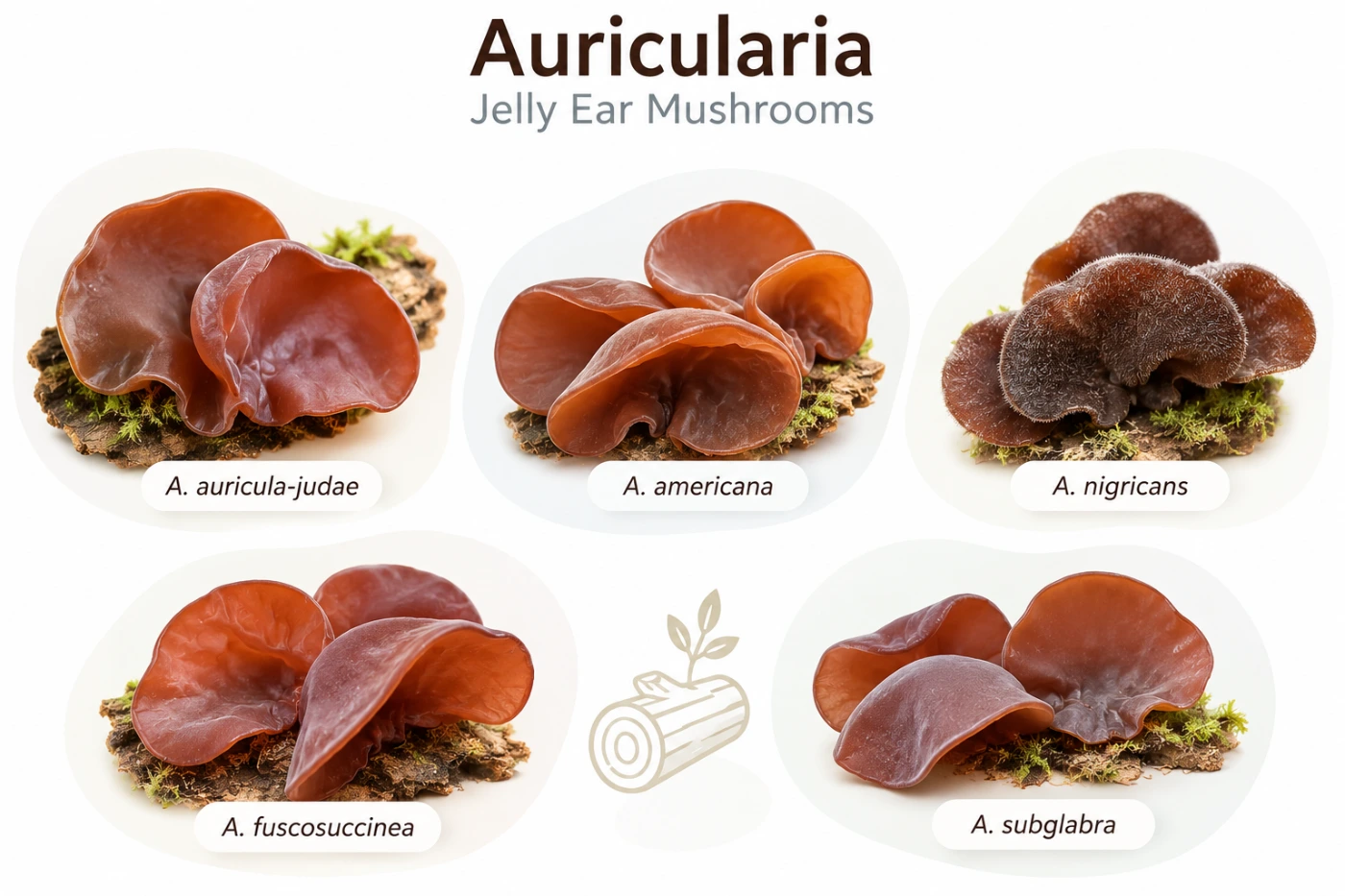
Auricularia is a genus of gelatinous wood-growing fungi commonly known as Jelly Ears, Wood Ears, or Tree Ears. They are recognized by their rubbery ear-shaped fruit bodies, brown to reddish-brown colors, smooth or finely hairy surfaces, and growth directly from dead or dying wood.
The most useful field pattern is brown ear-shaped jelly fungus + flexible rubbery texture + direct growth from wood. However, species-level identification can be difficult because several Auricularia species look very similar, and names historically used in Europe have often been applied too broadly elsewhere.
⚠️ Important: Do not identify a Jelly Ear to species from shape alone. Geography, host tree, surface hairiness, thickness, microscopic characters, and current regional taxonomy may all be needed.
Quick Identification
| Feature | Auricularia |
|---|---|
| Common names | Jelly Ear, Wood Ear, Tree Ear |
| Shape | Ear-shaped, cup-shaped, folded, irregular |
| Color | Tan, reddish brown, dark brown |
| Texture when fresh | Gelatinous, rubbery, flexible |
| Texture when dry | Thin, hard, shriveled |
| Underside | Smooth to slightly wrinkled |
| Gills | Absent |
| Pores | Absent |
| Stem | Usually absent or very short |
| Spore print | White |
| Ecology | Saprotrophic |
| Substrate | Dead or dying wood |
| Main habitat | Woodland, parks, hedgerows |
| Season | Often year-round in wet weather |
| Main look-alikes | Exidia, Tremella, Phaeotremella, other jelly fungi |
What Are Auricularia Mushrooms?
Auricularia are jelly fungi rather than conventional cap-and-stem mushrooms. Their fruit bodies are soft and flexible when wet and can resemble ears, cups, folds, or irregular brown lobes attached directly to wood.
They lack gills and pores. The fertile surface is generally smooth or finely wrinkled, which immediately separates them from most familiar mushrooms.
Why Are They Called Jelly Ears?
The name comes from both shape and texture. Many fruit bodies resemble a human or animal ear, with folds, lobes, and a slightly concave inner surface.
When fresh, the flesh is rubbery and gelatinous rather than brittle. This combination of ear-like shape and flexible texture is highly characteristic of the genus.
What Happens When Jelly Ears Dry Out?
Dry weather causes Auricularia to shrink dramatically. A large soft fruit body can become thin, hard, dark, and almost unrecognizable.
Rain can rehydrate the dried fungus and restore much of its original shape and flexibility. This ability to dry and revive repeatedly is typical of many jelly fungi.
Surface Texture
The outer surface can be smooth, finely hairy, velvety, or somewhat fuzzy depending on the species. Some species have a distinctly hairy outer surface while the inner fertile surface remains smoother.
Surface texture is one of the useful characters for separating similar species. A close side-lit photograph often reveals hairs that are difficult to see from above.
Color
Fresh Jelly Ears range from pale tan and pinkish brown to reddish brown, chocolate brown, or nearly black. Color can darken substantially as the fruit body dries.
Weather, age, hydration, and substrate can all alter appearance. Exact color is therefore less reliable than texture and structure.
Underside and Fertile Surface
There are no gills beneath the fruit body. Instead, spores develop on a relatively smooth or slightly wrinkled surface.
The fertile side may appear paler or more translucent than the outer surface. In some specimens, veins or shallow folds become more obvious with age.
Stem
Most Jelly Ears have little or no obvious stem. The fruit body is attached laterally or directly to the wood.
Some species may narrow into a short base. A long central stem would point away from typical Auricularia.
Spore Print
The spore print is white. In practice, obtaining a clean print from an irregular jelly fungus can be more difficult than with ordinary cap mushrooms.
Spore color is mainly useful for confirming the broader group. Microscopic spore shape and other characters may be necessary for species-level work.
Where Do Auricularia Species Grow?
Jelly Ears grow directly from wood and act mainly as decomposers. They occur on dead branches, fallen trunks, stumps, and sometimes weakened portions of living trees.
Hardwood is especially common as a substrate. The exact host preference differs among species and regions.
Elder and Auricularia auricula-judae
In Europe, Auricularia auricula-judae is particularly well known from elder, especially dead or weakened elder branches. It can also occur on other deciduous wood.
The species remains accepted under that name in Index Fungorum.
Auricularia in North America
North American Jelly Ears should not automatically be called Auricularia auricula-judae. Modern treatments recognize regionally distinct species, and MushroomExpert currently treats several older North American names as belonging to Auricularia americana.
This is a good example of why geographic context matters. A mushroom can look almost identical to a European species while representing a different lineage.
Main Auricularia Species
Auricularia auricula-judae — European Jelly Ear
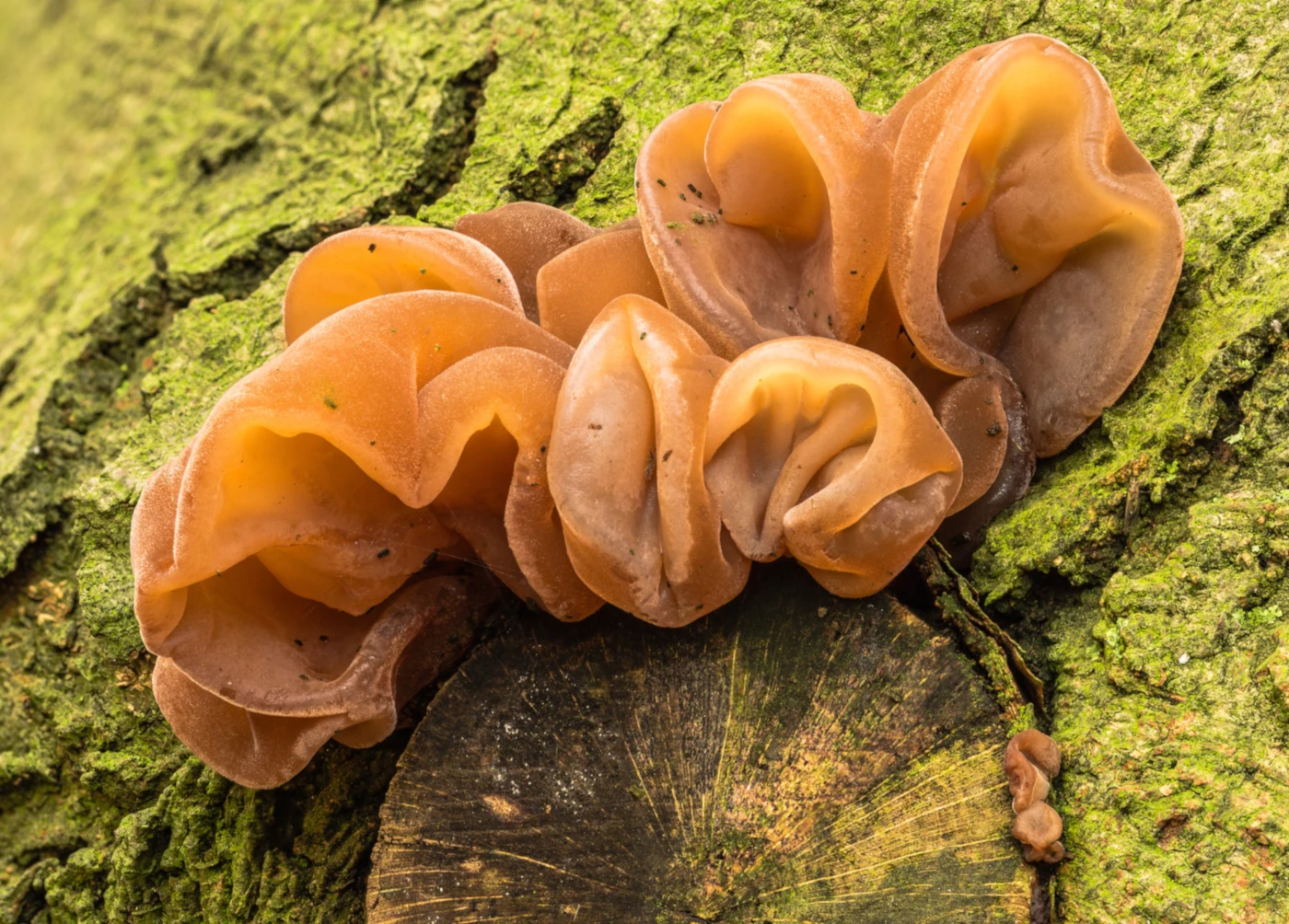
This is the classic European Jelly Ear and one of the best-known members of the genus. It typically forms reddish-brown to dark brown ear-shaped fruit bodies on deciduous wood.
Elder is a particularly characteristic host. The fruit body is flexible when wet and becomes much thinner and darker when dry.
Identification
Look for a brown, gelatinous, ear-shaped fungus growing directly from hardwood, especially elder in Europe.
Main Difference
European geography plus elder association strongly supports A. auricula-judae.
Auricularia americana — American Jelly Ear
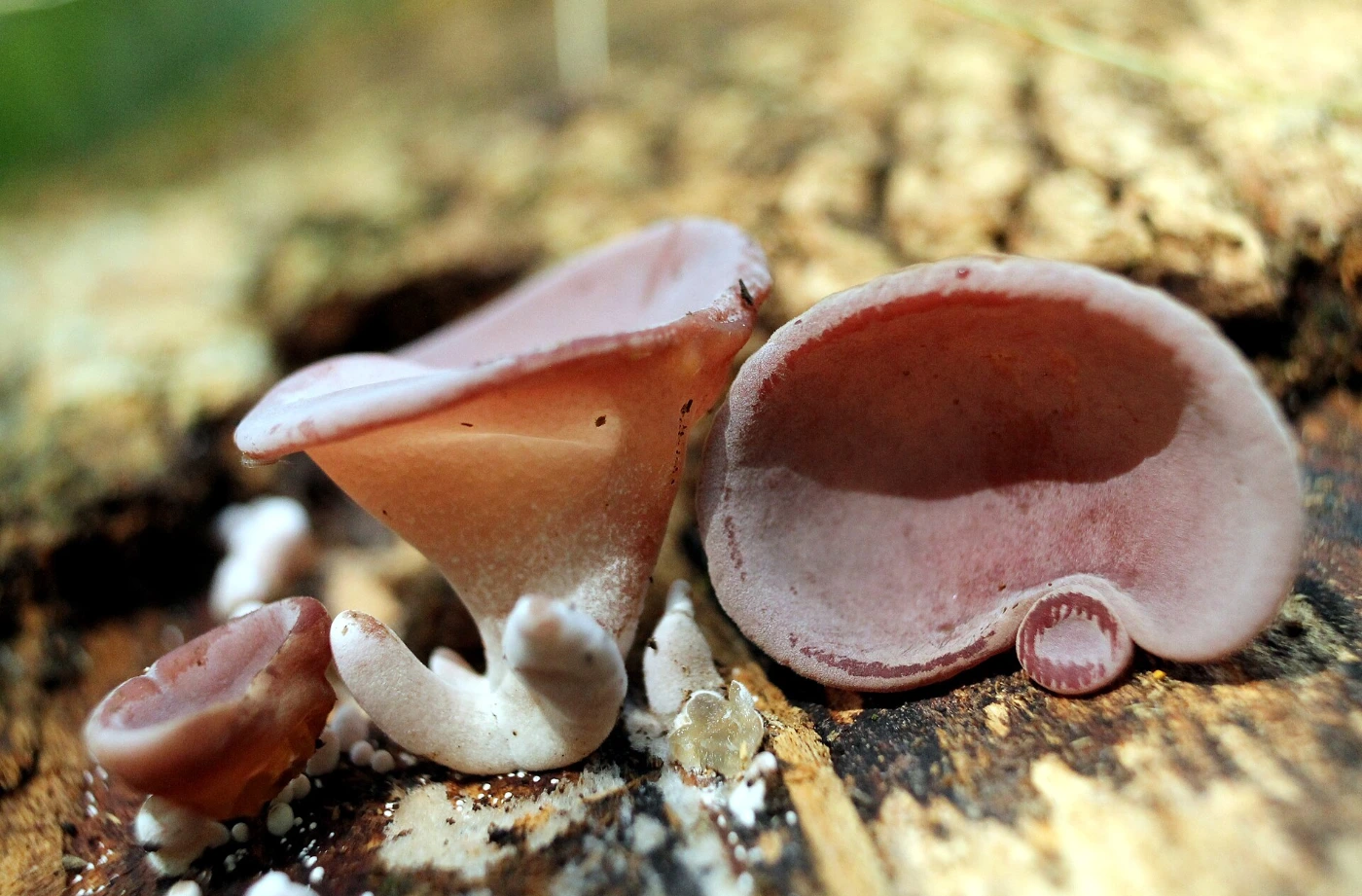
Auricularia americana is an important North American Jelly Ear. Modern North American treatments use this name for material that older sources sometimes called A. auricula-judae, A. auricula, A. angiospermarum, or even A. fuscosuccinea.
The species produces brown gelatinous fruit bodies on wood and may look extremely similar to European Jelly Ear.
Identification
The overall field pattern is a brown flexible ear-shaped fungus growing on decaying wood in North America.
Main Difference
Geography and modern taxonomy are more useful than simple visual appearance when separating it from European A. auricula-judae.
Auricularia nigricans – Hairy Wood Ear or Black Wood Ear
Auricularia nigricans is a darker, often more strongly hairy species found in warmer regions. The name Auricularia polytricha has historically been used for similar material, but Index Fungorum currently treats A. polytricha as a synonym of A. nigricans.
Fruit bodies can become dark brown to almost black and may be noticeably velvety on the outer surface.
Identification
Look for darker coloration and a more obviously hairy or woolly outer surface.
Main Difference
Hairiness and tropical or subtropical distribution help separate it from smoother temperate Jelly Ears.
Auricularia fuscosuccinea – Brown Wood Ear (descriptive/common-use label, not strongly standardized)
Auricularia fuscosuccinea is a reddish-brown jelly fungus described from the Caribbean region. Index Fungorum currently recognizes the name as valid.
Its appearance overlaps with several other Auricularia, so field identification without geographic and microscopic context can be difficult.
Identification
Expect reddish-brown gelatinous fruit bodies on bark or dead wood in warmer regions.
Main Difference
Regional distribution and microscopic characters are often needed because morphology overlaps heavily with related species.
Auricularia subglabra – No established common name
Auricularia subglabra was described from decaying hardwood in Costa Rica and remains accepted under that name.
It is another reminder that tropical American Jelly Ears include their own regional species rather than being simple extensions of European taxa.
Identification
Field appearance is broadly ear-like and gelatinous, with species-level identification relying heavily on location and microscopy.
Main Difference
Central American distribution and technical characters separate it from more familiar temperate species.
Jelly Ear vs Exidia
Exidia species are among the most common look-alikes. They also form brown to black gelatinous masses on dead wood.
The difference is often shape. Exidia tends to form irregular lobes, cushions, or fused blobs rather than distinct ear-shaped fruit bodies.
Identification
Look for blackish or brown gelatinous patches that merge together across the wood.
Main Difference
Distinct ear-like lobes favor Auricularia. Irregular fused jelly masses favor Exidia.
Jelly Ear vs Tremella
Tremella species can also be gelatinous, but many are yellow, orange, or strongly lobed. Their fruit bodies often resemble brains or clusters of translucent folds.
Brown forms do occur, so color alone is not enough. Shape and substrate remain useful.
Identification
Many Tremella have convoluted, brain-like, or highly folded fruit bodies.
Main Difference
Ear-shaped and flattened favors Auricularia. Highly convoluted jelly masses favor Tremella-type fungi.
Jelly Ear vs Phaeotremella
Phaeotremella species can produce brownish gelatinous fruit bodies on wood and may resemble dark Jelly Ears from a distance.
They often form thicker, more irregular, brain-like masses instead of thin individual ears.
Identification
The fruit body is usually lobed and convoluted rather than distinctly ear-shaped.
Main Difference
A recognizable ear shape is a much stronger Auricularia character.
Jelly Ear vs Cup Fungi
Some brown cup fungi can superficially resemble dry Jelly Ears. However, most cup fungi have a firmer, less rubbery texture.
They also do not typically collapse and rehydrate in the same dramatic way.
Identification
Check texture before relying on shape. A fresh Jelly Ear should be flexible and gelatinous.
Main Difference
Rubbery jelly texture = Auricularia-type fungus. Firm or brittle cup texture = likely another group.
Is Jelly Ear Edible?
Several Auricularia species are widely used as food, particularly in Asian cuisines. Commercial “wood ear” mushrooms belong to this broader group.
However, common names such as Wood Ear can refer to several species. Correct regional identification still matters, especially for wild collections.
Why Wood Ear Is Popular in Cooking
Jelly Ears have a mild flavor but a distinctive crunchy, elastic texture. This texture remains noticeable even after cooking.
They are commonly used in soups, stir-fries, hot pots, and cold dishes. Dried commercial Wood Ears rehydrate very effectively.
Can Jelly Ear Be Eaten Raw?
Wild mushrooms should generally be cooked rather than eaten raw. Cooking also improves texture and reduces contamination risk from the substrate.
A wild specimen should be confidently identified before any culinary use. Commercial dried Wood Ears are usually prepared according to package instructions.
How to Clean Jelly Ear
Because Jelly Ears grow directly on wood, bark fragments and debris can collect around the attachment point. Trim away tough or dirty bases and rinse the fruit bodies briefly.
Their gelatinous texture tolerates washing better than many delicate mushrooms. However, prolonged soaking is unnecessary unless rehydrating dried commercial specimens.
How to Dry Jelly Ear
Jelly Ears dry extremely well. Clean specimens can be spread in a dehydrator or dried with good airflow until completely hard and brittle.
Dried fruit bodies shrink considerably. When rehydrated, they regain much of their original size and flexible texture.
Why Auricularia Can Survive Dry Periods
The fruit body tolerates substantial water loss. During dry weather it shrinks and becomes tough, then absorbs water again when rain returns.
This does not mean an individual fruit body lives indefinitely. Repeated drying and rehydration eventually lead to aging and decomposition.
Season
Jelly Ears can appear in many seasons because they grow on wood and respond strongly to moisture. Mild wet winters can be particularly productive in temperate regions.
Unlike many mycorrhizal mushrooms, they are not restricted to a short autumn fruiting period. Rain and available dead wood can matter more than calendar month.
How to Identify Auricularia Step by Step
First confirm that the fungus is growing directly from wood. Then check for a flexible gelatinous consistency and ear-shaped or cup-like fruit bodies.
Next examine the outer surface for hairs and the inner surface for wrinkles or veins. Finally, consider geography and host tree before assigning a species name.
Common Identification Mistakes
One common mistake is calling every brown jelly fungus Auricularia auricula-judae. That European name has historically been applied much too broadly.
Another mistake is ignoring the outside surface. Hairiness can be important for distinguishing species such as darker tropical Wood Ears.
A third mistake is identifying dried specimens only from color. Once dry, several jelly fungi become dark, thin, and visually similar.
A fourth mistake is assuming that all “Wood Ear” products or wild mushrooms belong to one species. The culinary name covers multiple Auricularia taxa.
How to Photograph Jelly Ear
Photograph both the outer and inner surfaces. A side view showing thickness and attachment to the wood is especially helpful.
Include the substrate and, if possible, identify the host tree. Close-up photographs under side lighting can reveal surface hairs that may otherwise be invisible.
Can AI Identify Auricularia?
AI can often recognize the genus from a clear photograph showing brown ear-shaped gelatinous fruit bodies on wood. Genus-level identification is generally easier than exact species identification.
Regional species separation is more difficult. Geography, host tree, surface texture, and sometimes microscopic examination are needed for confidence.
Interesting Facts
Jelly Ears can change appearance dramatically without actually disappearing. A soft brown ear after rain may shrink into a thin blackish patch during dry weather and expand again after the next rainfall.
The genus also demonstrates how DNA studies have changed mushroom identification. North American collections once routinely called A. auricula-judae are now treated differently in modern regional taxonomy.
The name Auricularia itself refers to an ear-like form. This shape is so characteristic that the common names Jelly Ear, Wood Ear, and Tree Ear have developed independently in several languages.
Commercial Wood Ear mushrooms are valued more for texture than strong flavor. Their ability to dry compactly and rehydrate successfully has also made them particularly convenient as a stored food.
Frequently Asked Questions
What is a Jelly Ear mushroom?
Jelly Ear is a common name for brown gelatinous fungi in the genus Auricularia. They usually grow directly from dead or dying wood.
Is Jelly Ear the same as Auricularia auricula-judae?
Not always. A. auricula-judae is the classic European species, but similar mushrooms in other regions may belong to different Auricularia species.
Does Jelly Ear grow on elder?
Yes. European A. auricula-judae is particularly well known from elder, although it can occur on other hardwoods.
Does Jelly Ear have gills?
No. The fertile surface is smooth or slightly wrinkled rather than gilled.
Why does Jelly Ear become hard when dry?
The gelatinous tissue loses water and contracts. Rain can rehydrate the fruit body and restore much of its flexible texture.
Are Wood Ear mushrooms edible?
Several Auricularia species are widely eaten and cultivated. Wild mushrooms should still be identified correctly before use.
Is Auricularia found in North America?
Yes. North America has its own Auricularia species, including A. americana, and older records using the European name A. auricula-judae should be interpreted cautiously.
What is the easiest way to distinguish Auricularia from other jelly fungi?
Look for distinct ear-shaped or cup-like brown fruit bodies attached to wood. Irregular fused blobs are more suggestive of genera such as Exidia.
Final Identification Notes
Auricularia species are best recognized by the combination of brown to reddish-brown ear-shaped fruit bodies, gelatinous flexible texture, smooth or finely hairy surfaces, and direct growth from wood.
Species-level identification is more difficult than genus-level recognition. European A. auricula-judae, North American A. americana, darker hairy species such as A. nigricans, and tropical taxa can all overlap in appearance.
The practical field pattern is: brown ear-shaped jelly + flexible texture + growth directly from hardwood = strong Auricularia candidate. From there, geography, host tree, surface hairs, and regional taxonomy help determine the species.
Upload a photo and get possible matches in seconds.