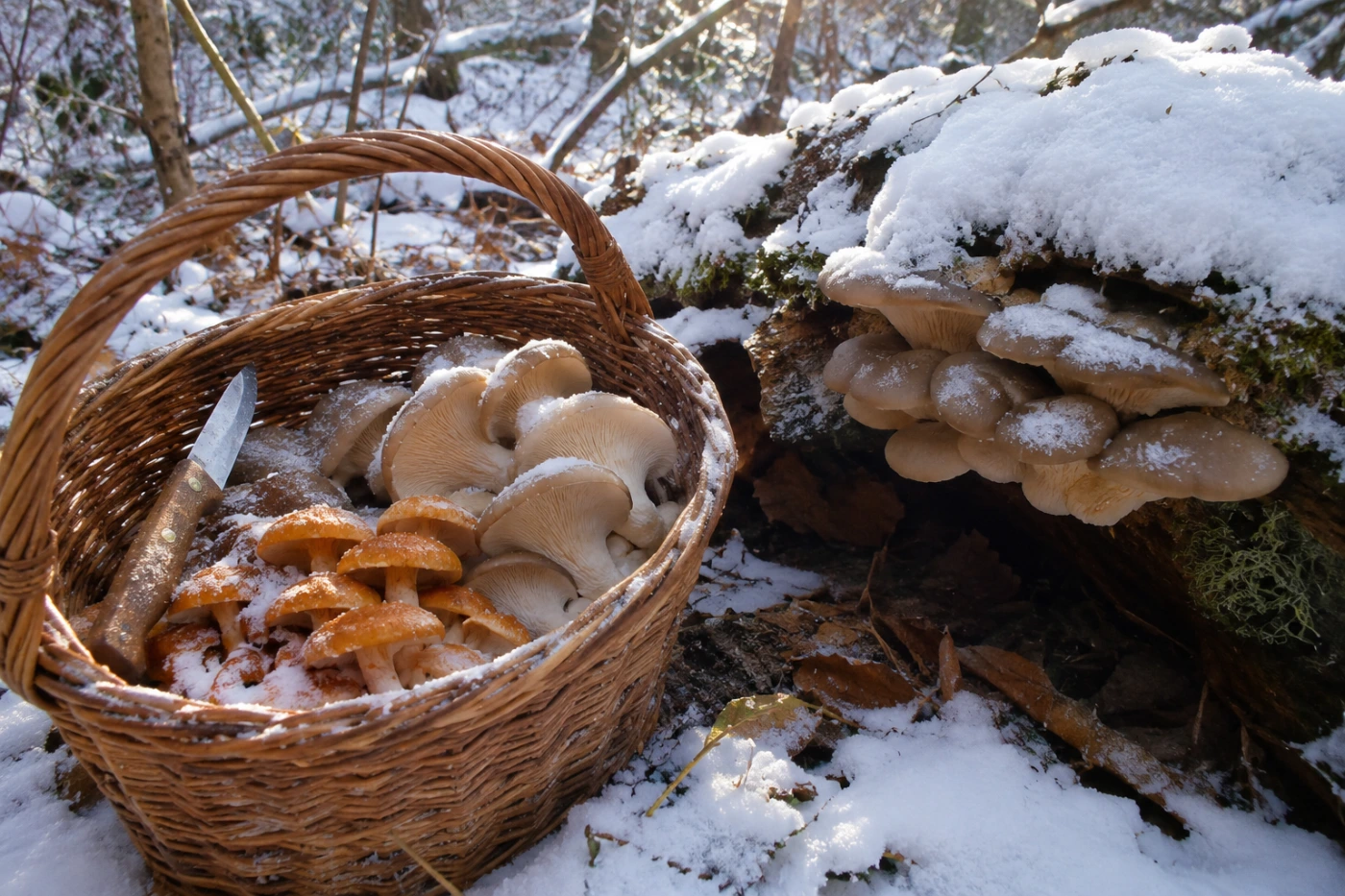
Winter can be an excellent season for mushroom hunting. Oyster Mushrooms, Velvet Shank, Jelly Ears, Winter Chanterelles, and several other fungi can continue fruiting after many autumn species have disappeared.
Cold weather also creates new identification problems. Frost can change color and texture, snow can hide the stem base and substrate, old fruit bodies may partially decompose, and several edible winter mushrooms have dangerous look-alikes.
The most important winter rule is simple: only collect mushrooms that are fresh enough and complete enough to identify confidently. A mushroom that was easy to recognize before freezing may become much harder to identify after repeated frost and thaw cycles.
⚠️ Important: Freezing does not make poisonous mushrooms safe. Amatoxins found in deadly Amanita, Galerina, and some Lepiota remain toxic after freezing, and routine cooking or freezing does not reliably destroy them.
Quick Winter Foraging Safety Guide
| Situation | Safer approach |
|---|---|
| Fresh mushroom after light frost | Identify normally, checking all features |
| Frozen solid mushroom | Leave until thawed or avoid collecting |
| Repeatedly frozen and thawed | Usually leave it |
| Very old, soft, or waterlogged | Do not collect for food |
| Stem base hidden by snow | Excavate and inspect it |
| Mushroom growing from buried wood | Confirm substrate carefully |
| Unknown brown mushroom on wood | Consider Galerina and other dangerous look-alikes |
| Identification depends on color | Be cautious: frost can alter color |
| Mushroom collected in another region | Use regional identification resources |
| Any uncertainty | Do not eat it |
Winter foraging rewards patience more than speed. Cold weather can preserve some mushrooms beautifully while making others unsuitable for reliable identification.
Why Winter Mushroom Identification Is Different
Cold temperatures slow fungal growth and decomposition, but they do not stop them completely. A mushroom may remain visible for much longer than it would during warm autumn weather.
That does not necessarily mean it is fresh. Some fruit bodies can remain standing through repeated freezing, thawing, rain, and snow.
These cycles can change cap color, soften tissues, flatten gills, damage stems, and erase veil remnants. Identification characters that would normally be obvious may become weak or disappear completely.
Frost Can Change Mushroom Appearance
Frozen tissue contains ice crystals that disrupt mushroom cells. When the mushroom thaws, water leaks from damaged tissue and the fruit body may become soft, translucent, darker, or unusually wet.
A pale mushroom may darken after thawing, while a brightly colored cap can become washed out. Gills can collapse together and sticky caps may lose their original surface texture.
For this reason, photographs taken after a mushroom has repeatedly frozen may not match field-guide images very well. Structure and ecology become more important than exact color.
Frozen Mushrooms Can Be Harder to Identify
A mushroom frozen solid cannot easily be examined for flexibility, smell, bruising, or texture. Attempting to break it apart can also destroy important characters.
If species identification depends on subtle features, leave a frozen specimen in place rather than forcing an identification. A fresh fruiting body from the same patch may appear after the next suitable weather period.
Repeated Freeze-Thaw Cycles
One light frost does not automatically ruin a mushroom. Many winter species naturally tolerate cold temperatures and can remain firm after freezing.
Repeated freeze-thaw cycles are more problematic. Cellular damage accumulates, and mushrooms may become watery, soft, discolored, or more susceptible to bacterial decomposition.
For culinary collecting, avoid specimens that have obviously frozen and thawed many times. Even if the species is edible, poor condition can make it undesirable.
Can You Eat Mushrooms After Frost?
Some cold-tolerant edible species can remain usable after a light frost if they are still fresh, firm, and correctly identified. The condition of the mushroom matters more than the fact that temperatures fell below freezing.
A specimen that has become mushy, waterlogged, foul-smelling, or unusually discolored should be discarded. Frost does not reverse decomposition or make an old mushroom fresh again.
Freezing Does Not Destroy Mushroom Toxins
Cold weather provides no protection from toxic mushrooms. Amatoxins are chemically stable and remain dangerous after freezing and thawing.
This matters especially with Galerina marginata, Death Caps, destroying angels, and other amatoxin-containing fungi. A deadly mushroom found frozen on a winter log remains deadly.
Recent poisoning surveillance also reinforces the broader rule that ordinary food preparation does not reliably remove mushroom toxins.
Winter Look-Alikes Deserve Extra Attention
The reduced number of mushroom species in winter can create false confidence. A collector may assume that a brown mushroom growing in December must be one of the familiar winter edibles.
Several dangerous species can still occur during cool weather, especially during mild winters. The correct approach is to identify every collection independently rather than relying on season alone.
Velvet Shank vs Deadly Galerina
Flammulina velutipes, the classic Velvet Shank or Wild Enoki, is one of the best-known winter mushrooms. It can fruit during cold weather on dead hardwood.
The dangerous comparison is Galerina marginata, which also grows on wood and contains amatoxins. The two should never be separated by winter season alone.
Typical Velvet Shank has a sticky orange-brown cap, pale gills, a dark velvety lower stem, and a white spore print. Galerina marginata develops rusty-brown spores and typically has a ring or ring zone on the stem.
The practical rule is: white spores + dark velvety stem support Flammulina; rusty spores or a ring zone are serious warning signs for Galerina.
Never Identify Wild Enoki From the Cap Alone
A photograph showing only a cluster of orange-brown caps is not enough. Several wood-growing mushrooms can look similar from above.
Always examine the gills, complete stem, substrate, and spore print when necessary. If the lower stem is missing, identification becomes less reliable.
Oyster Mushrooms and Pale Winter Look-Alikes
Oyster Mushrooms can fruit well into winter and often remain in good condition during cold weather. Their broad caps, decurrent gills, and clustered growth from wood are usually distinctive.
However, pale shelf-like mushrooms should still be examined carefully. Pleurocybella porrigens, Angel Wings, is thinner, more delicate, usually white, and associated primarily with conifer wood.
Angel Wings has historically been eaten in some regions but has been associated with severe and fatal neurological poisoning. It should not be treated as an interchangeable white Oyster Mushroom.
Check the Wood
Substrate becomes especially important in winter. Snow and leaves may hide whether a mushroom is growing from hardwood, conifer wood, buried roots, or soil.
Brush away snow around the base and look at the actual attachment point. Hardwood versus conifer can immediately change which species are likely.
A mushroom that appears to grow from soil may actually be fruiting from a buried stump or root. This is common with several wood-decaying fungi.
Snow Can Hide Important Features
Snow frequently covers the lower stem and base of a mushroom. This is dangerous when those structures are needed for identification.
Amanita identification is an obvious example. A buried volva can be completely hidden beneath snow, leaves, or frozen soil.
Always expose the entire stem base of an Amanita-like mushroom. Cutting it above the ground can remove one of the most important diagnostic features.
Do Not Collect Broken Specimens for Food
Winter mushrooms are easily damaged by frozen branches, ice, animals, and repeated thawing. Partial specimens may lack the stem base, cap margin, ring, or other structures needed for identification.
If you cannot see the complete mushroom, do not assume the missing structures were absent. A broken mushroom can be much harder to identify safely than an intact one.
Old Mushrooms Can Look Like Different Species
Age changes mushrooms in every season, but winter allows old fruit bodies to persist unusually long. A mushroom that would normally decompose within days may remain recognizable for weeks.
Old gills may turn darker, caps may bleach, stems may become hollow or soft, and odors can change. Mold can also colonize the fruit body.
When appearance differs significantly from fresh reference specimens, condition should be considered before assuming unusual taxonomy.
Check for Softness and Waterlogging
Press the mushroom gently. Fresh winter species may be cold and firm, but they should not feel slimy from decomposition or collapse under light pressure.
Waterlogged mushrooms often release liquid after thawing. Their texture may become gelatinous or spongy even if they looked normal while frozen.
Such mushrooms are poor candidates for food. Identification and freshness are separate questions, and both need satisfactory answers.
Mold Is a Reason to Leave the Mushroom
White, green, gray, or colored fungal growth appearing on an old mushroom may indicate secondary mold. This is different from natural cap texture or mycelium around the stem base.
Do not try to trim visible mold from badly deteriorated wild mushrooms and eat the rest. Winter preservation can hide how long the fruit body has already been standing.
Winter Chanterelles
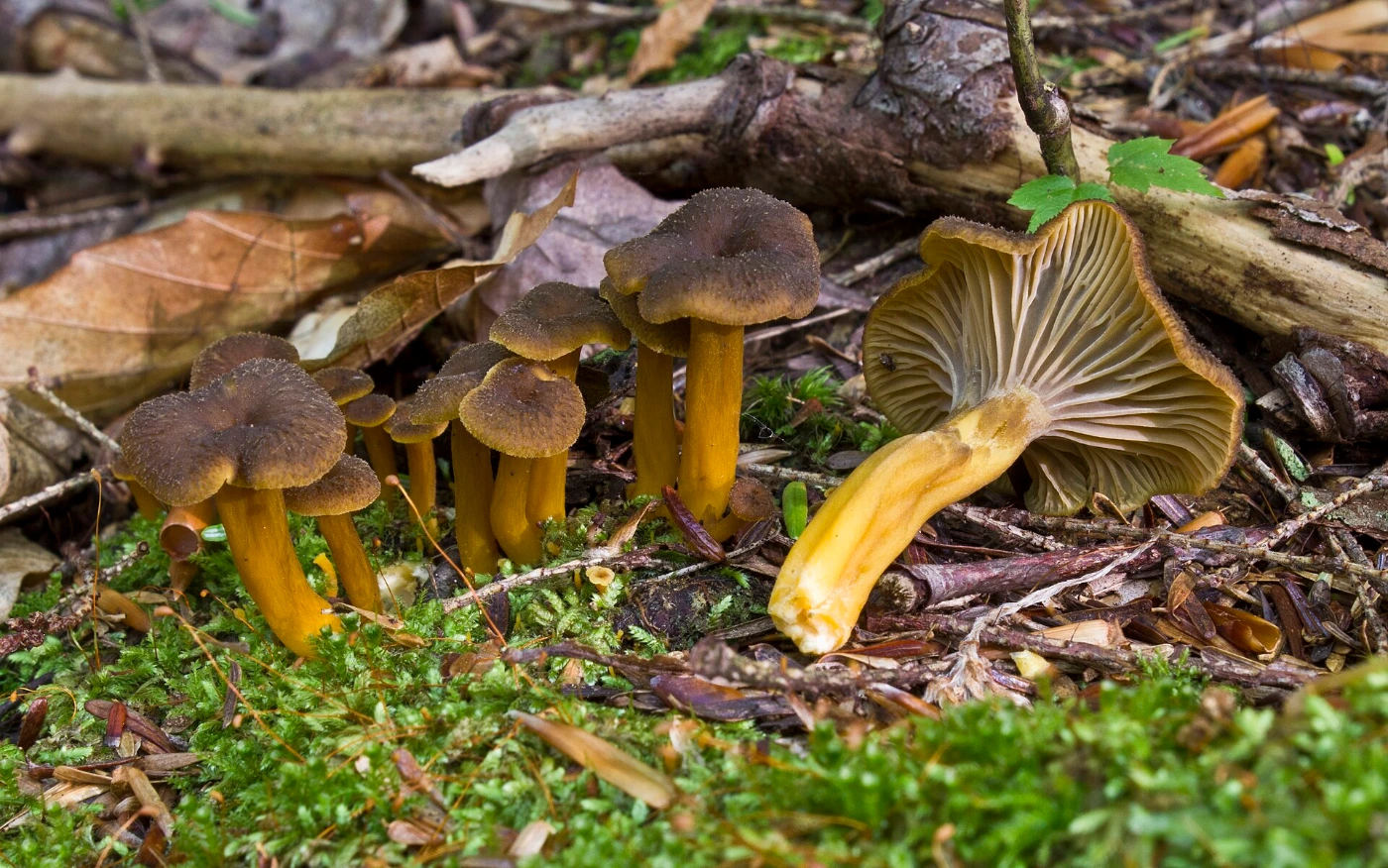
Winter Chanterelle, Craterellus tubaeformis, is well adapted to cool weather and can persist late into the season. It usually has a brownish funnel-shaped cap, yellowish to grayish blunt ridges underneath, and a hollow stem.
The underside remains critical. True Winter Chanterelles have blunt folds or ridges rather than thin blade-like gills.
Snow, water, and age can flatten these folds, so examine multiple fresh specimens when possible. A badly weathered individual should not be the basis for the whole identification.
Jelly Fungi in Winter
Jelly Ears and several other jelly fungi can be especially conspicuous during wet winter weather. They often tolerate drying, freezing, and rehydration better than conventional fleshy mushrooms.
Even so, not every brown jelly fungus is an Auricularia. Exidia, Phaeotremella, and other genera can grow on similar wood.
Shape, surface texture, substrate, and geography still matter. Winter abundance does not eliminate the need for identification.
Mild Winters Can Extend Poisonous Mushroom Seasons
A calendar date is not a reliable safety boundary. Toxic mushrooms may continue fruiting whenever temperature and moisture remain suitable.
Recent CDC data from California documented significant amatoxin poisoning during a period extending from November through March, showing that dangerous Amanita fruiting can overlap strongly with what many people consider winter mushroom season.
Local climate matters much more than the month. A mild rainy December may resemble autumn biologically, while a frozen January may produce almost nothing.
Regional Identification Matters Even More in Winter
Travel can create another source of errors. A winter mushroom familiar from Europe may have a different regional counterpart in North America, and vice versa.
The CDC specifically advises using region-specific information because edible fungi in one region can have dangerous look-alikes elsewhere.
This is particularly important for genera with complex modern taxonomy, including Flammulina, Amanita, Auricularia, and several bolete groups.
Short Daylight Creates Identification Problems
Winter daylight disappears quickly. A mushroom that appears obvious in the forest may become difficult to evaluate once darkness begins.
Plan enough time to inspect and photograph specimens while natural light remains. Artificial flashlight illumination can distort cap colors, especially yellow, brown, and violet tones.
If necessary, take the mushroom home for further examination only when collecting is legal and the specimen can be kept separate from mushrooms intended for food.
Keep Unknown Mushrooms Separate
Do not mix uncertain specimens with edible collections. Broken pieces can become impossible to match to the original mushroom later.
Use separate containers or paper bags for specimens collected for identification. Labeling the location, host tree, and substrate can preserve information that is otherwise lost once you leave the site.
Photograph Before Picking
A habitat photograph can be especially valuable during winter. Capture the mushroom in place with nearby trees, wood, moss, snow, and surrounding substrate visible.
Then photograph the cap, underside, complete stem, and base. If bruising or color change is important, take another photograph after several minutes.
These images are often more useful than a single clean mushroom photographed at home.
Cold Hands Make Handling Harder
Gloves and numb fingers can make small structures such as cortina remnants, rings, stem dots, or delicate gills harder to inspect. Winter identification often requires more deliberate examination.
Use thin gloves when detailed handling is needed and carry a small brush or knife for clearing snow and debris. Avoid damaging the mushroom before important characters have been recorded.
Slippery Ground Is a Real Foraging Risk
Winter mushroom safety is not only about poisoning. Ice, wet roots, snow-covered holes, steep slopes, and short daylight can make woodland travel more hazardous.
Wear footwear with good traction and avoid taking unnecessary risks to reach a mushroom. A rare or attractive specimen is not worth a fall on frozen ground.
Stay Warm and Dry
Slow mushroom hunting involves much more standing still than ordinary hiking. This can cause you to become cold faster than expected.
Layer clothing, carry waterproof outerwear, and protect hands from prolonged moisture. In remote areas, winter conditions can change rapidly.
Know Where You Are Foraging
Snow can obscure trails and familiar landmarks. Forest tracks that are obvious in autumn may look completely different after snowfall.
Use reliable navigation and tell someone where you are going when foraging in remote areas. The risk of becoming lost increases when daylight is short and weather deteriorates.
Check Local Foraging Rules
Winter does not change land ownership or collection regulations. National parks, nature reserves, private land, and protected fungal sites can have restrictions on mushroom collecting.
Check local rules before harvesting. Some areas permit small personal collections while others prohibit removal entirely.
Do Not Rely on Apps Alone
Identification apps and AI can help suggest possible species, but winter-damaged mushrooms present an especially difficult visual problem. Missing colors, broken stems, snow, and degraded tissue can produce confident but incorrect matches.
Use multiple characters and regional references. A photo prediction should be treated as a hypothesis to investigate, not permission to eat the mushroom.
If You Are Not Sure, Leave It
Winter provides many opportunities to observe fungi without collecting them. A mushroom that is too old, too frozen, incomplete, or ambiguous can still be photographed.
Leaving uncertain specimens is not a failed identification. It is often the correct decision when key characters are no longer available.
What to Do After Suspected Mushroom Poisoning
If someone becomes ill after eating wild mushrooms, seek professional medical or poison-center advice promptly. Do not delay while trying to identify the mushroom perfectly.
Keep remaining uncooked specimens, cooked leftovers, and photographs when possible. These materials can help specialists determine the likely toxin or species.
Symptoms from dangerous mushroom poisoning can be delayed for many hours, so feeling well immediately after a meal does not prove the mushrooms were safe.
Common Winter Foraging Mistakes
One common mistake is assuming that poisonous mushrooms disappear after the first frost. Fruiting depends on local conditions, and dangerous species can persist during mild winter periods.
Another mistake is collecting frozen or deteriorated mushrooms whose diagnostic features are no longer reliable. Species identification should come before culinary value.
A third mistake is assuming that freezing detoxifies mushrooms. Amatoxins and several other mushroom toxins can remain active through freezing and ordinary cooking.
Frequently Asked Questions
Is it safe to forage mushrooms in winter?
Yes, if you can identify the mushrooms confidently and conditions are safe. Winter requires extra attention because frost, snow, and aging can change important identification characters.
Can you eat mushrooms after they freeze?
Some cold-tolerant edible mushrooms remain usable after a light frost if they are still firm and fresh. Repeatedly frozen, thawed, soft, or waterlogged mushrooms are better left in the forest.
Does freezing kill mushroom toxins?
No. Important toxins such as amatoxins remain active after freezing and thawing.
What is the most important winter mushroom look-alike?
Wild Enoki or Velvet Shank versus Galerina marginata is one of the most important comparisons. Galerina marginata contains deadly amatoxins.
Do poisonous mushrooms grow in winter?
Yes. Exact fruiting depends on regional climate, and some poisonous mushrooms can persist or fruit during mild winters.
Can snow make mushroom identification unsafe?
Yes. Snow can hide the substrate, stem base, volva, and other important features. Clear the area around the mushroom before identifying it.
Are old winter mushrooms safe if they still look normal?
Not necessarily. Low temperatures can preserve the external shape even while tissue has deteriorated through repeated freeze-thaw cycles.
Should I use a mushroom identification app in winter?
Apps can help generate possibilities but should not be used alone for an edibility decision. Winter-damaged mushrooms can be especially difficult for image-based identification.
Final Notes
Winter mushroom foraging can be productive because several edible fungi tolerate cold weather and continue fruiting after the main autumn season. The challenge is that frost, snow, short daylight, and old fruit bodies can make identification less reliable.
The safest winter collections are fresh, complete specimens with clearly visible diagnostic features. Leave mushrooms that are badly frozen, repeatedly thawed, moldy, waterlogged, incomplete, or impossible to separate confidently from dangerous look-alikes.
The practical winter rule is: check freshness → expose the entire mushroom → confirm substrate and host → compare dangerous look-alikes → use regional identification → leave anything uncertain. Cold weather slows fungal activity, but it does not make poisonous mushrooms safe.
Upload a photo and get possible matches in seconds.