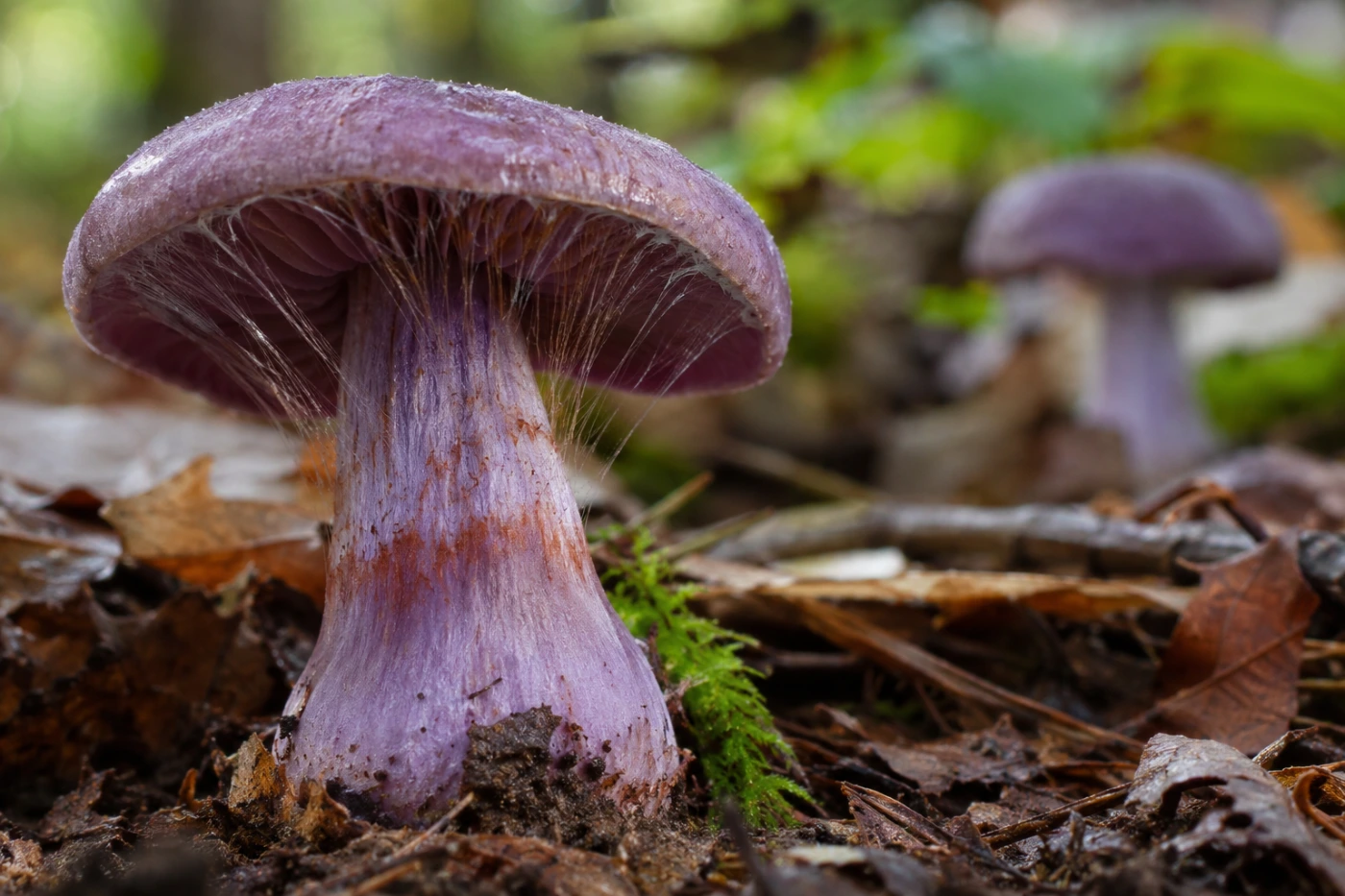
A cortina is a delicate, cobweb-like partial veil found in many mushrooms, especially species of the genus Cortinarius. It stretches from the edge of the cap to the stem and temporarily covers the gills while the mushroom is young.
As the cap expands, the cortina breaks apart. In mature mushrooms, only fine fibers or rusty-brown remnants may remain on the stem, which can make this feature easy to miss.
⚠️ Important: The presence of a cortina is an important identification clue, but it should never be used alone to determine whether a mushroom is edible. Cortinarius is a large and difficult genus that includes seriously poisonous species.
1. What Does a Cortina Look Like?
A fresh cortina looks like extremely fine spiderweb threads between the stem and the cap margin. It may be white, pale gray, lilac, violet, or almost transparent depending on the species.
The veil is much thinner than the solid membrane seen in mushrooms with a conventional ring. In very young Cortinarius, it may form a visible web covering part of the gills.
As the mushroom opens, these threads stretch and break. This means the cortina is often easiest to see in young specimens.
2. What Happens to the Cortina as the Mushroom Ages?
The cortina usually disappears as a complete veil. Small fibers remain attached to the upper stem or cap margin.
In Cortinarius, rusty-brown spores often fall onto these fibers. This can create a rusty ring-like band or streaked zone around the stem.
That rusty zone can be more useful than the original web itself. A mature mushroom may no longer show an obvious cortina, but rusty fibers can reveal where it once was.
3. Cortina vs Ring
A cortina and a ring are both remnants of a partial veil, but they look very different. A typical mushroom ring is a continuous membrane or skirt around the stem.
A cortina is made from fine separate fibers. After breaking, it usually does not leave a solid ring.
| Feature | Cortina | Typical Ring |
|---|---|---|
| Structure | Fine web-like fibers | Solid membrane |
| Young mushroom | Spiderweb between cap and stem | Veil covers gills |
| Mature mushroom | Fibers or rusty zone | Ring or skirt remains |
| Common in | Cortinarius | Amanita, Agaricus, Suillus and others |
This difference is especially useful when separating webcaps from mushrooms that have a true ring.
4. Why Is a Cortina Important for Mushroom Identification?
The cortina is one of the defining field characters of Cortinarius. If a young purple, brown, or yellow mushroom has a cobweb-like veil between its cap and stem, Cortinarius should immediately be considered.
The feature becomes particularly useful when identifying mushrooms such as Wood Blewit. Young Wood Blewit can resemble purple Cortinarius, but Wood Blewit does not have a cortina.
Spore color provides another strong clue. Cortinarius typically produces rusty-brown spores, which often collect on the broken cortina and stain the upper stem.
5. How to Check for a Cortina
Look first at young mushrooms. Examine the space between the cap margin and the upper stem for fine web-like threads.
In older specimens, inspect the upper stem carefully. Rusty fibers, a brownish band, or patches of fine veil material may be remnants of the cortina.
Also check the gills and spore print. Rusty-brown mature gills combined with cortina remnants strongly support Cortinarius.
The practical field pattern is: cobweb-like veil when young → broken fibers on the stem → rusty spores collecting on those fibers = classic cortina pattern.
Upload a photo and get possible matches in seconds.