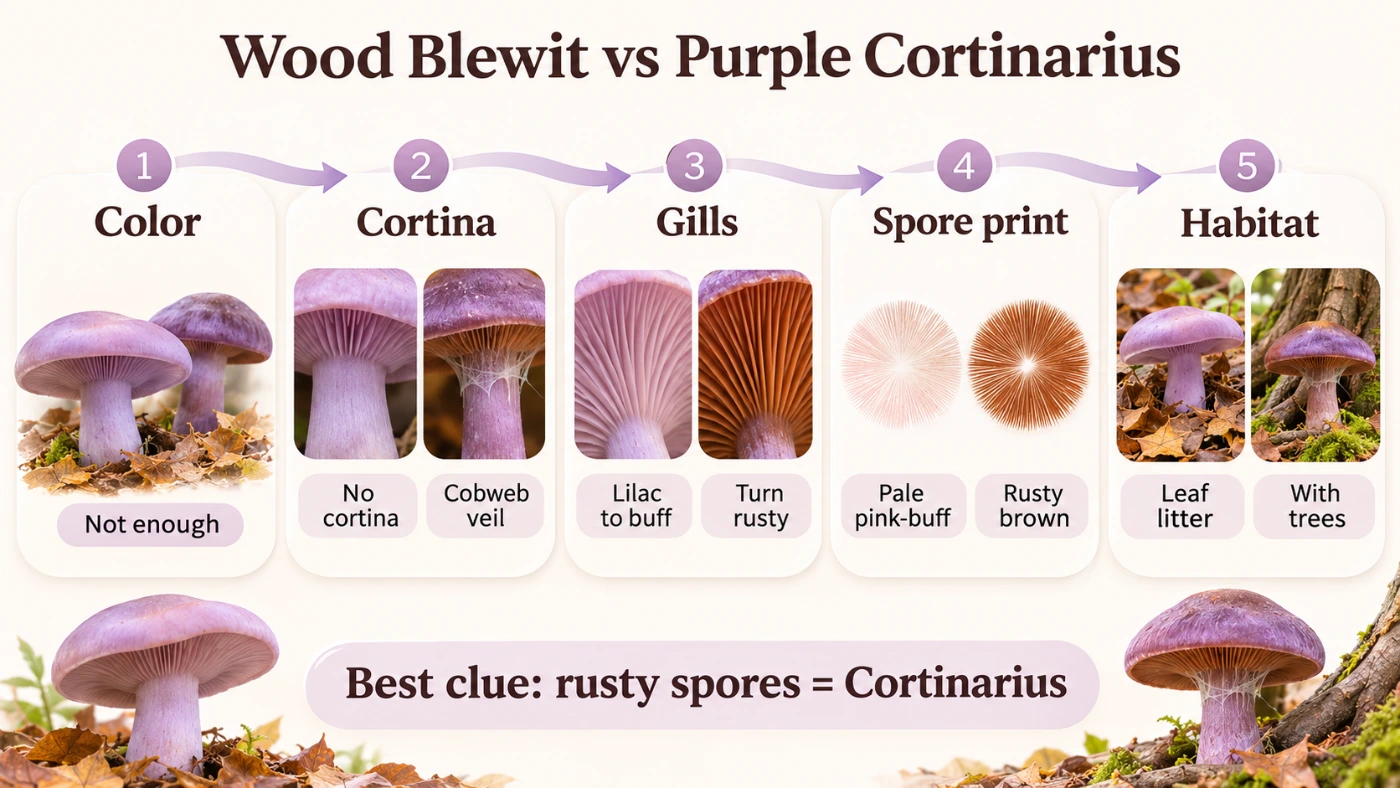
Wood Blewit and purple Cortinarius mushrooms can look remarkably similar, especially when they are young. Both may have violet caps, purple gills, and lilac stems, and both can occur in woodland during autumn.
The most reliable distinction is not simply how purple the mushroom looks. Wood Blewit has no cortina and produces a pale pinkish-buff spore print, while purple Cortinarius species typically develop rusty-brown spores and often show a cobweb-like cortina or rusty veil remnants on the stem.
⚠️ Important: Do not identify a purple mushroom as Wood Blewit from color alone. Cortinarius is a large and difficult genus that includes seriously poisonous species, so a mushroom with rusty spores, a cortina, or uncertain features should not be treated as a Wood Blewit.
Quick Comparison
| Feature | Wood Blewit | Purple Cortinarius |
|---|---|---|
| Current name | Collybia nuda | Cortinarius spp. |
| Older name | Lepista nuda | Various |
| Cap | Lilac to violet when young, fading tan-brown | Violet, purple, brown-purple, often fibrillose |
| Gills when young | Lilac to violet | Lilac, violet, purple |
| Mature gills | Buff to brownish | Rusty brown |
| Spore print | Pale pinkish-buff | Rusty brown |
| Cortina | Absent | Usually present when young |
| Stem | Lilac, smooth, no rusty veil zone | Purple, often with rusty cortina remnants |
| Stem base | Often swollen slightly | Can be bulbous or strongly swollen |
| Smell | Pleasant, aromatic, sometimes perfumed | Variable |
| Ecology | Saprotrophic in leaf litter and organic debris | Mycorrhizal with trees |
| Main clue | Pale spores + no cortina | Rusty spores + cortina |
| Edibility | Edible when correctly identified and cooked | Many species unsuitable; some seriously poisonous |
What Is a Wood Blewit?
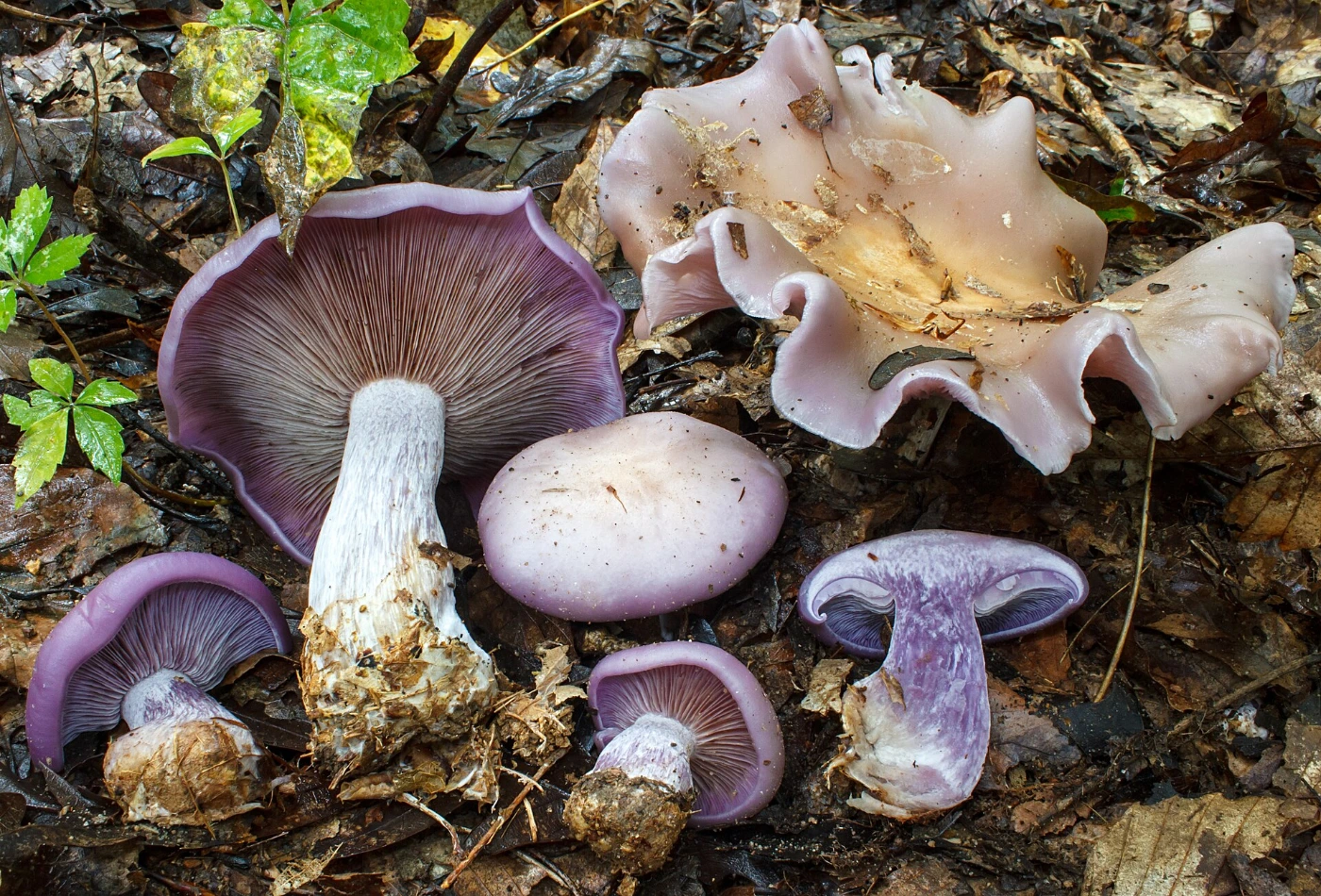
Wood Blewit is currently classified as Collybia nuda. The mushroom was long known as Lepista nuda, and that older name remains very common in field guides and mushroom websites.
It is a robust autumn mushroom with violet to lilac colors when young. As the fruit body ages, the cap often fades toward buff, tan, or brown while the gills and stem can retain some violet coloration.
What Is a Purple Cortinarius?
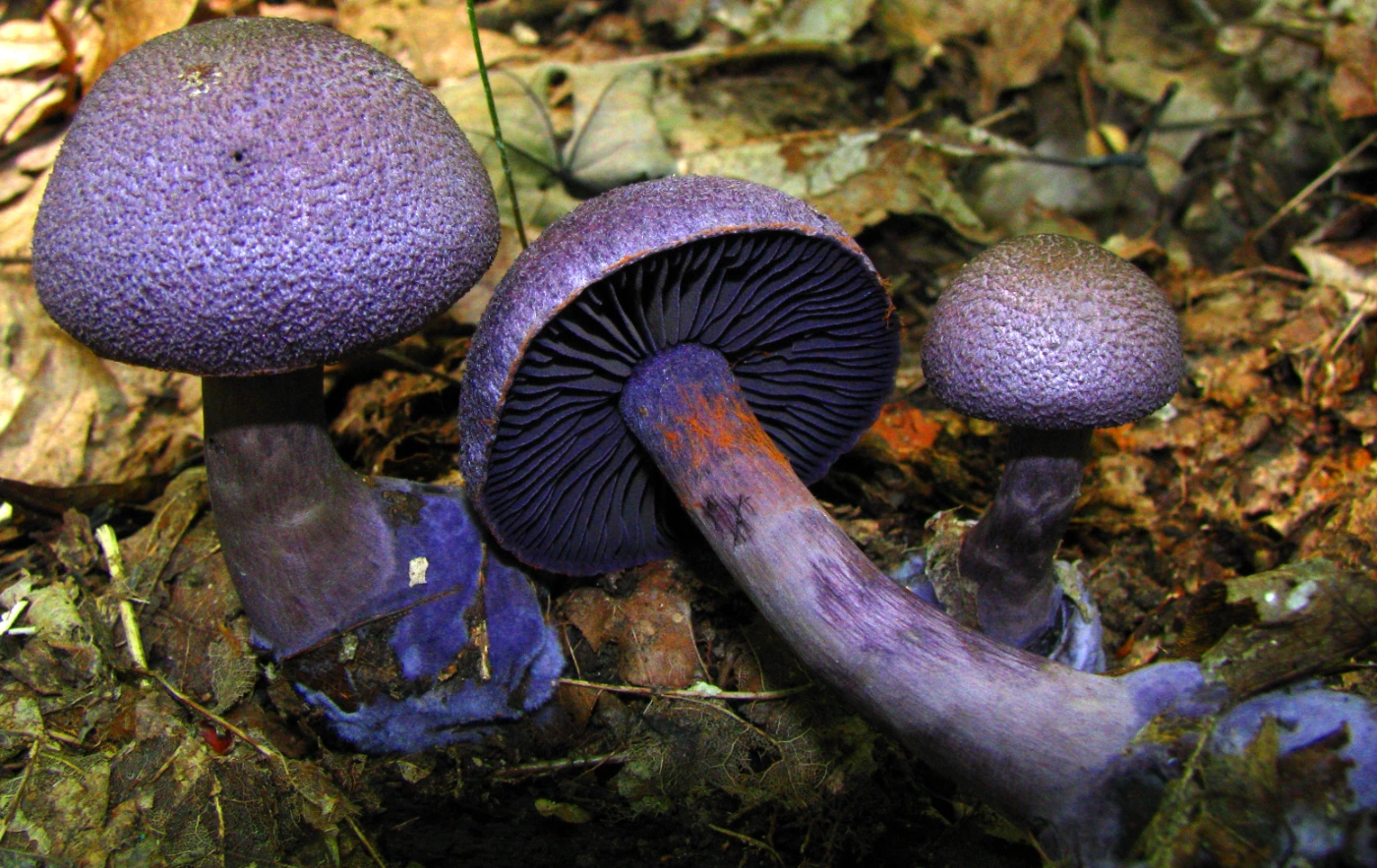
“Purple Cortinarius” does not refer to a single species. The genus Cortinarius contains numerous mushrooms with violet, lilac, purple-brown, or bluish coloration.
Some are intensely purple throughout, while others show violet only when young. As the spores mature, the gills commonly become increasingly rusty brown.
The Fastest Difference: Check for a Cortina
The name Cortinarius comes from the cortina, a fine cobweb-like partial veil stretching between the cap margin and stem in young mushrooms. It can look like delicate spider silk covering the gills.
Wood Blewit does not have a cortina. A clean stem without cobweb-like veil remnants is therefore an important supporting feature.
What Does a Cortina Look Like?
On very young Cortinarius, the cortina may be clearly visible as fine threads running from the cap to the stem. It can be white, pale lilac, violet, or almost transparent.
As the mushroom opens, the threads break. Mature specimens may retain only a fibrous ring-like zone or rusty streaks on the upper stem where falling spores have accumulated.
Why Mature Cortinarius Can Be Difficult
The cortina can almost disappear with age. An old Cortinarius may therefore no longer display the obvious web-like veil shown in field-guide photographs.
Rusty staining around the upper stem becomes particularly important in these mushrooms. The mature gills and spore print can provide even stronger evidence.
Spore Print: The Most Reliable Home Test
Wood Blewit produces a pale spore print, usually described as pinkish-buff, pale flesh-colored, or very light pink-brown. The color is subtle and should be checked on both white and dark paper if necessary.
Cortinarius produces a distinctive rusty-brown spore print. This difference is one of the safest ways to separate a questionable purple Wood Blewit from a purple webcap.
Why the Gills Change Color
Young Wood Blewit gills are commonly lilac or violet. With age they become paler and may fade toward buff or brownish tones, but they do not acquire the characteristic rusty spore coating of Cortinarius.
Purple Cortinarius gills can begin violet as well. As rusty spores mature and accumulate, the gills increasingly turn cinnamon, reddish brown, or rust-colored.
Wood Blewit Cap
Young Wood Blewits often have smooth, fleshy violet or lilac caps. The color is usually strongest when the mushroom is fresh and young.
With age, the center commonly fades to tan, beige, buff, or brown. Mature specimens can therefore look surprisingly different from the bright purple mushrooms shown in many photographs.
Purple Cortinarius Cap
Purple Cortinarius caps vary enormously because many species are involved. They may be uniformly violet, violet-brown, gray-purple, reddish purple, or brown with lilac margins.
Some caps are dry and finely fibrous, while others are sticky or viscid when wet. Radial fibers on the surface are common in many species.
Wood Blewit Gills
The gills are crowded and lilac when young. They are usually attached to the stem with a notched or sinuate attachment.
They gradually lose their violet intensity with age. Even mature gills do not normally develop the strong rusty-orange coating typical of a mature Cortinarius.
Cortinarius Gills
Young gills can be almost exactly the same lilac or violet color as a Wood Blewit. This is one reason young specimens are easily confused.
The difference becomes clearer as spores mature. Many Cortinarius gills turn rusty brown, and deposits of the same spores can appear on the stem below the broken cortina.
Wood Blewit Stem
The stem is usually stout, lilac to pale violet, and relatively smooth. The base can be somewhat swollen and often collects leaf litter or pale mycelial material.
There is no true ring and no cortina zone. The surface may fade with age but should not show the characteristic rusty spore-coated web remnants of Cortinarius.
Cortinarius Stem
Purple Cortinarius stems can also be violet or lilac. Some are relatively slender, while others have a pronounced swollen or bulbous base.
Cortina remnants may form fibrous bands or an indistinct ring zone. Rusty-brown spores often settle onto these fibers and make them much easier to notice.
Stem Base Differences
Wood Blewit can have a thickened base, so a swollen stem alone does not indicate Cortinarius. The shape must be considered together with veil remnants and spores.
Some Cortinarius species develop distinctly club-shaped or bulbous bases. In species such as Cortinarius purpurascens, the swelling can be particularly noticeable.
Smell
Wood Blewit commonly has a distinctive pleasant odor that may be described as fruity, perfumed, floral, or aromatic. The smell can be fairly noticeable in fresh fruit bodies.
Purple Cortinarius species have much more variable odors. Some smell mild or pleasant, while others have distinctive earthy or unusual scents, so odor alone is not a safe separator.
Habitat
Wood Blewit is saprotrophic and commonly fruits in rich leaf litter, compost-like organic material, woodland debris, gardens, parks, and hedgerows. It may occur in deciduous, coniferous, or mixed environments.
Cortinarius species are mycorrhizal and grow in association with living trees. Beech, oak, birch, pine, spruce, and many other trees can support different species.
Growth in Fairy Rings
Wood Blewits frequently fruit in groups, arcs, or fairy rings. Several mushrooms may appear relatively close together in rich litter.
Cortinarius can also fruit in groups, so growth pattern alone is not decisive. Ecology, spores, and veil structure remain more useful.
Season
Wood Blewit is particularly associated with late autumn and early winter. It often continues fruiting after many other woodland mushrooms decline and can persist into mild winter weather.
Purple Cortinarius species are also common in autumn. The large seasonal overlap makes timing relatively weak as a separating feature.
Wood Blewit vs Cortinarius violaceus
Cortinarius violaceus, the Violet Webcap, is one of the most striking purple members of the genus. It is usually much darker than Wood Blewit, with a deep violet to almost black-purple cap and purple flesh.
Young specimens have a purple cortina, and the gills eventually become rusty brown as spores mature. Its spore print is rusty brown rather than pale.
Identification
Violet Webcap has a dry, often finely hairy or velvety cap and dark purple flesh. The overall coloration is usually deeper and more saturated than in typical Wood Blewit.
The stem may have a swollen base and retains purple tones. Young mushrooms show a cortina between cap and stem.
Main Difference
Wood Blewit fades toward buff and has pale spores. Violet Webcap remains much darker and produces rusty-brown spores.
Wood Blewit vs Cortinarius purpurascens
Cortinarius purpurascens, the Bruising Webcap, can have violet gills and stem when young. Its cap is usually more ochre-brown or dirty brown, often retaining violet tones around the margin.
The young mushroom has a pale violet cortina. Its gills mature toward rust-brown, and bruised tissues can develop stronger purple coloration.
Identification
The stem is violet and usually swollen toward the base. Rusty spores eventually discolor both gills and the cortina remnants.
The cap can be viscid when wet. This differs from the generally smoother and less webcap-like appearance of Wood Blewit.
Main Difference
Rusty gills, cortina remnants, and a distinctly swollen stem base favor C. purpurascens. Pale spores and no cortina favor Wood Blewit.
Wood Blewit vs Purple Cortinarius
| Feature | Wood Blewit | Purple Cortinarius |
|---|---|---|
| Young cap | Lilac / violet | Violet / purple / purple-brown |
| Young gills | Lilac | Lilac / purple |
| Mature gills | Buff to brownish | Rusty brown |
| Cortina | None | Usually present when young |
| Spore print | Pale pinkish-buff | Rusty brown |
| Stem | Smooth, lilac | Often fibrous with veil remnants |
| Rusty stem zone | Absent | Common in mature specimens |
| Ecology | Saprotrophic | Mycorrhizal |
| Best test | Pale spore print | Rusty spore print |
When specimens are fresh and young, the two groups can genuinely look similar. Mature gill color and a spore print make the comparison much easier.
Why Color Alone Fails
Purple coloration is widespread among unrelated mushrooms. Even within Wood Blewit, the color changes dramatically as the mushroom ages.
A mature Wood Blewit may be mostly beige or brown, while a young Cortinarius may be brilliantly violet. Purple should therefore be treated as the beginning of identification, not the conclusion.
Why Forking or Gill Shape Is Not Enough
Both groups have true gills and can show variations in attachment and spacing. Small differences in gill shape can be difficult to judge from photographs.
The spore color and presence of a cortina are much stronger characters. They remain useful even when the overall mushroom is atypical.
How to Check for Cortina Remnants
Look closely at the upper half of the stem. Fine fibers, web-like strands, or a rusty ring-like zone can indicate a broken cortina.
Also inspect the cap margin of young specimens. Delicate threads may still connect it to the stem before the mushroom fully opens.
How to Make a Spore Print
Remove the stem and place the cap gill-side down on a suitable surface. Covering it with a bowl can help prevent drying and air movement.
After sufficient spores have fallen, examine the deposit carefully. Pale pinkish-buff supports Wood Blewit, while a clearly rusty-brown deposit strongly indicates Cortinarius or another brown-spored group.
Do Not Confuse Buff With Rusty Brown
A weak Wood Blewit print can look beige or flesh-colored. Lighting can make subtle colors difficult to interpret.
Cortinarius spores are much richer and darker, typically rusty, cinnamon-brown, or reddish brown. A strong rust-colored print should rule out Wood Blewit.
Is Wood Blewit Edible?
Wood Blewit is generally considered edible when correctly identified and thoroughly cooked. Raw or undercooked specimens can cause digestive upset in some people.
The main practical concern is misidentification. Because purple Cortinarius can resemble it, confident identification should come before any discussion of cooking.
Are Purple Cortinarius Mushrooms Poisonous?
The genus is too large and difficult to make broad edibility assumptions. It includes species that are seriously poisonous, including webcaps containing toxins capable of causing severe kidney damage.
For practical foraging, an uncertain purple Cortinarius should not be eaten. The genus should be approached as an identification problem rather than an edible-mushroom group.
Why Cortinarius Requires Extra Caution
Cortinarius is one of the largest and most difficult genera of agaric mushrooms. Species-level identification can require microscopic characters, chemistry, ecology, and modern taxonomy.
Several species are visually very similar. This makes “it looks like the edible purple one” an unsafe approach.
Young Wood Blewit vs Young Cortinarius
Young mushrooms are the hardest stage because both may have fresh lilac gills and stems. The rusty spore coating of Cortinarius may not yet have developed.
This is when the cortina becomes most useful. Young webcaps usually show their veil most clearly before it breaks.
Mature Wood Blewit vs Mature Cortinarius
Age often makes the distinction easier. Wood Blewit typically fades toward tan while retaining pale spores.
Cortinarius commonly develops rusty-brown gills and rusty deposits on the upper stem. Even if the cortina itself has vanished, its spore-stained remains may still be visible.
Common Identification Mistakes
One common mistake is identifying any lilac woodland mushroom as Wood Blewit. Purple coloration occurs in numerous genera and has little value by itself.
Another mistake is looking only for an obvious cobweb on mature Cortinarius. The cortina can disappear, leaving only fibers or rusty staining behind.
A third mistake is assuming that a pleasant smell proves Wood Blewit. Some webcaps have mild or pleasant odors as well.
A fourth mistake is skipping the spore print when the mushroom is ambiguous. In this particular comparison, spore color provides unusually strong evidence.
How to Photograph Wood Blewit and Purple Cortinarius
Photograph the mushroom before picking it and include the surrounding habitat. Tree species, leaf litter, and growth pattern can all provide useful context.
Then photograph the gills, full stem, stem base, and any fibers or ring-like zones. A close-up of the upper stem is especially valuable when searching for cortina remnants.
Can AI Tell Wood Blewit From Cortinarius?
AI can often recognize typical mature specimens, but young purple mushrooms can remain difficult even from high-quality photographs. A model cannot reliably determine spore-print color if no spore print has been made.
For a difficult specimen, provide photographs of the cap, gills, entire stem, and stem base together with a spore-print image. Habitat and nearby trees can improve the identification further.
Interesting Facts
The scientific name of Wood Blewit has changed repeatedly. It was widely known as Lepista nuda, but modern classification places it in Collybia as Collybia nuda.
The specific epithet nuda means “naked.” An interesting historical explanation is that the stem lacks the cortina remnants that distinguish webcaps, a feature already recognized in early comparisons with violet Cortinarius.
Purple color can disappear surprisingly quickly in Wood Blewits. Older mushrooms may become so tan or brown that someone familiar only with young violet specimens may not recognize them.
The reverse happens in Cortinarius: the original violet colors may fade while rusty spores become increasingly obvious. Observing mushrooms at different stages can therefore make this comparison much easier.
Frequently Asked Questions
What is the easiest way to tell a Wood Blewit from a purple Cortinarius?
Check for a cortina and make a spore print. Wood Blewit lacks a cortina and has pale pinkish-buff spores, while Cortinarius usually has a cortina when young and rusty-brown spores.
Does Wood Blewit have a cobweb-like veil?
No. A true Wood Blewit does not have the characteristic cobweb-like cortina found in young Cortinarius.
Can Cortinarius have purple gills?
Yes. Many purple webcaps have violet or lilac gills when young, which can make them look very similar to Wood Blewit.
What color are Wood Blewit spores?
The spore print is pale, usually pinkish-buff or flesh-colored. It should not be strongly rusty brown.
What color are Cortinarius spores?
Cortinarius produces rusty-brown spores. Mature spores often turn the gills and veil remnants a characteristic rust color.
Does Wood Blewit stay purple as it ages?
Not necessarily. The cap often fades from violet to buff, tan, or brown, although some lilac color may remain in the gills or stem.
Can a mature Cortinarius lose its cortina?
Yes. The delicate veil can disappear almost completely, which is why rusty spores and stem staining become important in older mushrooms.
Is every purple Cortinarius poisonous?
No single toxicity rule applies to every species, but the genus contains seriously poisonous mushrooms and is difficult to identify. An uncertain webcap should not be eaten.
Final Identification Notes
Wood Blewit and purple Cortinarius can overlap strongly in color, habitat, season, and general size. The safest distinction therefore comes from structural and reproductive characters rather than purple coloration.
Wood Blewit, Collybia nuda, has no cortina and produces a pale pinkish-buff spore print. Purple Cortinarius typically has a cobweb-like cortina when young, rusty-brown mature gills, rusty spore deposits, and a rusty-brown spore print.
The practical field pattern is: purple mushroom → inspect the upper stem for cortina → check mature gill color → make a spore print. Pale spores + no cortina support Wood Blewit; rusty spores or cortina remnants point away from it and toward Cortinarius.
Upload a photo and get possible matches in seconds.