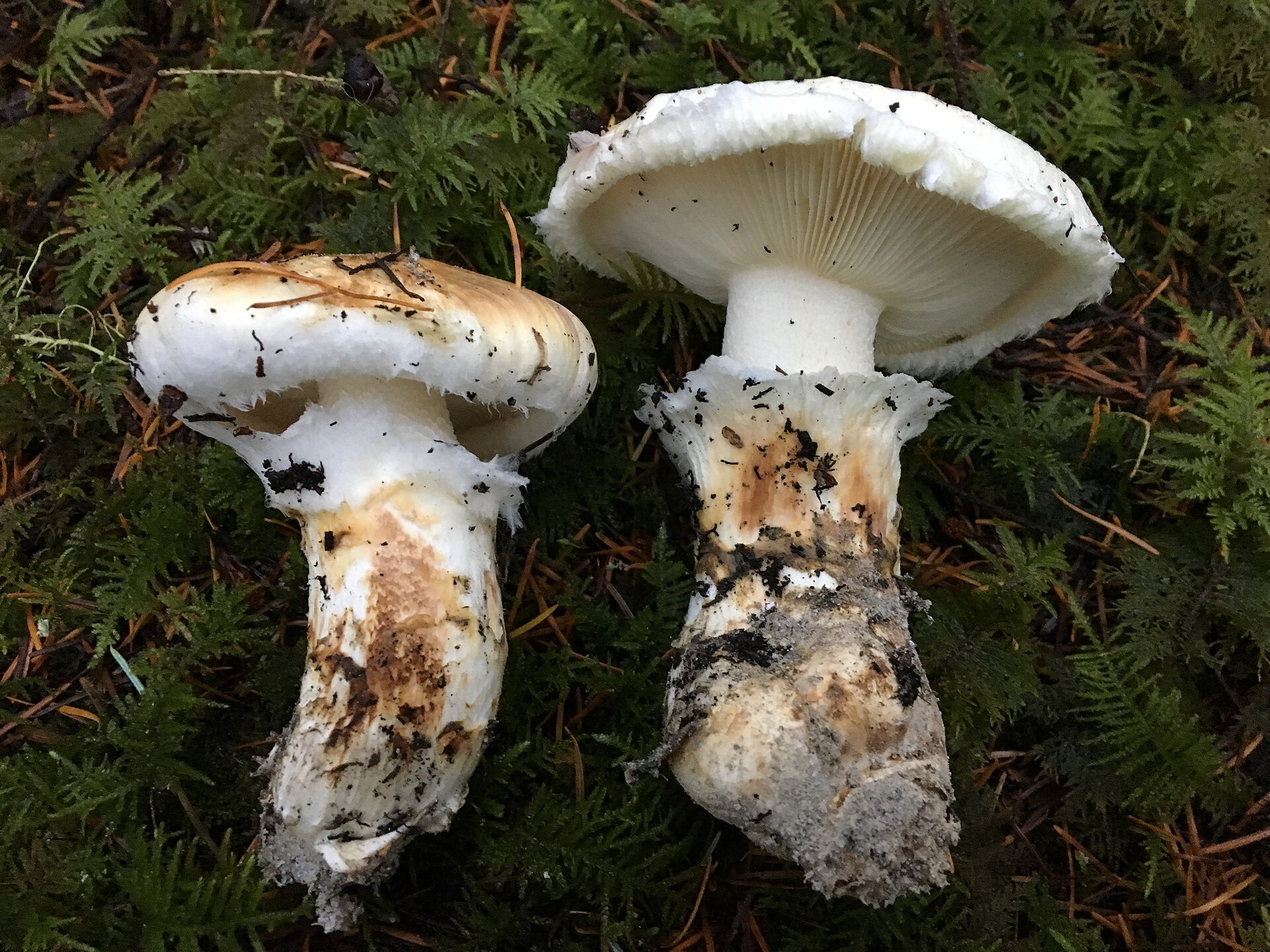
Tricholoma murrillianum, commonly known as the American Matsutake, is a large, firm, strongly aromatic mushroom of western North America. It grows mainly with conifers and is especially valued for its distinctive spicy aroma and dense flesh.
The most useful field pattern is large white mushroom + brownish cap staining + strong spicy aroma + substantial veil and ring + deep growth in conifer duff. Young fruit bodies are often partly buried and may push up the forest floor before the cap becomes visible.
⚠️ Important: American Matsutake should not be identified from smell alone. Several white or brownish Tricholoma species can resemble it, and some Tricholoma are inedible or toxic, so the full combination of structure, habitat, odor, and geography matters.
Quick Identification
| Feature | Tricholoma murrillianum |
|---|---|
| Common name | American Matsutake |
| Cap color | White when young, later brown-stained or brown-scaled |
| Cap surface | Dry to slightly moist, often fibrillose |
| Gills | White, crowded |
| Gill attachment | Attached to notched, not decurrent |
| Stem | Thick, firm, white |
| Ring | Present, often prominent |
| Veil | Strong partial veil |
| Flesh | White, dense, firm |
| Smell | Strong, spicy, cinnamon-like, pungent |
| Spore print | White |
| Ecology | Mycorrhizal |
| Main hosts | Pine, Douglas fir, hemlock, fir and other western trees |
| Habitat | Conifer and mixed forest |
| Distribution | Western North America |
| Season | Autumn to winter |
| Edibility | Highly valued edible when correctly identified |
| Main look-alikes | Other Tricholoma, Amanita, Catathelasma |
What Does Tricholoma murrillianum Look Like?
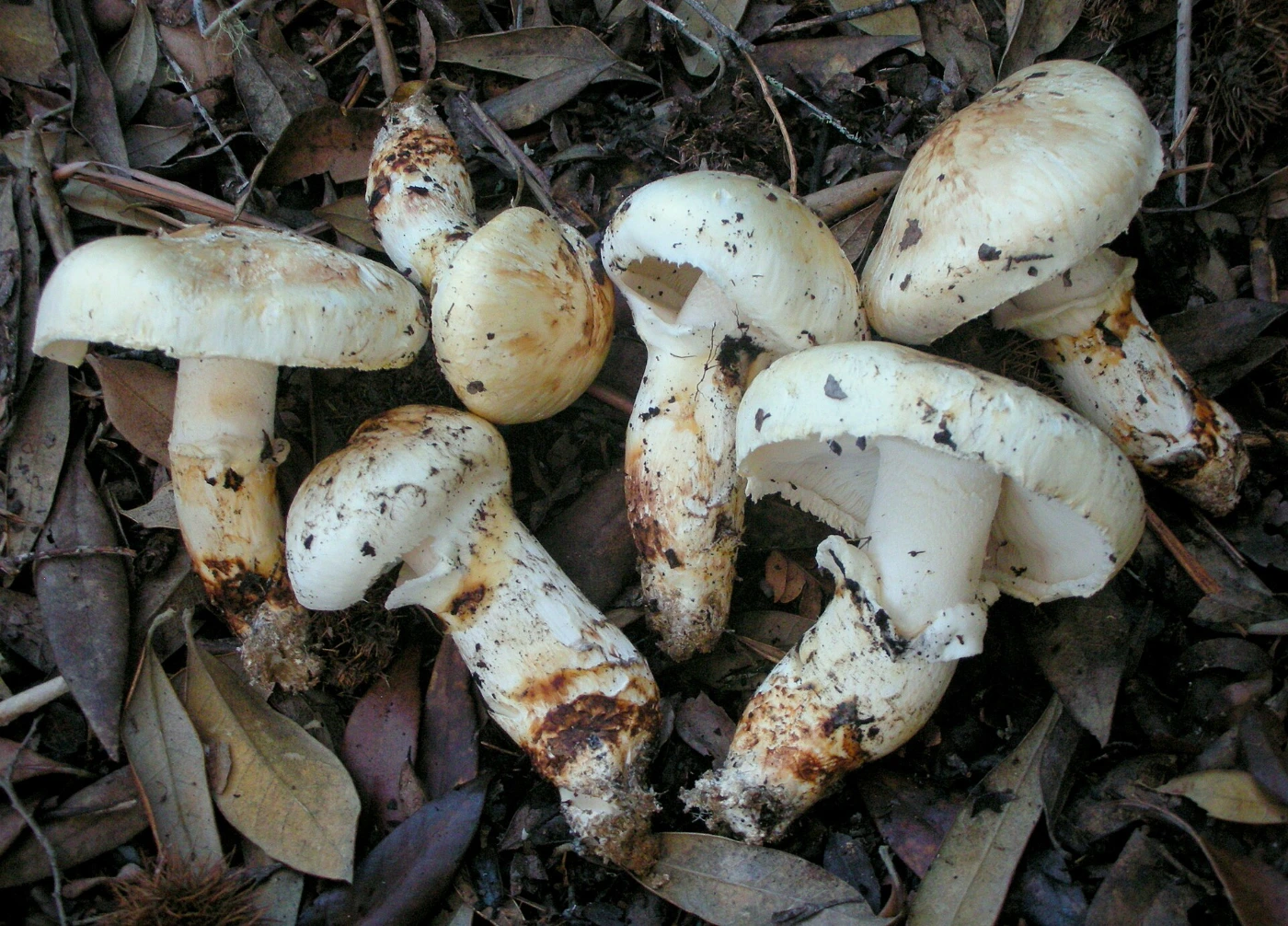
American Matsutake is a robust mushroom with thick white flesh and a substantial stem. Young specimens are often nearly white, but the cap gradually develops brownish, cinnamon, or tan discoloration as it expands.
The mushroom usually looks dense and compact rather than fragile. Mature specimens may have a broad cap with brown fibrils or scales over a pale background.
Cap
The cap begins convex and may remain rounded for a long time. With age, it becomes broadly convex or nearly flat while usually retaining a thick, fleshy appearance.
The surface is whitish at first and later develops brownish fibers, patches, or scales. These markings often become stronger toward the center.
Cap Color
Fresh young specimens can be almost entirely white. As they age, brown, cinnamon, or tan areas develop and can create a mottled appearance.
Cap color is variable and should not be used alone. Young specimens may appear much paler than mature ones from the same patch.
Gills
The gills are white to cream and crowded. They are true gills rather than ridges or pores.
They attach to the stem or may be slightly notched near it, but they do not run down the stem. Older gills can develop some brownish staining.
Stem
The stem is thick, firm, and often deeply rooted in the forest duff. It may taper slightly toward the base.
The upper stem is usually pale, while the lower part can develop brownish areas beneath the ring. The flesh remains dense rather than hollow.
Ring and Veil
One of the most useful characters is the strong partial veil. In young mushrooms, it covers the gills and later breaks to leave a prominent ring or sheath-like zone on the stem.
The lower portion of the stem can remain wrapped in veil material. This gives mature specimens a distinctive sheathed appearance.
Flesh
The flesh is white, thick, and very firm. Matsutake is unusually dense compared with many other gilled woodland mushrooms.
The texture is one reason the mushroom is so highly valued. Even mature specimens can remain relatively firm when fresh.
Smell
The aroma is one of the most distinctive features. It is often described as spicy, cinnamon-like, resinous, or pungent, sometimes with an unusual earthy or musky component.
The smell can be very strong in fresh specimens. However, odor varies between people, so it should support identification rather than replace structural characters.
Spore Print
The spore print is white. This is typical of many Tricholoma species.
Because many look-alikes also have pale spores, the spore print is mainly useful for confirming the broader group rather than separating closely related species.
Where Does Tricholoma murrillianum Grow?
American Matsutake is mycorrhizal and grows in association with living trees. It is primarily found in western North America from the Rocky Mountains west to the Pacific Coast.
It occurs mainly with conifers, including pines, Douglas fir, hemlock, and fir. On parts of the West Coast, it can also occur in association with tanoak and madrone.
Why It Is Often Hidden Underground
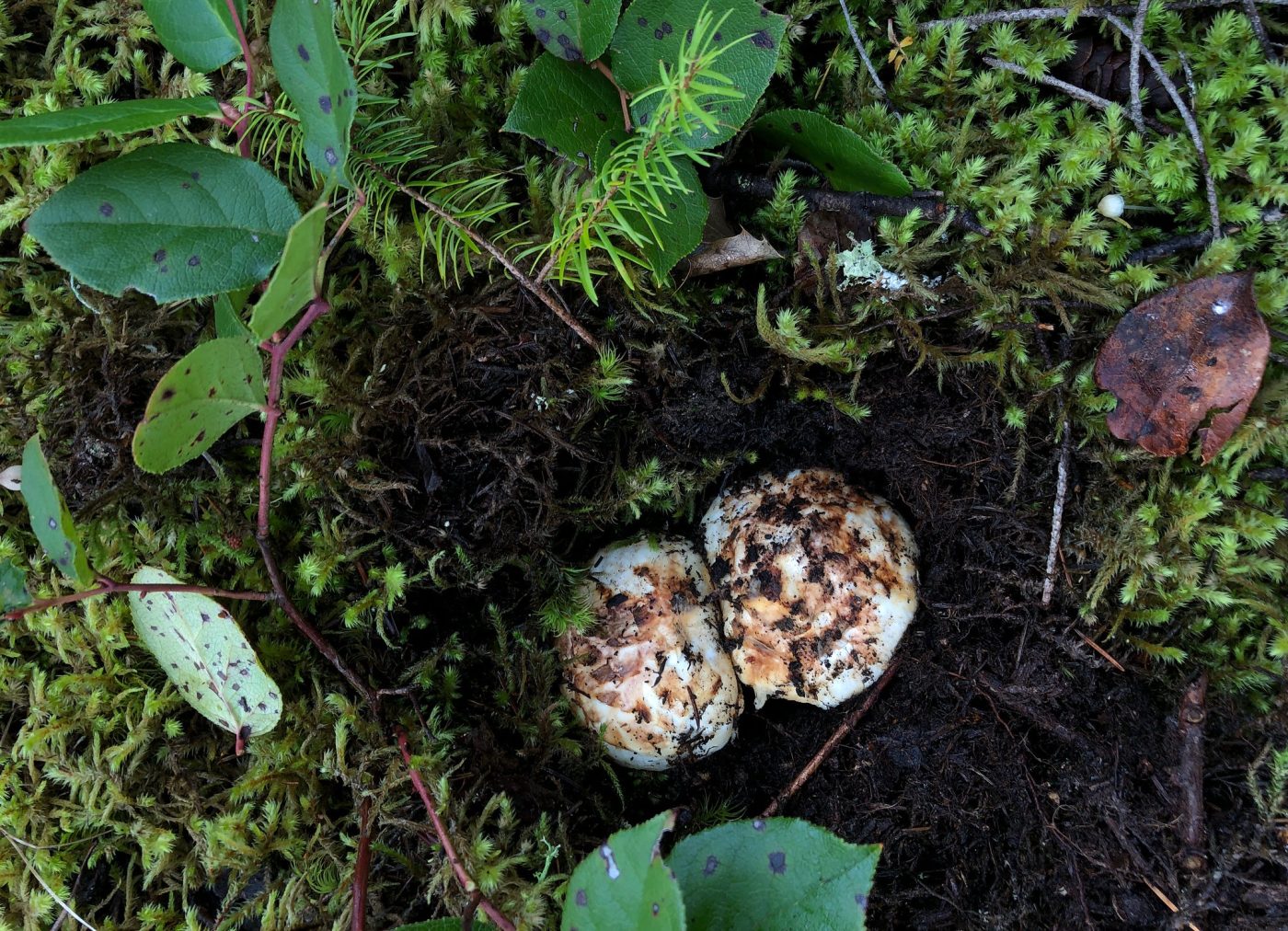
Young Matsutake frequently develop beneath a thick layer of needles and forest litter. The expanding fruit body pushes upward and creates a small hump in the ground.
Experienced foragers sometimes search for these raised areas rather than exposed caps. A mushroom can remain almost completely buried while already reaching a substantial size.
Pine Forests
Pines are among the most important hosts for American Matsutake. Lodgepole pine and other western pines can support productive fruitings.
The mushrooms often occur in dry, well-drained forest soils with deep needle litter. Exact habitat varies considerably across its range.
Douglas Fir and Hemlock Forests
American Matsutake also occurs with Douglas fir, hemlock, and fir. These habitats are especially relevant in the Pacific Northwest.
Moisture and autumn cooling help trigger fruiting. Productive sites can produce mushrooms repeatedly over many seasons.
Tanoak and Madrone
On the West Coast, the species is not restricted strictly to conifers. Tanoak and madrone associations are also documented.
This is useful because a matsutake-like mushroom in coastal forest should not be rejected simply because pine is absent. Local tree composition matters.
Season
The main season is autumn into winter. Fruiting often begins after summer temperatures drop and soil moisture increases.
Timing changes with elevation and latitude. Higher elevations may fruit earlier, while coastal areas can remain productive later into winter.
Distribution
Tricholoma murrillianum is the western North American matsutake. Its range extends from the Rocky Mountains to the Pacific Coast.
This is an important taxonomic correction because older North American books often used the name Tricholoma magnivelare for western collections.
Tricholoma murrillianum vs Tricholoma magnivelare
For many years, western American Matsutake was commonly called Tricholoma magnivelare. Modern research separates western and eastern North American populations.
Tricholoma murrillianum is associated with western North America, while T. magnivelare is used for eastern North American matsutake. Their physical appearance can be extremely similar, so geography is one of the most practical separating characters.
American Matsutake vs Japanese Matsutake
Japanese Matsutake is usually referred to as Tricholoma matsutake. It occurs primarily in Eurasia and has a long cultural and culinary history in Japan and other parts of Asia.
The American species is closely related and has a similar aroma and ecological strategy. However, western North American specimens should not automatically be labeled T. matsutake.
Is Tricholoma murrillianum Edible?
American Matsutake is widely regarded as a highly valued edible mushroom when correctly identified. Its aroma and firm texture make it especially prized in Japanese-style cooking and commercial harvesting.
The mushroom is usually cooked in ways that preserve its fragrance rather than overpower it. Fresh young specimens with intact veils are often considered the highest quality.
Why Matsutake Is So Valuable
The species cannot be easily cultivated in the same way as saprotrophic mushrooms such as Oyster Mushrooms. It depends on complex mycorrhizal relationships with living trees.
This makes wild harvest the main source. The combination of scarcity, seasonal availability, and distinctive aroma contributes to its value.
Look-Alikes
Several large white or brownish woodland mushrooms can resemble American Matsutake. Odor, veil structure, stem base, gill attachment, and habitat are especially useful.
Tricholoma magnivelare — Eastern American Matsutake
Identification
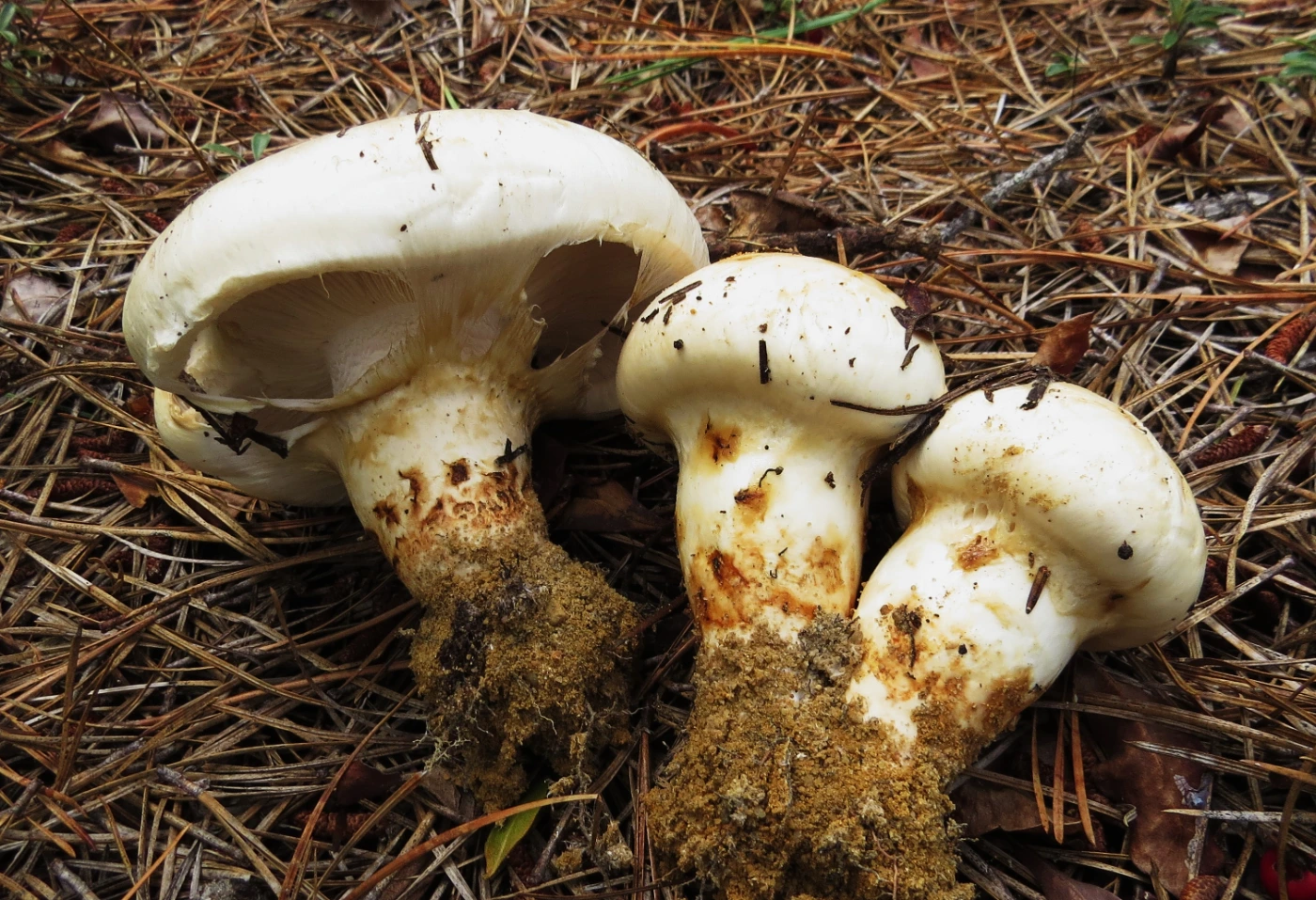
Tricholoma magnivelare is extremely similar in appearance. It also has white flesh, brownish cap markings, a strong aroma, and a prominent veil.
The most practical difference is geography. T. magnivelare is associated with eastern North America, while T. murrillianum is western.
Main Difference
Western North America = Tricholoma murrillianum. Eastern North America = Tricholoma magnivelare.
Tricholoma matsutake — Matsutake
Identification
Tricholoma matsutake is the Eurasian matsutake and shares the same general robust structure and strong aromatic odor.
Its cap tends to become brown-scaled, and it also forms mycorrhizal relationships with trees. Geography and molecular taxonomy separate it from western North American T. murrillianum.
Main Difference
Eurasia strongly favors T. matsutake. Western North America favors T. murrillianum.
Tricholoma caligatum
Identification
Tricholoma caligatum can have a brown-scaled cap and a substantial ring or sheath. It may therefore resemble matsutake closely.
Its odor and taste are often less characteristic, and ecology can differ. Some forms are associated with hardwoods rather than typical matsutake conifer habitats.
Main Difference
The strong characteristic matsutake aroma plus western conifer ecology favors T. murrillianum.
Catathelasma Species
Identification
Some Catathelasma are large, white, thick-stemmed mushrooms with rings and woodland habitat. They can superficially resemble matsutake.
Their gills often run farther down the stem, and the overall structure differs when examined carefully. Odor is usually not the classic strong matsutake scent.
Main Difference
Decurrent gills and different odor favor Catathelasma. Crowded attached-to-notched gills and strong matsutake aroma favor T. murrillianum.
White Amanita Species
Identification
Large white Amanitas can occur in the same forests and may have both rings and white gills. Some species are dangerously poisonous.
Amanitas usually have a distinct volva or bulbous structures at the stem base. Matsutake instead has a sheathing veil around the lower stem but no true Amanita-style volva.
Main Difference
A true volva or clearly bulbous Amanita base is a major warning sign. Matsutake identification should never be made without inspecting the entire stem base.
American Matsutake vs Amanita
| Feature | American Matsutake | Amanita |
|---|---|---|
| Gills | White, crowded | White to pale |
| Ring | Present | Often present |
| Volva | Absent | Often present |
| Stem base | Sheathed but not volva-like | Often bulbous or enclosed in volva |
| Smell | Strong spicy aroma | Usually different |
| Habitat | Mycorrhizal woodland | Mycorrhizal woodland |
| Best clue | Aroma + sheath + no volva | Volva / bulbous base |
This is an important safety comparison because pale young mushrooms can look similar from above. Always excavate the entire stem base rather than cutting the mushroom at ground level.
American Matsutake vs Tricholoma caligatum
| Feature | T. murrillianum | T. caligatum |
|---|---|---|
| Cap | White with brown markings | Brown-scaled |
| Aroma | Strong spicy matsutake odor | Usually less characteristic |
| Veil | Prominent | Prominent |
| Habitat | Primarily western conifer forests | Variable |
| Geography | Western North America | Broader / different regional forms |
| Best clue | Aroma + western ecology | Different odor and ecology |
Because these species can be visually similar, habitat and smell become especially important.
How to Identify Tricholoma murrillianum
Start with geography and habitat. A large matsutake-like mushroom in western North American conifer forest fits the expected range.
Next check the dense white flesh, crowded white gills, and prominent veil. The cap should be pale when young and develop brownish markings with age.
Finally, smell the mushroom and inspect the entire stem base. A strong spicy aroma plus a substantial sheathing veil and absence of an Amanita-style volva strongly support T. murrillianum.
Young vs Mature Matsutake
Young specimens are often almost completely white and remain partly enclosed by the veil. Their caps may still be hidden beneath soil or needle litter.
As they mature, the cap expands and develops increasing brown discoloration or scales. The veil breaks and leaves a prominent ring or sheath around the stem.
Why Young Matsutake Are More Valuable
Young unopened specimens generally have firmer flesh and a stronger concentration of aroma. Their intact veils also make them easier to grade commercially.
Older specimens remain usable but can become softer and more heavily stained. Aroma may also change as the mushroom ages.
Why Matsutake Grows So Deeply
The fruit bodies often begin developing beneath dense forest duff. This protects them from drying and may help maintain stable temperature and humidity.
As the cap expands, it pushes through the litter. Small cracks or raised areas in the ground can reveal hidden mushrooms before they emerge.
Common Identification Mistakes
One common mistake is using Tricholoma magnivelare for every American Matsutake. Western North American material is now generally treated as T. murrillianum.
Another mistake is identifying by smell alone. Odor is powerful but subjective, and structure still needs to match.
A third mistake is cutting the mushroom above ground and leaving the base behind. This can hide a volva or bulbous base that would suggest Amanita.
A fourth mistake is assuming every large white mushroom beneath conifers is matsutake. Several Tricholoma, Catathelasma, and Amanita species can occur in similar habitats.
How to Photograph Tricholoma murrillianum
Photograph the mushroom in place before removing it. Include surrounding needles, soil, and host trees whenever possible.
Then carefully excavate the full stem and photograph the base, ring, gills, and cap surface. A cross-section showing the dense solid flesh can provide additional information.
Can AI Identify American Matsutake?
AI can often recognize typical specimens when the cap, gills, veil, stem base, and habitat are visible. Geography is particularly important because related matsutake species can look nearly identical.
Smell cannot be evaluated from an image, so photo identification loses one of the strongest characters. The user should therefore provide a description of the odor when possible.
Interesting Facts
American Matsutake often reveals itself by creating a small mound in forest litter before the cap emerges. Foragers sometimes call these hidden bulges “mushrumps.”
Its aroma is chemically complex and can be interpreted very differently by different people. Some describe cinnamon and spices, while others notice resinous, musky, or slightly unusual notes.
The species is also an example of how DNA research has changed mushroom naming. Western North American matsutake was long called T. magnivelare, but genetic work showed that western and eastern populations represent distinct taxa.
Like other mycorrhizal mushrooms, American Matsutake depends on living trees. This ecological relationship is one reason reliable commercial cultivation remains difficult.
Frequently Asked Questions
What is American Matsutake?
American Matsutake is the common name for Tricholoma murrillianum in western North America. It is a large aromatic mycorrhizal mushroom associated mainly with conifer forests.
What does American Matsutake smell like?
It has a strong spicy and pungent aroma often compared with cinnamon, resin, or warm spices. The smell is distinctive but subjective.
Does Tricholoma murrillianum have a ring?
Yes. A prominent partial veil usually leaves a ring or sheath-like zone on the stem.
What trees does American Matsutake grow with?
It is associated with pine, Douglas fir, hemlock, fir, and other trees. Tanoak and madrone can also be important on parts of the West Coast.
Where does Tricholoma murrillianum grow?
It occurs in western North America from the Rocky Mountains to the Pacific Coast. Older sources may list western collections under T. magnivelare.
Is Tricholoma murrillianum the same as Tricholoma magnivelare?
No. Modern taxonomy generally separates western T. murrillianum from eastern North American T. magnivelare.
Is American Matsutake edible?
Yes, it is widely prized as an edible mushroom when correctly identified. It should still be distinguished carefully from other white woodland mushrooms.
What is the most important dangerous look-alike?
White Amanita species deserve particular attention. A volva or bulbous Amanita-style stem base is a major warning sign.
Final Identification Notes
Tricholoma murrillianum is best recognized by the combination of large firm white fruit bodies, brownish cap markings with age, crowded white gills, a prominent veil and ring, powerful spicy aroma, and western North American woodland habitat.
Geography is particularly important. Western American Matsutake should generally be called T. murrillianum, while T. magnivelare is associated with eastern North America and T. matsutake with Eurasia.
The practical field pattern is: large dense white mushroom + brown cap staining + strong spicy aroma + sheathing ring + deeply buried growth under western North American trees = strong Tricholoma murrillianum candidate.
Upload a photo and get possible matches in seconds.