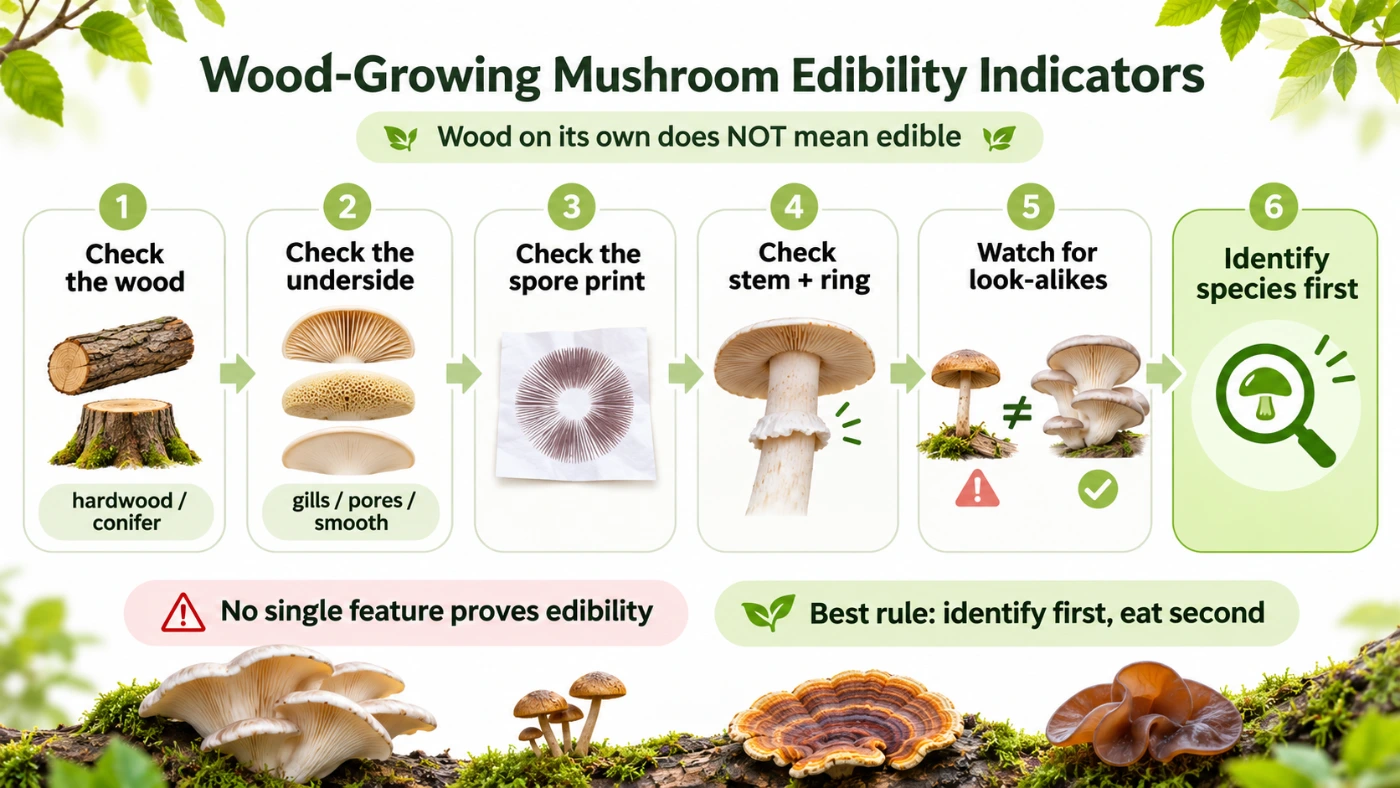
Mushrooms growing on trees, logs, stumps, or buried roots include some excellent edible species, but they also include deadly poisonous fungi. Oyster Mushrooms, Chicken of the Woods, Jelly Ears, and some other popular wild foods all grow on wood, yet the same habitat can also support dangerous species such as Galerina marginata.
This means there is no reliable visual feature that tells you a wood-growing mushroom is edible. Instead, features such as substrate, gills or pores, spore color, stem structure, bruising, texture, and growth pattern should be used to identify the species first.
⚠️ Important: Never use “growing on wood” as an edibility test. Deadly Galerina marginata grows on stumps, logs, and fallen branches and contains amatoxins capable of causing fatal liver poisoning.
What Does “Wood-Growing” Mean?
A wood-growing mushroom is usually a fungus whose fruit body emerges directly from a trunk, stump, branch, log, or buried woody material. Most of these fungi are saprotrophic or parasitic rather than mycorrhizal.
Saprotrophic fungi obtain nutrients by breaking down dead organic material. Parasitic fungi can colonize living or weakened trees and may continue fruiting after the host dies.
The actual substrate can sometimes be hidden. A mushroom that appears to grow from soil may really be attached to a buried root or old stump, so checking the attachment point is important.
Are Mushrooms Growing on Wood More Likely to Be Edible?
No. Wood habitat does not predict edibility.
Several familiar edible mushrooms grow on wood, including Oyster Mushrooms and Chicken of the Woods. At the same time, deadly or otherwise dangerous mushrooms can grow on exactly the same logs and stumps.
The most important example is Galerina marginata. It fruits on dead wood, particularly coniferous wood but also sometimes hardwood, and contains amatoxins similar to those found in Death Caps.
The Most Useful Edibility “Indicators” Are Really Identification Clues
Instead of asking whether a feature means “edible,” ask whether it narrows the mushroom to a known species.
Useful clues include the type of wood, the underside structure, spore color, stem anatomy, veil remnants, flesh texture, bruising, and whether the mushrooms grow singly or in dense clusters.
No single character is enough. Safe identification comes from a consistent combination of features.
1. Check What the Mushroom Is Growing On
Substrate is one of the strongest clues for wood-growing mushrooms. Some species prefer hardwood, others conifers, and some are strongly associated with particular tree genera.
Oyster Mushroom, Pleurotus ostreatus, is primarily associated with deciduous wood and is particularly common on beech and other hardwoods.
Angel Wings, Pleurocybella porrigens, looks superficially similar but is typically found on well-rotted conifer wood. This substrate difference is one of the most useful clues separating the two groups.
Chicken of the Woods, Laetiporus sulphureus, is commonly associated with hardwoods such as oak, beech, and sweet chestnut. Host tree therefore matters even when the mushroom itself looks distinctive.
Hardwood vs Conifer Wood
The distinction between hardwood and conifer is especially important for pale shelf mushrooms. A thick fleshy oyster-like mushroom on hardwood is a different identification problem from a thin white shelf mushroom on a mossy conifer log.
However, host preference is not an absolute rule. Some fungi can grow on multiple tree types, so substrate should support an identification rather than determine it alone.
2. Examine the Underside
The underside often gives more information than the cap. Wood-growing mushrooms may have gills, pores, smooth fertile surfaces, teeth, or maze-like structures.
Oyster Mushrooms have true gills that run down the stem or attachment point. Chicken of the Woods has pores rather than gills, while Jelly Ears have a smooth or finely wrinkled fertile surface.
This structural difference can quickly separate broad groups that look similar from above.
Gills
True gills are thin blade-like structures radiating from the attachment point. Their color, spacing, attachment, and mature spore deposits are all important.
Wood-growing gilled mushrooms deserve particular caution because dangerous species such as Galerina marginata belong to this group.
A small brown mushroom with true gills on wood should never be assumed edible simply because it resembles Wild Enoki or another familiar species.
Pores
Polypores and some shelf fungi have hundreds of tiny pores beneath the fruit body. Many recognizable edible wood fungi belong to pore-bearing groups.
Chicken of the Woods is a classic example, with a pale yellow pore surface beneath bright orange-yellow brackets.
Pores do not guarantee edibility. Many tough, bitter, inedible, or medically problematic polypores also grow on wood.
Smooth or Jelly-Like Undersides
Jelly fungi such as Auricularia lack conventional gills and pores. Their fertile surfaces are smooth or slightly wrinkled.
Texture becomes especially useful here. A flexible gelatinous ear-shaped fungus is a very different identification problem from a fleshy oyster-shaped mushroom with gills.
3. Make a Spore Print When Look-Alikes Are Close
Spore color is one of the most useful tools for separating similar wood-growing mushrooms.
For example, Flammulina velutipes, the classic Wild Enoki or Velvet Shank, produces a white spore print. Similar brown wood-growing Galerina produce brown to rusty-brown spores.
This difference can be critical because cap color alone may overlap strongly.
White Spore Prints
White spores occur in several familiar edible wood-growing groups, including many Pleurotus. Chicken of the Woods also produces a white spore print.
However, white spores are not an edibility indicator. Many poisonous mushrooms also produce white spores.
The value of a spore print comes from how it fits the rest of the identification.
Rusty or Brown Spore Prints
Rusty or brown spores should immediately change the identification shortlist. Galerina marginata produces a brown spore print and mature gills become increasingly rusty.
Some edible wood-growing mushrooms also have brown spores, so again the color is not a toxicity test. It is a species-identification character.
4. Look for Rings, Cortinas, and Veil Remnants
Veil structures are often important in wood-growing gilled mushrooms. A ring may be obvious when young and disappear or collapse with age.
Galerina marginata can have a fragile ring that becomes difficult to see in mature fruit bodies. Its disappearance is one reason older specimens can be especially dangerous to identify casually.
A missing ring does not always mean the mushroom never had one. Look for fibers, discoloration, or a ring zone on the upper stem.
Rings Are Not Edibility Signs
Some edible mushrooms have rings, and some poisonous mushrooms have rings. The structure therefore has diagnostic value but no simple safety meaning.
The same applies to partial veils, cortinas, and stem sheaths. Their presence can narrow the genus or species but cannot answer the edibility question by itself.
5. Check Stem Color and Texture
The stem can be one of the fastest ways to separate dangerous look-alikes.
Wild Enoki typically develops a dark brown to almost black, velvety lower stem. Galerina marginata instead has a more fibrous stem with a ring or ring zone and brown spores.
Oyster Mushrooms often have a very short lateral stem or almost no obvious stem. Some small oyster-like mushrooms have no stem at all, which can lead to confusion with genera such as Crepidotus.
6. Evaluate Flesh Thickness
Thickness is particularly useful with shelf-shaped fungi.
Typical Oyster Mushrooms have relatively substantial, fleshy caps. Angel Wings are much thinner and more delicate, with white tongue-shaped or fan-shaped caps on conifer wood.
This comparison matters because Angel Wings were historically considered edible but have been linked to severe and fatal neurological poisoning in Japan.
Oyster Mushroom vs Angel Wings
| Feature | Oyster Mushroom | Angel Wings |
|---|---|---|
| Typical genus | Pleurotus | Pleurocybella |
| Cap | Thick, fleshy | Thin, delicate |
| Color | Gray, beige, brown, sometimes pale | Usually white |
| Gills | Decurrent | White gills |
| Stem | Short or lateral | Usually absent |
| Typical wood | Hardwood | Conifer |
| Spore print | Pale / whitish | White |
| Safety | Edible when correctly identified | Not recommended; linked to severe poisoning |
| Best clue | Fleshy + hardwood | Thin white + conifer |
A pale shelf mushroom should therefore never be called Oyster Mushroom from shape alone.
7. Look at Growth Pattern
Some wood fungi appear as single brackets, while others form shelves, dense clusters, rosettes, or overlapping fans.
Oyster Mushrooms commonly grow in overlapping clusters. Chicken of the Woods forms large tiers of bright brackets, while Galerina marginata may fruit singly or in groups from decaying wood.
Growth pattern can strongly support an identification, but clusters are not inherently edible. Several dangerous mushrooms grow in dense groups.
Dense Clusters Are Not a Safety Signal
A large cluster can look more reassuring because all the mushrooms appear uniform. In reality, clustering is simply a biological growth pattern.
Honey Mushrooms, Sulphur Tuft, Galerina, Pholiota, Oyster Mushrooms, and many other wood fungi can all fruit in groups.
Every cluster still requires species identification.
8. Pay Attention to Color Changes and Bruising
Bruising reactions can help distinguish some wood-growing species. Pores may darken, flesh may yellow, or damaged areas may turn brown or black.
For example, the Giant Polypore Meripilus giganteus can be distinguished from pale Chicken of the Woods partly because its pores blacken when bruised.
Bruising does not indicate edibility by itself. A color change is simply another identification feature.
9. Age Matters
Young and mature fruit bodies can look surprisingly different. A fresh edible species may become tough, bitter, insect-damaged, or decomposed even though the identification remains correct.
Chicken of the Woods is a good example: young brackets are soft and tender, while older specimens become tough and eventually deteriorate.
Edibility therefore has two separate questions: Is this the correct species? and Is this specimen still in good condition?
Old Wood Mushrooms Are Often Poor Food
Wood fungi can persist longer than many terrestrial mushrooms. A fruit body may remain attached to a log long after its texture has deteriorated.
Avoid mushrooms that are moldy, strongly discolored, waterlogged, foul-smelling, or unusually soft. Identification cannot compensate for poor condition.
10. Smell Can Help, but Never Prove Edibility
Some mushrooms have distinctive odors that help narrow identification. Others have almost no useful smell at all.
Galerina marginata has been described as having a mealy odor, but smell varies between specimens and observers.
A pleasant smell does not mean a mushroom is edible. Dangerous mushrooms can smell mild or ordinary.
High-Risk Wood-Growing Look-Alikes
Some comparisons deserve extra caution because the edible and dangerous mushrooms share the same substrate and general appearance.
Wild Enoki vs Galerina marginata
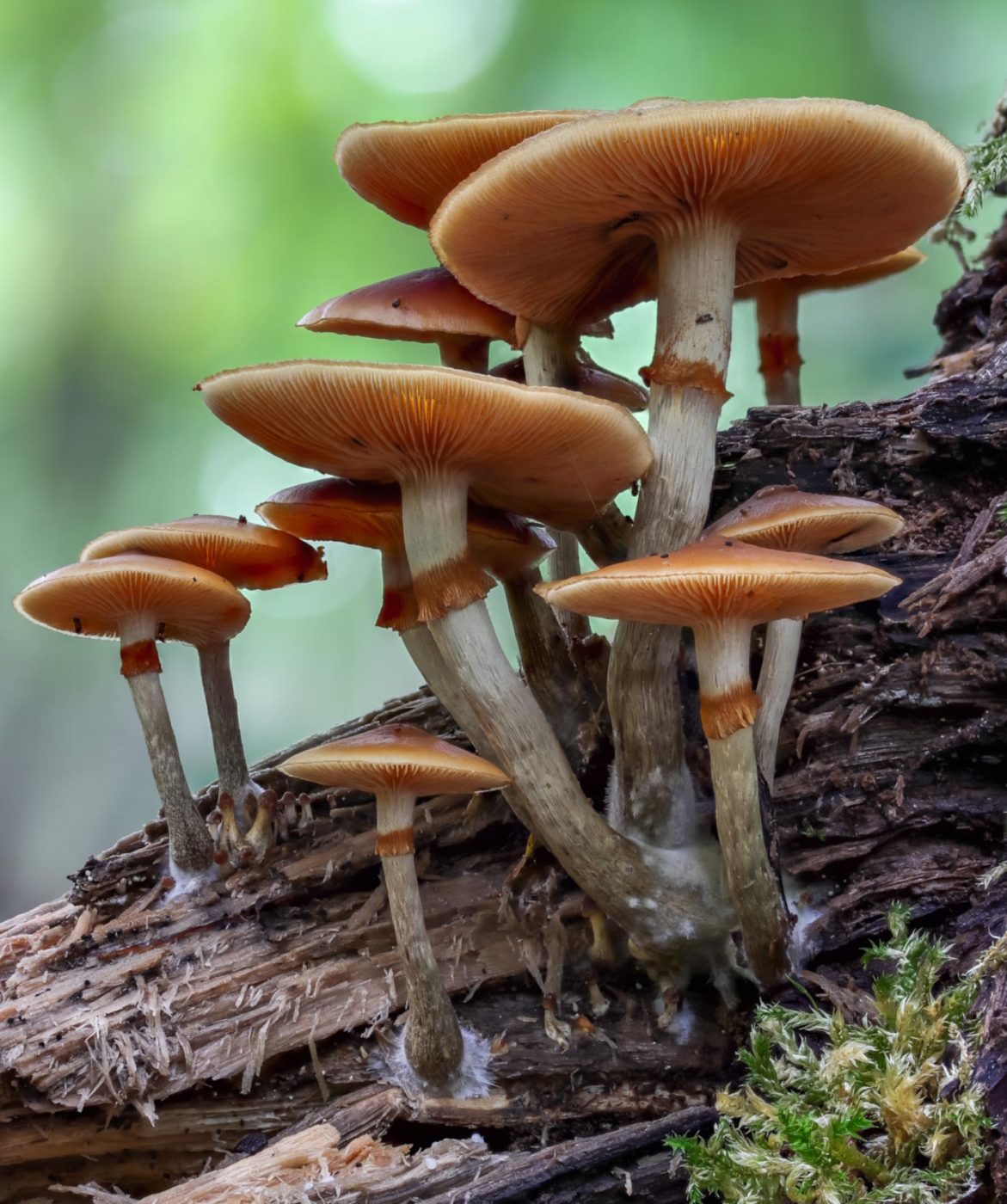
This is one of the most important wood-growing comparisons. Both can produce small brownish caps on dead wood.
Wild Enoki has a dark velvety lower stem and white spores. Galerina marginata typically develops rusty-brown spores and often has a ring or ring zone.
Main Difference
White spores + dark velvety lower stem support Flammulina. Rusty-brown spores + ring zone strongly suggest Galerina.
Oyster Mushroom vs Angel Wings
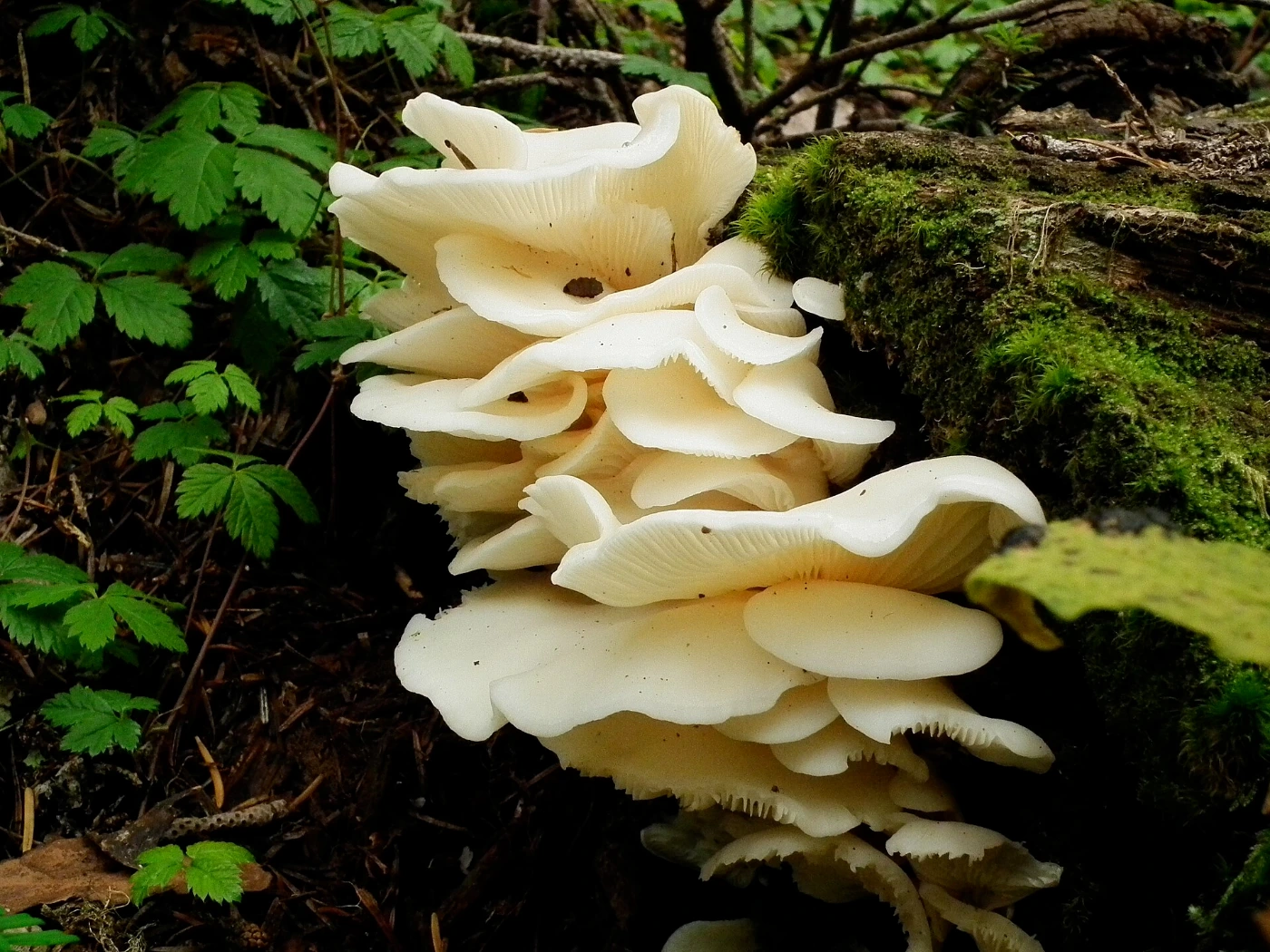
Both produce pale fan-shaped mushrooms with decurrent gills. The difference becomes clearer when texture and substrate are considered.
Oyster Mushrooms are thicker and usually associated with hardwood. Angel Wings are thin, white, nearly stemless, and typically grow on conifer wood.
Main Difference
Thick fleshy caps on hardwood support Pleurotus. Thin white caps on conifer wood support Pleurocybella.
Oyster Mushroom vs Crepidotus
Small Crepidotus can resemble miniature Oyster Mushrooms because they grow laterally from wood and may lack a stem.
However, species such as Crepidotus applanatus develop pale brown gills and a pinkish-buff spore print rather than the pale spores expected from typical Oyster Mushrooms.
Main Difference
Spore color and mature gill color can quickly separate these groups.
Sheathed Woodtuft vs Galerina marginata
Kuehneromyces mutabilis is considered edible by many sources but is dangerously similar to Galerina marginata. First Nature explicitly recommends that only very experienced foragers consider collecting it because the two may be difficult to distinguish reliably.
This is a good example of a broader safety principle: sometimes the correct edibility decision is to avoid an edible species because its dangerous look-alike is too similar.
Bright Colors Do Not Mean Safe or Poisonous
Chicken of the Woods is vivid orange and yellow yet is widely collected as an edible mushroom when correctly identified and young.
At the same time, many poisonous wood fungi are dull brown and visually unremarkable. Color is therefore a poor shortcut for toxicity.
There is no universal “warning color” for mushrooms.
Does Growing on Hardwood Mean Safer?
No. Hardwood supports many edible species, but it also supports poisonous and inedible fungi.
Galerina marginata, for example, is most strongly associated with conifer wood but can also occur on deciduous wood.
Likewise, several visually similar shelf fungi grow on hardwood. Host type narrows the identification but never guarantees safety.
Does Growing on Conifer Wood Mean Dangerous?
No. Conifer wood also supports both harmless and problematic fungi.
The important point is that some look-alike comparisons change dramatically with substrate. Angel Wings on conifer wood, for example, deserve much more consideration than when a thick oyster-like mushroom is growing on beech.
Use conifer versus hardwood as evidence, not as an edibility rule.
Are Bracket Fungi Safer Than Gilled Mushrooms?
Bracket fungi include many non-toxic species, but many are tough, bitter, indigestible, or unsuitable as food. Some can also cause gastrointestinal reactions.
Their shape may reduce confusion with certain deadly gilled mushrooms, but it does not create a general edible category.
Every bracket fungus still needs identification.
Can You Eat a Mushroom Because Animals Eat It?
No. Slugs, insects, squirrels, and other animals can consume fungi that are toxic to humans.
Different species metabolize fungal compounds differently. Feeding damage provides no useful evidence of human edibility.
Can Cooking Make an Unknown Wood Mushroom Safe?
No. Cooking is not a substitute for identification.
Amatoxins in Galerina marginata remain dangerous after ordinary cooking. A mushroom that has not been identified safely should not be eaten because it was boiled, fried, dried, or frozen.
Host Tree Can Change the Identification
Some wood-growing species occur preferentially on particular trees. Oak, beech, birch, willow, poplar, and conifers can each support characteristic fungal communities.
Chicken of the Woods, for instance, commonly occurs on oak, beech, chestnut, and other hardwoods.
Record the host whenever possible. A photograph of the bark, leaves, or surrounding branches can be surprisingly valuable later.
Buried Roots Can Be Misleading
Some wood-decay fungi fruit from underground roots and appear to grow directly from soil. This can cause them to be mistaken for terrestrial or mycorrhizal mushrooms.
Look closely at the base and gently clear leaf litter when necessary. Finding buried wood can completely change the identification.
Jack-o’-Lantern mushrooms are a classic example of wood fungi that can appear terrestrial when growing from buried roots.
Geography Matters
Wood-growing mushrooms can have region-specific counterparts. A European name should not automatically be applied to a similar North American or Asian fruit body.
This is particularly important in genera with complex modern taxonomy, including Pleurotus, Flammulina, Armillaria, Laetiporus, and Auricularia.
An identification should therefore include both morphology and geographic range.
A Better Way to Evaluate a Wood-Growing Mushroom
Instead of looking for an “edibility indicator,” work through identification in a fixed order. First confirm the substrate and tree type, then inspect the underside and entire stem.
Next determine spore color when needed, record bruising or texture, and compare the mushroom with dangerous regional look-alikes. Only after a species-level identification is established should edibility be considered.
This approach is slower than applying simple rules, but it is much safer.
Useful Wood-Growing Edible Groups
Several well-known edible mushrooms grow on wood, but each still requires complete identification. Common examples include Oyster Mushrooms, young Chicken of the Woods, Jelly Ears, and some regional Honey Mushrooms.
Their shared substrate does not make them one safe category. They differ dramatically in anatomy, ecology, taxonomy, and look-alikes.
For beginners, large distinctive species with fewer dangerous look-alikes are generally more suitable study targets than small brown gilled mushrooms.
Wood-Growing Mushrooms Beginners Should Treat With Extra Caution
Small brown gilled mushrooms are among the poorest candidates for beginner foraging. Several unrelated genera converge on the same brown-cap, brown-gill, wood-growing appearance.
The presence of deadly Galerina marginata makes casual identification especially risky. Poison Control emphasizes that experts use many combined characters—including cap, underside, spores, stalk, bruising, growth pattern, and substrate—rather than a single appearance clue.
How to Photograph a Wood-Growing Mushroom
Photograph the mushroom before removing it. Include enough of the trunk, stump, or log to show how and where it is attached.
Then photograph the cap, underside, full stem, attachment point, and any veil structures. If the mushroom is clustered, photograph the entire cluster as well as individual fruit bodies.
Record whether the substrate is hardwood or conifer and, if possible, identify the tree species. These details can be as valuable as the mushroom photograph itself.
Can AI Determine Whether a Wood Mushroom Is Edible?
AI can help narrow possible genera or species when the complete mushroom and substrate are visible. It performs much better with multiple photographs than with one cap-only image.
However, visually similar species such as Galerina marginata and edible wood-growing mushrooms can require spore prints, microscopy, or expert examination. AI identification should therefore not be treated as an edibility decision.
Common Identification Mistakes
One common mistake is assuming that shelf-shaped mushrooms are safe because they do not resemble Amanita. Wood-growing fungi have their own dangerous look-alike problems.
Another mistake is relying on the substrate alone. Hardwood and conifer preferences are valuable clues but overlap occurs.
A third mistake is ignoring mature specimens. Young gills may be pale before spore color becomes obvious, while rings and veil structures can disappear as mushrooms age.
A fourth mistake is identifying every mushroom in a mixed cluster as the same species. Different fungi can fruit from the same log at the same time, so each type should be checked individually.
Frequently Asked Questions
Are mushrooms growing on trees usually edible?
No. Wood supports both edible and poisonous species, so habitat alone cannot determine edibility.
What is the most dangerous wood-growing mushroom to know?
Galerina marginata is one of the most important because it contains deadly amatoxins and can resemble edible brown wood-growing mushrooms.
Does a white spore print mean a wood mushroom is edible?
No. Spore color helps identify mushrooms but does not directly indicate safety.
Are Oyster Mushrooms always safe if they grow on wood?
Only correctly identified Oyster Mushrooms should be eaten. Pale oyster-like fungi such as Angel Wings and Crepidotus need to be excluded.
Are mushrooms with pores safer than mushrooms with gills?
Not as a general rule. Pore-bearing mushrooms may be edible, inedible, bitter, or problematic depending on the species.
Does hardwood versus conifer matter?
Yes, because many species have substrate preferences. It is an important identification clue but not an edibility test.
Can an edible wood mushroom have a deadly look-alike?
Yes. Wild Enoki versus Galerina marginata is a classic example, and some edible woodtufts are also dangerously similar to Galerina.
Can cooking make an unidentified wood mushroom safe?
No. Identification must come first, and some toxins remain dangerous after cooking.
Final Notes
There are no reliable wood-growing mushroom edibility indicators in the sense of a shortcut that proves a mushroom is safe. The same logs and stumps can support edible Oyster Mushrooms, attractive but inedible fungi, and deadly Galerina.
The useful indicators are identification characters: substrate → underside → spore print → stem and veil structures → flesh texture → bruising → growth pattern → host tree → geography. Their purpose is to determine the species, not to label an unknown mushroom edible.
The practical safety rule is: identify the species first, then evaluate edibility. If a wood-growing mushroom cannot be separated confidently from a dangerous look-alike, the correct decision is not to eat it.
Upload a photo and get possible matches in seconds.