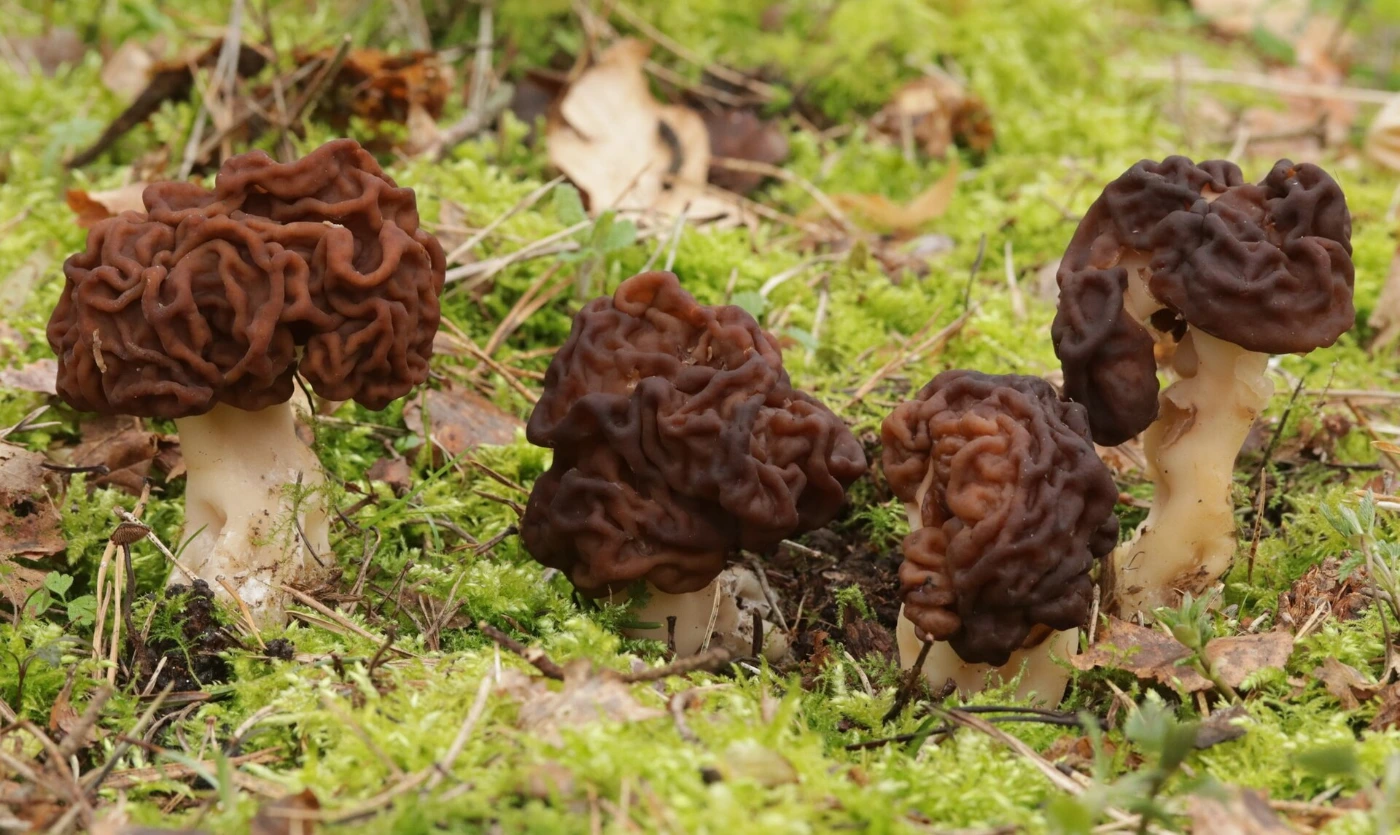
Gyromitra esculenta, commonly known as the False Morel or Brain Mushroom, is a distinctive spring fungus with a reddish-brown, strongly folded cap. Its convoluted surface can resemble a brain, and inexperienced mushroom hunters sometimes confuse it with true morels in the genus Morchella.
The distinction is important because G. esculenta contains gyromitrin, a toxic compound that can cause gastrointestinal illness, neurological effects, seizures, and serious systemic poisoning. Historical consumption after special preparation does not make the species reliably safe, and MushroomID does not recommend eating it.
⚠️ Important: Do not eat Gyromitra esculenta based on appearance, traditional preparation methods, or a photo identification. This species is associated with potentially severe gyromitrin poisoning.
Quick Identification
The combination of a brain-like reddish-brown cap, pale stem, spring fruiting, and irregular internal chambers is strongly suggestive of Gyromitra esculenta. Unlike a true morel, its cap does not have a regular network of deep pits surrounded by narrow raised ridges.
| Feature | Gyromitra esculenta |
|---|---|
| Common names | False Morel, Brain Mushroom |
| Cap | Irregular, strongly folded, brain-like |
| Cap color | Reddish brown to dark brown, occasionally almost black |
| Underside | No gills or pores |
| Stem | Pale, whitish to tan or pinkish |
| Interior | Hollow areas and irregular chambers |
| Habitat | Ground or rotten wood, often with conifers |
| Season | Spring to early summer |
| Spore-bearing surface | Outer surface of the cap |
| Edibility | Poisonous; not recommended |
How to Identify Gyromitra esculenta
Cap
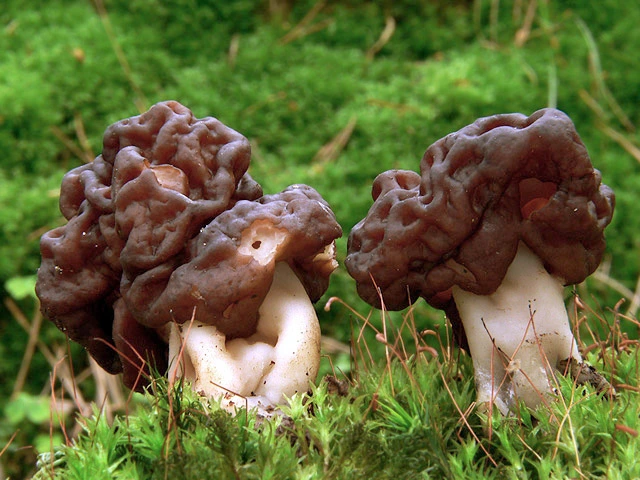
The cap is the most recognizable feature. It usually measures roughly 2–7 cm across and develops numerous rounded lobes and irregular wrinkles, producing the characteristic brain-like appearance. Color ranges from reddish or yellowish brown through dark chestnut and nearly black, although individual specimens can be considerably paler.
Unlike a true morel, the surface is not organized into distinct pits surrounded by narrow ridges. Instead, the tissue bulges and folds over itself in broad, rounded convolutions.
Underside
There are no gills, pores, or teeth. Gyromitra esculenta is an ascomycete, and its microscopic spores are produced on the exposed outer surface of the cap rather than on gills beneath it.
This feature separates it immediately from conventional gilled spring mushrooms, but it does not by itself distinguish it from true morels and other cup fungi. Those groups are also ascomycetes and lack conventional gills.
Stem
The stem is usually much paler than the cap and may be whitish, cream, tan, pinkish, or slightly grayish. Reported dimensions are commonly about 2–10 cm long and 0.5–2.5 cm wide, although larger specimens occur.
The stem may appear compressed, irregular, or slightly swollen rather than perfectly cylindrical. At maturity it can contain hollow areas, and the cap margin may curve toward or partly fuse with the stem.
Interior
Cutting the mushroom lengthwise is one of the most useful identification steps. Instead of the simple, continuous hollow cavity typical of a true morel, G. esculenta commonly shows irregular chambers and folds between the cap surface and the upper stem.
This distinction is especially helpful when the external shape is ambiguous. However, internal structure should be combined with the cap surface and overall form rather than used as a single yes-or-no test.
Flesh, Odor, and Taste
The flesh is relatively brittle and pale. Odor is generally described as mild or indistinct rather than strongly diagnostic, so smell is not a useful primary character for confirming this species.
Taste should never be used as an identification test for a suspected toxic Gyromitra. Other structural features provide much safer and more useful information.
Habitat
Gyromitra esculenta is strongly associated with woodland and is frequently reported from coniferous habitats. Records include sandy soil beneath pine, pine stands, mossy logs, soil, and rotten wood, although the fungus can also occur in association with hardwood habitats.
Because it often fruits in areas where people actively search for morels, habitat alone does not separate it from Morchella. The surrounding trees and substrate are supporting clues rather than proof of identity.
Season
This is primarily a spring fungus, although fruiting can continue into early summer in cooler regions. U.S. Forest Service material lists spring as its typical fruiting season, while Pacific Northwest records also place it in spring and early summer.
That timing creates a practical identification problem because it overlaps strongly with true morel season. Anyone collecting Morchella should therefore be familiar with the appearance of Gyromitra before harvesting.
Distribution
Gyromitra esculenta has a broad northern distribution and is well documented across Europe and parts of North America. It is particularly associated with temperate and boreal woodland environments where suitable spring conditions occur.
Its apparent abundance varies considerably from place to place. In some areas it is uncommon, while elsewhere it can be encountered regularly by morel hunters.
Taxonomy
The accepted scientific name remains Gyromitra esculenta (Pers.) Fr., published in 1849. Species Fungorum and Index Fungorum currently list it as the accepted name in the family Discinaceae, order Pezizales.
The species belongs to the same order as true morels but not to the family Morchellaceae. This explains why the two groups can share some broad structural features while still being taxonomically distinct.
Is Gyromitra esculenta Poisonous?
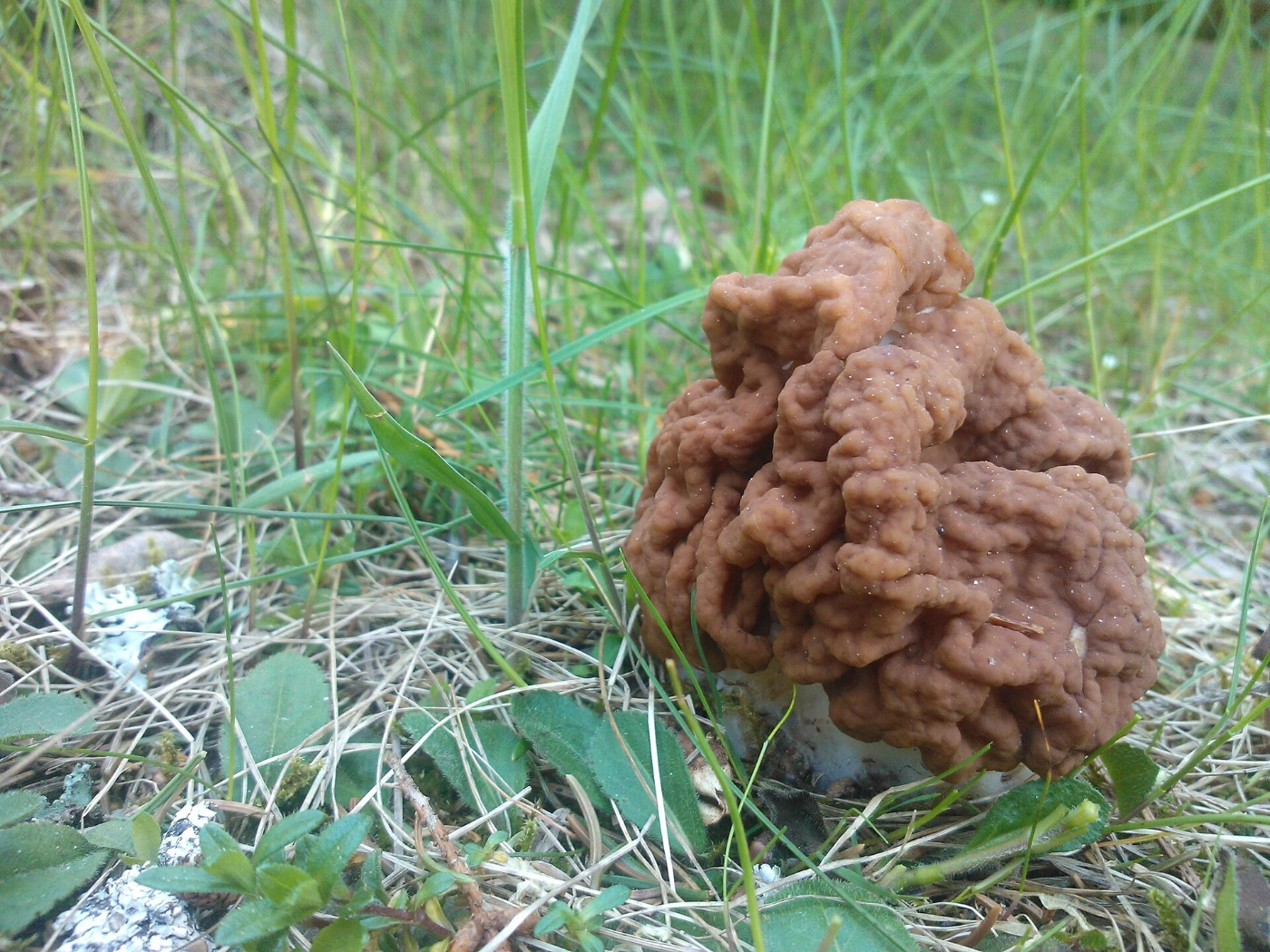
Yes. Gyromitra esculenta is associated with the toxin gyromitrin, which can be converted in the body to monomethylhydrazine (MMH). MMH interferes with vitamin B6-dependent biochemical pathways and can reduce production of the inhibitory neurotransmitter GABA.
Poisoning often begins with gastrointestinal symptoms such as nausea, vomiting, and abdominal pain. More serious cases can progress to dizziness, delirium, seizures, stupor, coma, liver injury, and other systemic effects.
Clinical severity varies, which makes historical reports of people eating the mushroom particularly misleading. A previous uneventful meal does not establish that another specimen, another preparation, or another person will have the same outcome.
Why Has Gyromitra esculenta Been Eaten?
The species has a long history of consumption in parts of northern and eastern Europe. Traditional preparation methods have included repeated boiling, discarding the water, drying, and other techniques intended to reduce gyromitrin concentration.
Those methods can lower toxin levels, but they do not convert species identification or toxin removal into a simple safety guarantee. Gyromitrin concentration varies, susceptibility varies between people, and toxic volatile compounds may also be released during preparation.
For a modern identification guide, the safest practical conclusion is straightforward: Gyromitra esculenta should be treated as poisonous and not recommended for consumption.
Gyromitra esculenta vs True Morels
Confusion with true morels is the most important identification issue. Both can appear in spring, both have an irregular cap, and both can occur in woodland, but the cap architecture is fundamentally different.
| Feature | Gyromitra esculenta — False Morel | Morchella — True Morel |
|---|---|---|
| Cap pattern | Rounded folds and convolutions | Deep pits surrounded by ridges |
| Overall look | Brain-like | Honeycomb-like |
| Interior | Irregular chambers | Continuously hollow |
| Cap structure | Lobed and folded | Organized pits and ridges |
| Color | Often reddish to dark brown | Tan, gray, yellow-brown or dark brown |
| Spring fruiting | Yes | Yes |
| Safety | Poisonous | Some species edible after correct identification and cooking |
The quickest external clue is therefore folds versus pits. A true morel has sharply defined depressions, while G. esculenta has rounded lobes that protrude outward and curl around one another.
Cutting the mushroom lengthwise provides a second strong clue. True morels form a comparatively clean hollow cavity, whereas G. esculenta has a much more irregular internal structure.
Look-Alikes
Morchella esculenta — Yellow Morel
The Yellow Morel [Morchella esculenta and related members of the yellow-morel complex] is one of the most obvious potential sources of confusion. Its cap is tan to yellow-brown and contains a recognizable network of pits separated by raised ridges.
Identification
True morels are hollow and have genuine recessed pits rather than rounded brain-like folds. Their overall structure is usually more organized than the twisted cap of G. esculenta.
Main Difference
Look at the surface rather than relying on general shape. True morel = pits and ridges; G. esculenta = convoluted lobes and folds.
Morchella spp. — Black Morels
Black Morels can be dark gray, brown, or nearly black, making color a poor separator from dark specimens of G. esculenta. Their caps nevertheless retain the characteristic pitted structure of Morchella.
Identification
The ridges often darken with maturity, while the pits remain clearly bounded. A longitudinal cut should reveal the typical hollow interior.
Main Difference
Do not use dark coloration as evidence for Gyromitra. The surface geometry remains the more reliable distinction.
Verpa bohemica — Early False Morel
The Early False Morel or Wrinkled Thimble-Cap [Verpa bohemica] has a wrinkled elongated cap that hangs around the stalk. It can occur during the same general spring period and is another source of confusion among people learning morels.
Identification
The cap is attached primarily near the top of the stem rather than along its lower margin. It is usually more thimble-shaped and vertically wrinkled than the broad, convoluted cap of G. esculenta.
Main Difference
Verpa bohemica looks like a wrinkled cap placed over a stem, while G. esculenta usually forms a broader mass of strongly folded, brain-like lobes.
Gyromitra brunnea — Gabled False Morel
The Gabled False Morel [Gyromitra brunnea] is a closer relative and can be harder to distinguish from G. esculenta. Its cap tends to form larger, more angular or saddle-like lobes rather than the tightly rounded brain-like convolutions typical of classic G. esculenta specimens.
Identification
Color can overlap substantially, so shape and microscopic characters may be necessary when specimens are atypical. Habitat and geography can provide additional supporting information.
Main Difference
Classic G. esculenta is usually more densely brain-like, whereas G. brunnea often develops broader, more angular lobes.
Common Identification Mistakes
A common mistake is assuming that every mushroom called a “false morel” can be identified the same way. Gyromitra, Verpa, and other morel-like fungi differ considerably in cap attachment, internal structure, season, and toxicology.
Another frequent error is using color alone. Both true and false morels can be brown, reddish brown, dark brown, or relatively pale, so cap structure is much more important than cap color.
The third major mistake is identifying an entire patch from one mushroom. More than one spring fungus can fruit in the same woodland, so each unusual specimen deserves individual examination.
Photographing Gyromitra esculenta for Identification
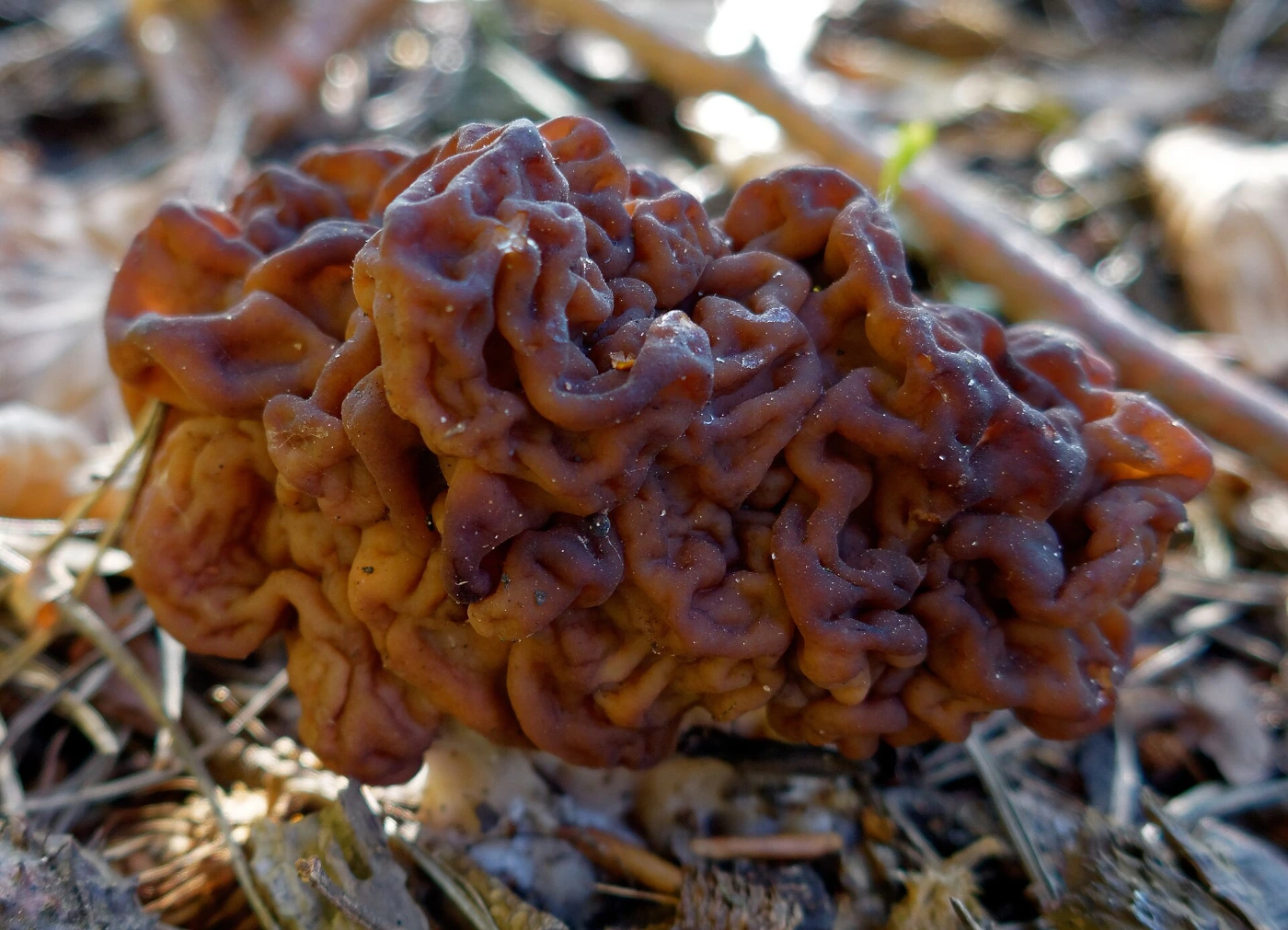
Start with a side view that clearly shows the entire cap and stem. Then photograph the cap close enough to show whether the surface consists of rounded folds or genuine pits and ridges.
After documenting the intact mushroom, make a longitudinal cut and photograph the interior. A photo showing chambers, folds, and the connection between cap and stem can be much more diagnostic than several photographs of the cap from above.
Include the surrounding habitat whenever possible. Pine needles, rotten wood, exposed soil, nearby trees, and growth pattern can all strengthen an identification.
Can AI Identify Gyromitra esculenta?
A clear photograph of a classic specimen is often visually distinctive enough for image recognition to suggest Gyromitra esculenta or at least the Gyromitra group. The strongly convoluted reddish-brown cap is an unusually recognizable field character.
Species-level identification is less certain when the mushroom is immature, damaged, unusually colored, or similar to another Gyromitra. A photograph also cannot reliably measure toxin concentration, so an AI identification should never be interpreted as evidence that a specimen is safe to eat.
FAQ
What is the common name of Gyromitra esculenta?
The most widely used English name is False Morel, while Brain Mushroom is also used because of the strongly convoluted surface of the cap. “False morel” is broader than this single species, however, and can also refer to other Gyromitra and morel-like fungi.
How can I recognize Gyromitra esculenta quickly?
Look for a reddish-brown cap made of rounded, brain-like folds rather than deep honeycomb pits. Cutting the mushroom lengthwise should also reveal a more irregular chambered structure than the simple hollow interior of a true morel.
Is Gyromitra esculenta edible after boiling?
Traditional processing can reduce gyromitrin, but reduced toxin concentration does not equal guaranteed safety. Because toxin levels and individual susceptibility vary, MushroomID treats G. esculenta as poisonous and does not recommend eating it.
Does Gyromitra esculenta contain gyromitrin?
Yes. Gyromitrin is the principal toxin associated with this species and can be metabolized to monomethylhydrazine, which is responsible for important neurological and systemic toxic effects.
When does Gyromitra esculenta grow?
It is primarily a spring fungus and may continue fruiting into early summer in some regions. This timing overlaps directly with true morel season, which contributes to accidental misidentification.
Does Gyromitra esculenta grow under pine trees?
It is frequently associated with coniferous woodland and has documented records beneath pine and in pine stands. It may also occur around rotten wood and in mixed woodland, so pine habitat supports an identification but does not prove it.
Can Gyromitra esculenta be mistaken for a true morel?
Yes, especially by inexperienced collectors searching during spring. The safest visual distinction is that true morels have a honeycomb of real pits and ridges, while G. esculenta has rounded, convoluted, brain-like folds.
Final Identification Notes
[Gyromitra esculenta] — the False Morel or Brain Mushroom — is best recognized by its reddish-brown, strongly convoluted cap, pale stem, spring fruiting season, and irregularly chambered internal structure. Its superficial resemblance to true morels makes it particularly important for anyone collecting Morchella to recognize.
The fastest practical check is to examine the cap closely and then cut the mushroom lengthwise. True morels show genuine honeycomb-like pits and a continuous hollow interior, whereas G. esculenta is dominated by rounded brain-like folds and a more irregular internal structure.
Because the species contains gyromitrin and has caused serious poisoning, identification should never be followed by an assumption that traditional boiling or drying makes it safe. Use morphology, habitat, and cross-sectional structure to identify the mushroom, but do not use photo identification alone for an edibility decision.
Sources
- Species Fungorum — current accepted name and classification of Gyromitra esculenta.
- Index Fungorum — nomenclatural record for Gyromitra esculenta.
- University of British Columbia Beaty Biodiversity Museum — identification features, common names, morphology, and comparison with true morels.
- U.S. Forest Service — morphology, season, habitat, and poisoning warning for Gyromitra esculenta.
- Lagrange et al. — toxicological review of false morels, gyromitrin, MMH, and poisoning syndrome.
- Burke Herbarium, University of Washington — habitat, season, and morphology of Gyromitra esculenta.
Upload a photo and get possible matches in seconds.