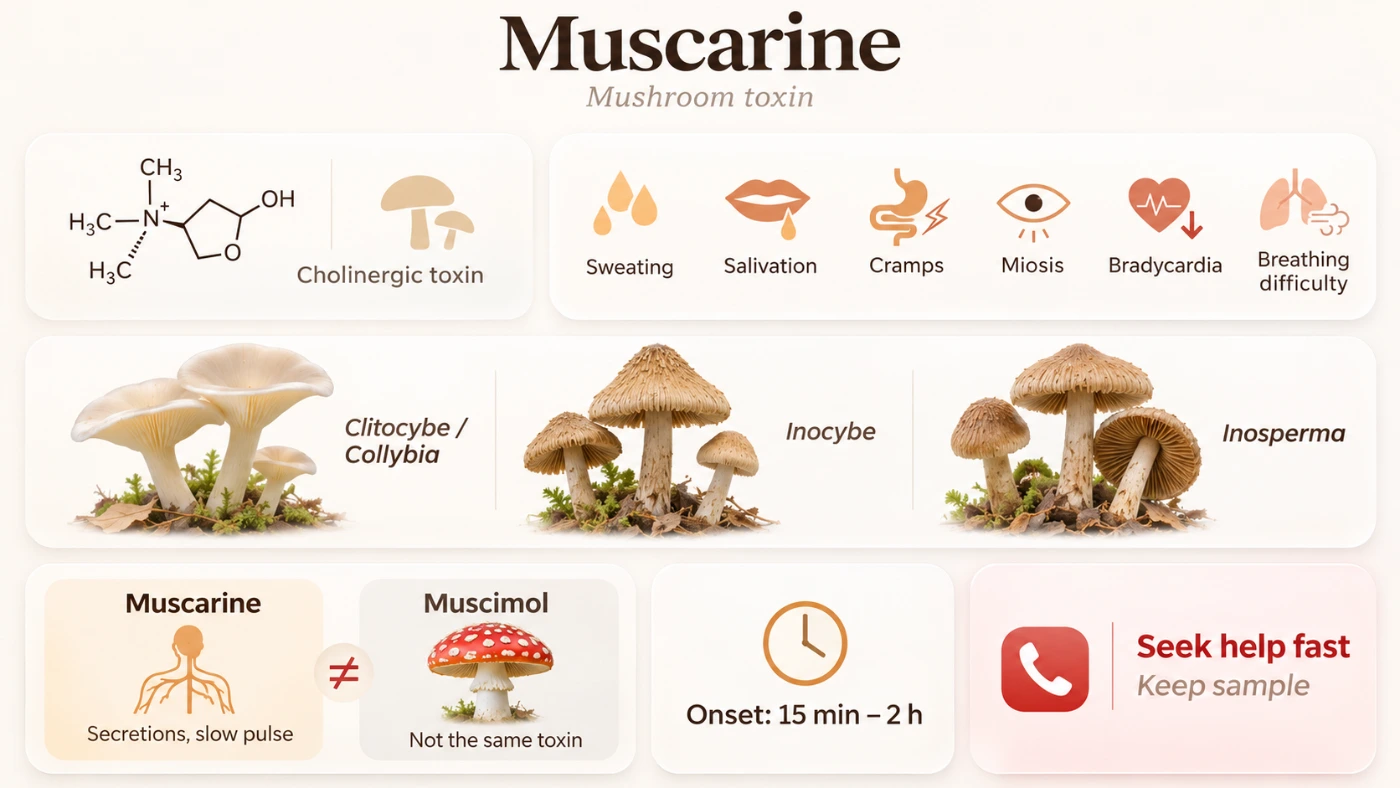
Muscarine is a mushroom toxin that overstimulates muscarinic acetylcholine receptors in the parasympathetic nervous system. Poisoning typically causes excessive sweating, salivation, tearing, abdominal cramps, vomiting, diarrhea, constricted pupils, slowed heart rate, low blood pressure, and sometimes breathing difficulty.
The toxin is especially important in several small pale funnel mushrooms and fibrecaps, including species traditionally placed in Clitocybe and Inocybe. Symptoms usually begin relatively quickly, often within 15 minutes to two hours after the mushrooms are eaten.
Despite its name, muscarine is not the main toxin responsible for the characteristic neurological effects of Fly Agaric (Amanita muscaria). Those effects are primarily caused by ibotenic acid and muscimol, although recent chemical studies indicate that muscarine concentrations in Amanita can vary more than older literature suggested.
⚠️ Important: Suspected muscarine poisoning requires prompt medical or poison-center advice. Severe poisoning can cause marked bradycardia, hypotension, bronchial secretions, breathing difficulty, cardiovascular collapse, and rarely death.
Quick Guide to Muscarine
| Feature | Muscarine |
|---|---|
| Type | Cholinergic mushroom toxin |
| Main target | Muscarinic acetylcholine receptors |
| Main effect | Excessive parasympathetic activity |
| Typical onset | About 15 minutes to 2 hours |
| Main symptoms | Sweating, salivation, tearing, vomiting, diarrhea |
| Pupils | Often constricted |
| Heart rate | Often slowed |
| Respiratory effects | Increased secretions, bronchoconstriction possible |
| Important mushroom groups | Clitocybe/Collybia, Inocybe, Inosperma |
| Main medical antidote | Atropine |
| Fly Agaric connection | Named after it, but Fly Agaric syndrome is mainly ibotenic acid/muscimol |
What Is Muscarine?
Muscarine is a naturally occurring quaternary ammonium compound structurally related to acetylcholine. It binds to muscarinic acetylcholine receptors and acts as a powerful parasympathomimetic substance.
Unlike acetylcholine, muscarine is not readily broken down by acetylcholinesterase. Its persistent receptor activation creates the characteristic collection of sweating, secretions, gastrointestinal symptoms, pupil constriction, and cardiovascular effects.
Because the molecule carries a permanent positive charge, it crosses the blood-brain barrier poorly. Its major effects are therefore peripheral autonomic effects, rather than the hallucinations, agitation, or altered consciousness typical of some other mushroom toxins.
What Does Muscarine Do in the Body?
The parasympathetic nervous system regulates many functions associated with digestion, glandular secretion, heart rate, and smooth muscle activity. Muscarine effectively pushes these systems into excessive activity.
Salivary glands release more saliva, tear glands produce more tears, and sweat production increases markedly. The gastrointestinal tract becomes more active, leading to abdominal cramping, nausea, vomiting, and diarrhea.
Muscarine can also slow the heart and reduce blood pressure. In more severe cases, increased respiratory secretions and bronchoconstriction can interfere with breathing.
Muscarinic Mushroom Poisoning
Muscarine poisoning produces a recognizable cholinergic or muscarinic syndrome. Symptoms generally develop rapidly compared with delayed mushroom syndromes such as amatoxin or orellanine poisoning.
A recent 25-year review of muscarinic mushroom poisonings in Wisconsin found sweating and excessive salivation to be the most common manifestations, followed by gastrointestinal symptoms. Severe cardiovascular effects also occurred, including bradycardia, hypotension, and one fatal cardiovascular collapse before treatment.
Most correctly treated patients recover without long-term complications. Nevertheless, the possibility of severe cardiovascular or respiratory effects means the syndrome should not be dismissed as simple gastrointestinal poisoning.
How Quickly Do Symptoms Begin?
Symptoms usually appear within 15 minutes to two hours after ingestion. This relatively rapid onset is one of the most useful clinical clues suggesting a muscarinic mushroom syndrome.
Some variation is possible depending on the amount eaten, mushroom species, preparation, stomach contents, and individual susceptibility. Timing alone cannot establish which mushroom was eaten, but it can help clinicians distinguish toxin syndromes.
Early Symptoms
Profuse sweating is one of the most characteristic early signs. Excessive salivation and tearing can develop at the same time, sometimes accompanied by a feeling of facial flushing or general weakness.
Nausea, vomiting, abdominal cramps, and diarrhea are also common. Because these symptoms can initially resemble ordinary gastrointestinal food poisoning, the accompanying sweating and secretions are particularly important clues.
Eye Symptoms
Muscarine stimulates receptors controlling the pupil and focusing mechanisms of the eye. Miosis, or constriction of the pupils, can therefore occur.
Blurred vision and difficulty focusing have also been documented in mushroom poisoning cases. These features help distinguish the syndrome from some other toxic mushroom reactions.
Heart and Blood Pressure Effects
Muscarine can slow the heart rate, producing bradycardia. Blood pressure may also fall because of cardiovascular and vascular effects.
Severe hypotension can lead to dizziness, fainting, or circulatory collapse. Although many cases are mild to moderate, serious cardiovascular toxicity has been documented.
Breathing Problems
Excessive bronchial secretions can make breathing difficult. Muscarinic receptor stimulation can also produce bronchoconstriction, narrowing the airways.
These effects are especially concerning in severe poisoning or in people with underlying respiratory disease. Breathing difficulty after eating an unidentified wild mushroom requires urgent medical assessment.
Which Mushrooms Contain Muscarine?
Clinically important muscarine concentrations occur particularly in mushrooms belonging to Clitocybaceae and Inocybaceae. Important groups include pale funnel mushrooms traditionally placed in Clitocybe and fibrecaps in Inocybe, Inosperma, and related genera.
Muscarine has also been detected in other fungal groups, but the presence of a detectable amount does not automatically mean the concentration is sufficient to cause the classic syndrome. Toxicological significance varies greatly between species.
Clitocybe rivulosa — Fool’s Funnel
Clitocybe rivulosa, now treated in some current taxonomic systems as Collybia rivulosa, is a small pale grassland mushroom associated with muscarine poisoning. It grows in lawns, meadows, roadside verges, parks, and similar grassy habitats.
The mushroom has a pale whitish to cream cap, crowded pale gills, and a ringless stem. Its ordinary appearance makes it dangerous because it can occur close to edible grassland mushrooms.
Muscarine poisoning from this type of funnel mushroom typically begins quickly. Sweating, salivation, tearing, gastrointestinal symptoms, pupil constriction, and cardiovascular effects can develop.
Clitocybe dealbata — Ivory Funnel
Clitocybe dealbata, commonly known as the Ivory Funnel, is another pale grassland species traditionally associated with muscarine. It can be extremely difficult to separate from similar white funnel mushrooms in the field.
Older literature sometimes treats C. dealbata and C. rivulosa differently from modern taxonomic systems, which adds to identification confusion. From a safety perspective, uncertain small pale funnel mushrooms should not be collected for food.
Published chemical data have reported substantial muscarine concentrations in C. dealbata. Members of this group remain among the classic causes of muscarinic mushroom poisoning.
Inocybe and Inosperma — Fibrecaps
Fibrecaps are among the most important muscarine-containing mushrooms. Many have small to medium-sized fibrous caps, brownish mature gills, and relatively slender stems.
Muscarine concentrations can be considerably higher in this group than in Fly Agaric. Reviews of Inocybe chemistry report muscarine across many species, with substantial variation between taxa.
Modern molecular taxonomy has divided the traditional genus Inocybe into several genera. Names such as Inosperma, Pseudosperma, and others may therefore appear in current identification resources.
Inosperma erubescens — Deadly Fibrecap
Inosperma erubescens, historically known as Inocybe erubescens or Inocybe patouillardii, is an important European muscarine-containing mushroom. It can initially appear pale but develops characteristic reddish staining as it ages or becomes damaged.
The mushroom may be confused with edible spring species such as St George’s Mushroom. The combination of fibrous cap structure, reddening, brownish mature gills, and muscarine toxicity makes correct identification important.
Clinical case series involving Inocybe patouillardii and related fibrecaps have documented the classic syndrome of sweating, salivation, tearing, gastrointestinal symptoms, miosis, blood-pressure changes, and cardiovascular effects.
Inocybe geophylla and Related Fibrecaps
Inocybe geophylla and related pale fibrecaps have also been involved in confirmed muscarinic poisonings. Their small size and pale coloration can make them look harmless to inexperienced collectors.
Expert-confirmed case series have demonstrated rapid symptoms following ingestion of Inocybe geophylla and other fibrecaps. Patients recovered after supportive treatment and, where appropriate, atropine.
Because species-level separation within Inocybaceae is difficult, uncertain fibrecaps should never be considered edible.
Does Amanita muscaria Contain Muscarine?
Yes, Amanita muscaria can contain muscarine, and muscarine was originally isolated from this species. The toxin’s name itself comes from muscaria.
However, the characteristic Fly Agaric poisoning syndrome is primarily caused by ibotenic acid and muscimol, not by muscarine. These compounds act on glutamatergic and GABAergic systems and produce confusion, ataxia, agitation, hallucinations, somnolence, and other neurological effects.
Historically, muscarine concentrations in Fly Agaric were considered extremely low. Newer analyses have detected a substantially wider range in some samples, so the simple statement that muscarine is always toxicologically irrelevant in A. muscaria may be too absolute.
Even so, muscarine should not be described as the main Fly Agaric toxin. Ibotenic acid and muscimol remain central to the characteristic A. muscaria syndrome.
Muscarine vs Muscimol
Muscarine and muscimol are completely different compounds despite their confusingly similar names. They act on different receptors and produce different poisoning syndromes.
| Feature | Muscarine | Muscimol |
|---|---|---|
| Main receptor | Muscarinic acetylcholine receptors | GABA-A receptors |
| Main nervous-system effect | Parasympathetic overstimulation | CNS depressant / psychoactive |
| Sweating and salivation | Characteristic | Not primary effect |
| Miosis | Common | Not defining |
| Hallucinations / altered perception | Not typical direct effect | Can occur |
| Major mushroom groups | Clitocybe, Inocybe, Inosperma | Amanita muscaria, A. pantherina |
| Specific medical antagonist | Atropine for severe syndrome | No equivalent muscarine-style antidote |
Confusing these names can produce serious misinformation. Fly Agaric should not be described simply as a “muscarine mushroom” even though muscarine was historically discovered in it.
Muscarine vs Amatoxins
Muscarine poisoning typically begins quickly and produces excessive secretions, sweating, gastrointestinal symptoms, pupil constriction, and cardiovascular effects. Amatoxin poisoning follows a very different clinical course.
Amatoxins damage cells, especially in the liver, and symptoms commonly begin only after a prolonged symptom-free interval. Species such as Amanita phalloides, destroying angels, and some Galerina and Lepiota contain amatoxins.
A patient initially recovering from gastrointestinal symptoms after amatoxin poisoning can still develop severe liver failure. This delayed pattern is fundamentally different from the classic rapid muscarinic syndrome.
Muscarine vs Orellanine
Orellanine is another delayed mushroom toxin, best known from species such as Cortinarius rubellus. It primarily damages the kidneys rather than producing a rapid cholinergic syndrome.
Symptoms from orellanine may be delayed for days, whereas muscarine usually causes noticeable effects within hours. The distinction demonstrates why symptom timing can be clinically useful even when the mushroom species is still unknown.
Is Muscarine Hallucinogenic?
No. Muscarine is not considered a hallucinogenic mushroom compound.
Its major actions occur through peripheral muscarinic acetylcholine receptors and produce autonomic symptoms such as sweating, salivation, gastrointestinal activity, constricted pupils, and changes in heart rate.
Hallucinations associated with Fly Agaric are mainly linked to muscimol and ibotenic acid rather than muscarine.
Does Muscarine Cross the Blood-Brain Barrier?
Muscarine crosses the blood-brain barrier poorly because it carries a permanent positive charge. This limits its direct central nervous system activity.
Its most important effects therefore occur outside the brain, particularly in glands, smooth muscle, the gastrointestinal tract, cardiovascular system, eyes, and respiratory system.
This pharmacology explains why muscarine poisoning looks so different from intoxication with muscimol or psilocybin.
Is Muscarine Destroyed by Cooking?
Cooking should not be used as a method for making a muscarine-containing mushroom safe. A mushroom known or suspected to contain clinically significant muscarine should simply not be eaten.
Traditional preparation methods are not a substitute for identification. Boiling, frying, drying, or discarding cooking water should never be relied upon to detoxify an unidentified fibrecap or funnel mushroom.
What Is Atropine?
Atropine blocks muscarinic acetylcholine receptors and can counteract the excessive receptor stimulation caused by muscarine. It is the principal specific medical treatment for clinically significant muscarinic poisoning.
Atropine is used by healthcare professionals when symptoms such as excessive secretions, bradycardia, hypotension, or respiratory effects justify treatment. Confirmed case series show recovery after supportive care and atropine in muscarinic mushroom poisoning.
Atropine should not be self-administered after mushroom ingestion. Dose and monitoring depend on the patient’s symptoms and cardiovascular status.
What to Do After Suspected Muscarine Mushroom Ingestion
Stop eating the mushrooms and contact a poison center or medical service promptly. Do not wait for severe sweating, breathing difficulty, or cardiovascular symptoms before seeking advice.
Keep intact mushrooms, trimmings, cooked leftovers, and photographs when possible. An expert identification can help clinicians distinguish muscarinic poisoning from other mushroom toxin syndromes.
Do not deliberately induce vomiting unless a healthcare professional specifically instructs you to do so. Home remedies should not replace poison-center or medical assessment.
Why Mushroom Samples Matter
Muscarine poisoning is a syndrome rather than a species diagnosis. Several unrelated mushrooms can produce similar symptoms, while a mixed meal can potentially contain more than one toxin type.
A complete specimen can therefore be extremely valuable. Cap, gills, stem, stem base, habitat, and spore characteristics may allow an experienced mycologist to identify the responsible mushroom.
Photographs taken before cooking are especially useful. Images of only a prepared meal often preserve very few diagnostic characteristics.
How Muscarinic Poisoning Is Diagnosed
Diagnosis is usually based on the combination of mushroom ingestion, rapid symptom onset, and characteristic cholinergic signs. Sweating, salivation, tearing, gastrointestinal symptoms, pupil constriction, and bradycardia form a particularly suggestive pattern.
Exact mushroom identification can strengthen the diagnosis but is not always available immediately. Medical treatment should not be delayed while waiting for a species name when symptoms are significant.
How Long Does Muscarine Poisoning Last?
Many patients improve within several hours with appropriate supportive care. In an expert-confirmed Inocybe case series, all patients recovered within approximately 12 hours.
Duration depends on the dose, mushroom species, individual patient, severity of cardiovascular or respiratory effects, and treatment. Severe cases require monitoring until the autonomic effects have resolved.
Can Muscarine Poisoning Be Fatal?
Yes, severe muscarinic mushroom poisoning can be fatal, although most recognized and appropriately treated cases recover. Cardiovascular collapse and serious respiratory effects are the major concerns.
A recent long-term case review documented severe cardiovascular toxicity and one death occurring before medical treatment. This reinforces the importance of early recognition rather than assuming that muscarine causes only mild sweating and stomach upset.
Common Misunderstandings About Muscarine
One common mistake is assuming that Fly Agaric poisoning is primarily caused by muscarine. The characteristic neurological effects of Amanita muscaria are mainly associated with ibotenic acid and muscimol.
Another mistake is assuming that muscarine causes hallucinations. Its characteristic effects are cholinergic and predominantly peripheral rather than psychedelic.
A third mistake is treating all white funnel mushrooms or fibrecaps as interchangeable species. Taxonomy can be difficult, but toxin risk remains important even when exact species identification is uncertain.
A fourth mistake is assuming rapid symptoms mean a mushroom poisoning cannot be serious. Muscarinic poisoning typically begins quickly and can still produce major cardiovascular or respiratory complications.
How to Photograph a Suspected Muscarine-Containing Mushroom
Photograph the mushroom in place before collecting it. Include the surrounding grass, woodland, trees, or other habitat because ecology can strongly narrow the identification.
Take photographs of the cap, gills, complete stem, and stem base. Small pale funnel mushrooms and fibrecaps often require details that disappear in a single top-down photograph.
If several specimens are present, photograph young and mature fruit bodies. Gill color, cap shape, staining, and veil remnants can change significantly with age.
Can AI Identify Muscarine-Containing Mushrooms?
AI can often recognize a probable fibrecap or pale funnel mushroom when clear photographs are available. Species-level identification remains difficult because many members of these groups are visually similar.
An AI result cannot determine the muscarine concentration in an individual mushroom. Chemical content can vary between species and potentially between populations or samples.
For safety decisions, an uncertain Clitocybe, Collybia, Inocybe, or Inosperma identification should be treated conservatively.
Interesting Facts
Muscarine was first isolated from Amanita muscaria in the nineteenth century, which explains both its name and the long-standing historical association between the two. Later toxicology showed that Fly Agaric’s characteristic neurological syndrome is primarily driven by different compounds.
The toxin also gave its name to muscarinic acetylcholine receptors, one of the two major classes of acetylcholine receptors in the body. The other major class is known as nicotinic receptors.
Modern fungal chemistry continues to complicate the old textbook story. Recent studies have found wider variation in muscarine concentrations among Amanita species and even in A. muscaria samples than older measurements suggested, while Clitocybe and Inocybaceae remain major clinically important sources.
Frequently Asked Questions
What is muscarine?
Muscarine is a mushroom toxin that activates muscarinic acetylcholine receptors. It produces excessive parasympathetic activity, including sweating, salivation, tearing, gastrointestinal symptoms, pupil constriction, and cardiovascular effects.
Which mushrooms contain the most important amounts of muscarine?
Clinically important sources include several Clitocybe-type funnel mushrooms and members of Inocybaceae such as Inocybe and Inosperma. Concentrations vary substantially between species.
Does Amanita muscaria contain muscarine?
Yes, but muscarine is not considered the principal cause of the characteristic Fly Agaric syndrome. Ibotenic acid and muscimol remain the main neuroactive compounds associated with its classic effects.
Is muscarine the same as muscimol?
No. Muscarine activates muscarinic acetylcholine receptors, while muscimol primarily acts at GABA-A receptors in the central nervous system.
Does muscarine cause hallucinations?
Not typically. Hallucinations associated with Fly Agaric are mainly related to muscimol and ibotenic acid rather than muscarine.
How quickly does muscarine poisoning begin?
Symptoms commonly begin within about 15 minutes to two hours. Rapid onset combined with sweating, salivation, tearing, and gastrointestinal symptoms strongly suggests a muscarinic syndrome.
What is the antidote for muscarine poisoning?
Atropine is the principal specific medical antagonist used for significant muscarinic symptoms. It must be administered and monitored by healthcare professionals.
Can muscarine poisoning kill someone?
Severe poisoning can be life-threatening and rare fatalities have occurred. Cardiovascular collapse, profound hypotension, and respiratory complications are the most serious risks.
Can cooking remove muscarine?
Cooking should not be relied upon to make a muscarine-containing mushroom safe. Correct identification and avoidance remain the appropriate approach.
Final Notes
Muscarine is a rapid-acting cholinergic mushroom toxin that overstimulates muscarinic acetylcholine receptors. Its characteristic syndrome combines sweating, salivation, tearing, nausea, vomiting, diarrhea, pupil constriction, bradycardia, hypotension, and potentially respiratory difficulty.
The most important mushroom sources are not Fly Agaric but muscarine-rich funnel mushrooms and fibrecaps, particularly species in Clitocybe/Collybia, Inocybe, Inosperma, and related groups. Amanita muscaria can contain muscarine, but its characteristic neurotoxic effects are primarily caused by ibotenic acid and muscimol.
The practical safety pattern is: rapid symptoms after a small pale funnel or fibrecap + heavy sweating + salivation + tearing + gastrointestinal symptoms = consider muscarinic mushroom poisoning and seek medical advice promptly. Severe muscarinic toxicity can affect the cardiovascular and respiratory systems, while atropine provides a specific medical treatment when clinically indicated.
Upload a photo and get possible matches in seconds.