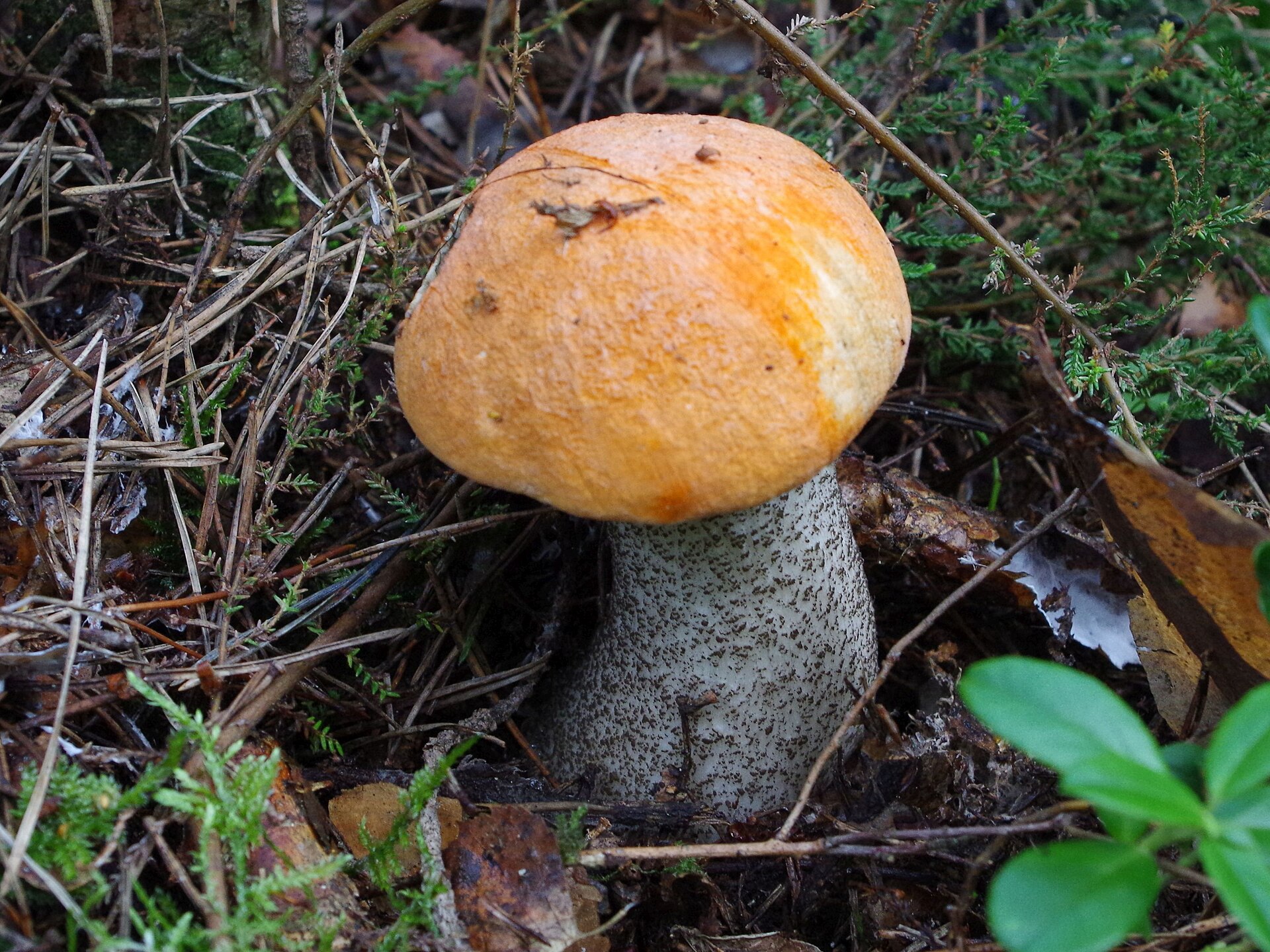
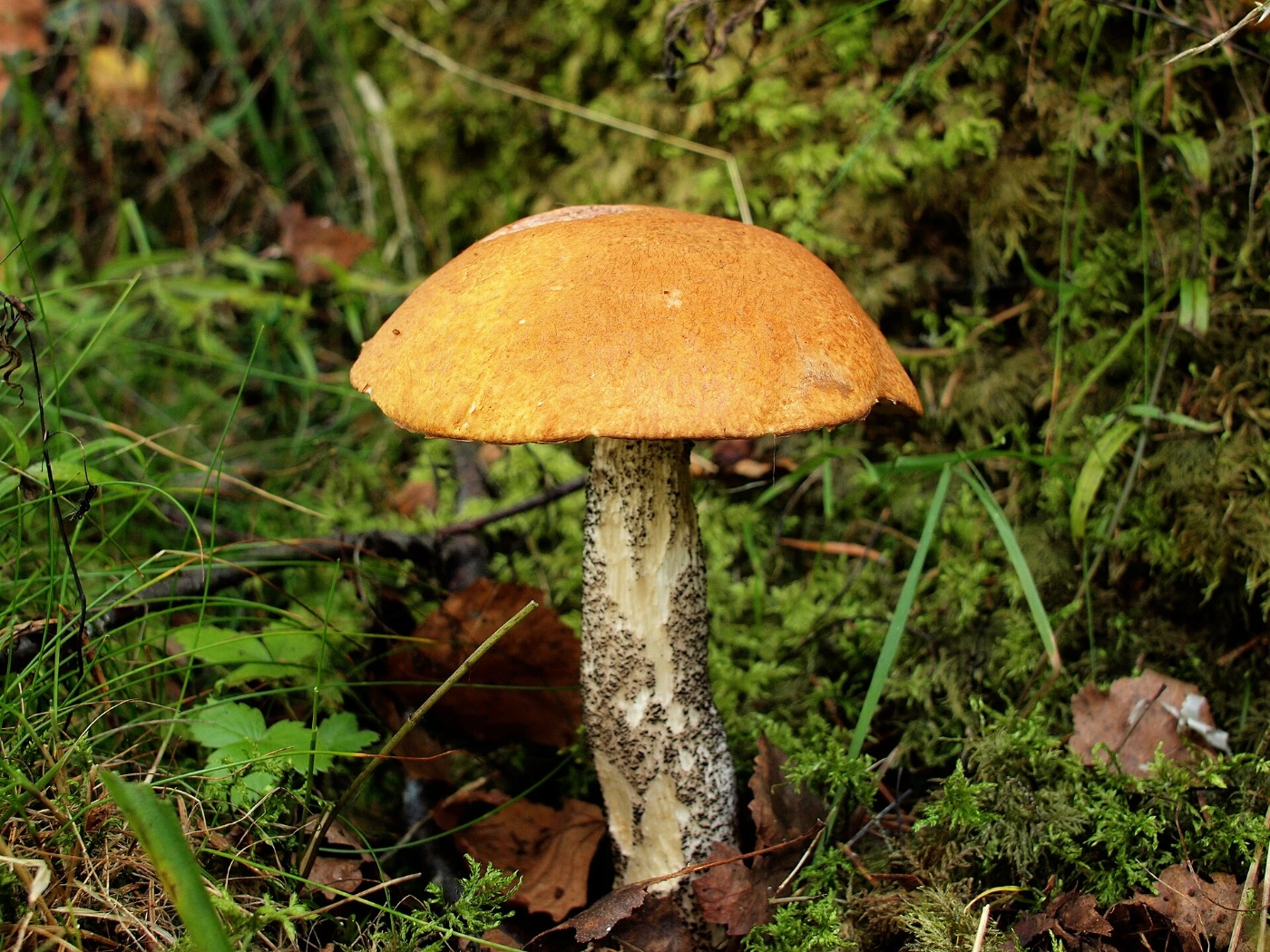
Leccinum versipelle, commonly known as the Orange Birch Bolete, is a large orange-capped bolete associated almost exclusively with birch trees. It is recognizable by its orange to yellow-brown cap, pale pores, tall stem covered with dark scabers, and flesh that gradually develops gray, violet, blue-green, and eventually nearly black discoloration after cutting.
For mushroom hunters, the nearby tree is one of the strongest identification clues. An orange-capped Leccinum growing beneath birch is a much stronger candidate for L. versipelle than a similar mushroom fruiting with aspen, oak, or other trees.
⚠️ Important: Do not identify an orange-capped Leccinum as edible from cap color alone. Closely related species are difficult to separate, and reports of adverse reactions after eating Leccinum mean that photo identification alone should never be used for an edibility decision.
Quick Identification
The most useful field combination is orange cap + birch host + dark stem scabers + pale pores + blue-green to dark staining near the stem base. The cap margin often extends slightly beyond the tubes, producing a characteristic overhanging or ragged edge.
| Feature | Leccinum versipelle |
|---|---|
| Common name | Orange Birch Bolete |
| Cap | Orange, orange-brown to yellow-brown |
| Cap size | Usually about 8–20 cm |
| Underside | Pores, not gills |
| Young pores | Pale grayish |
| Mature pores | Gray to ochraceous |
| Stem | Whitish to pale gray with dark scabers |
| Flesh | White, then gray/violet; blue-green near stem base |
| Spore print | Ochraceous brown |
| Host | Birch (Betula) |
| Ecology | Ectomycorrhizal |
| Season | Mainly summer to autumn |
| Edibility | Traditionally eaten in Europe, but requires cautious identification and thorough cooking |
How to Identify Leccinum versipelle
Cap
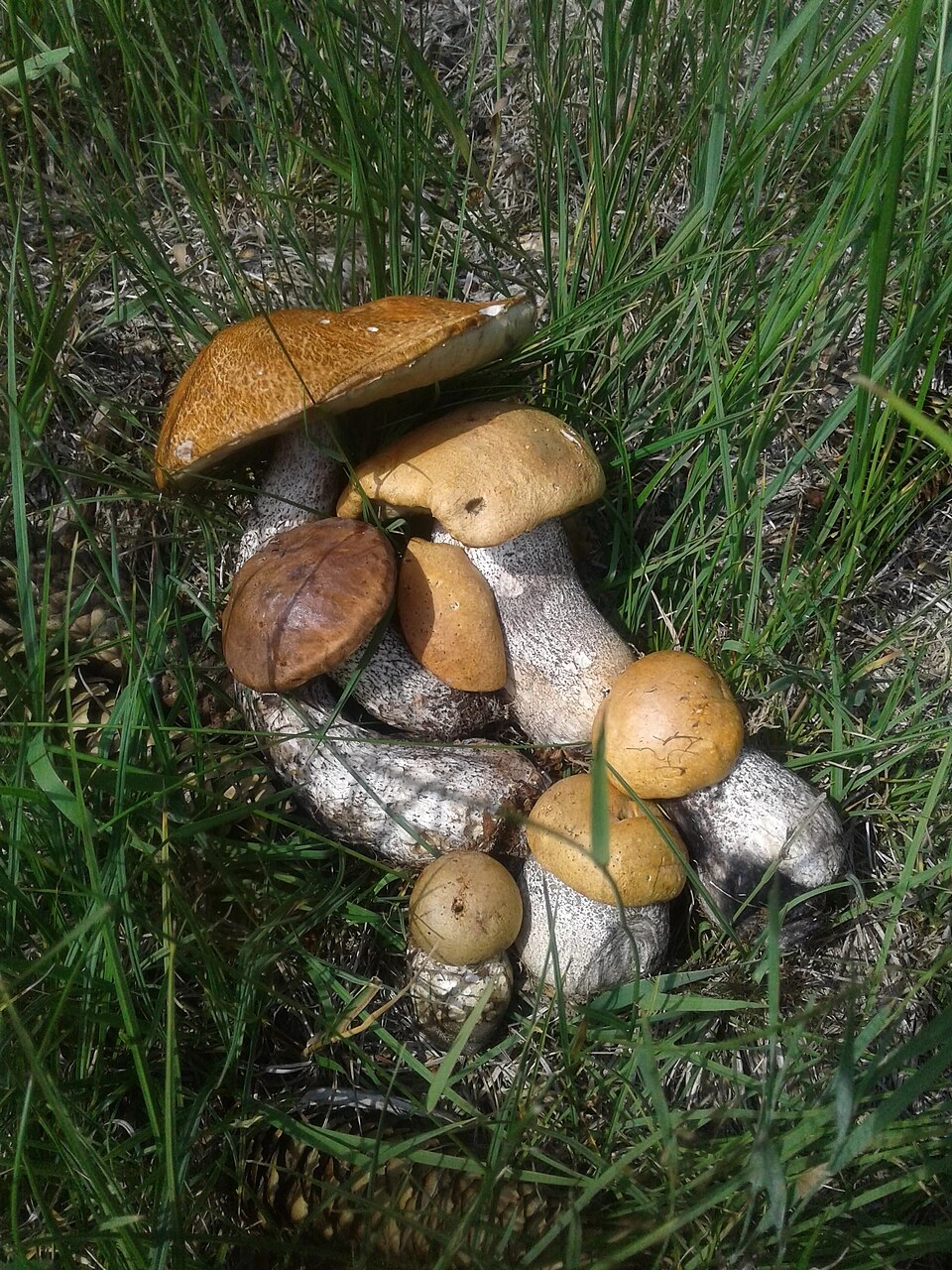
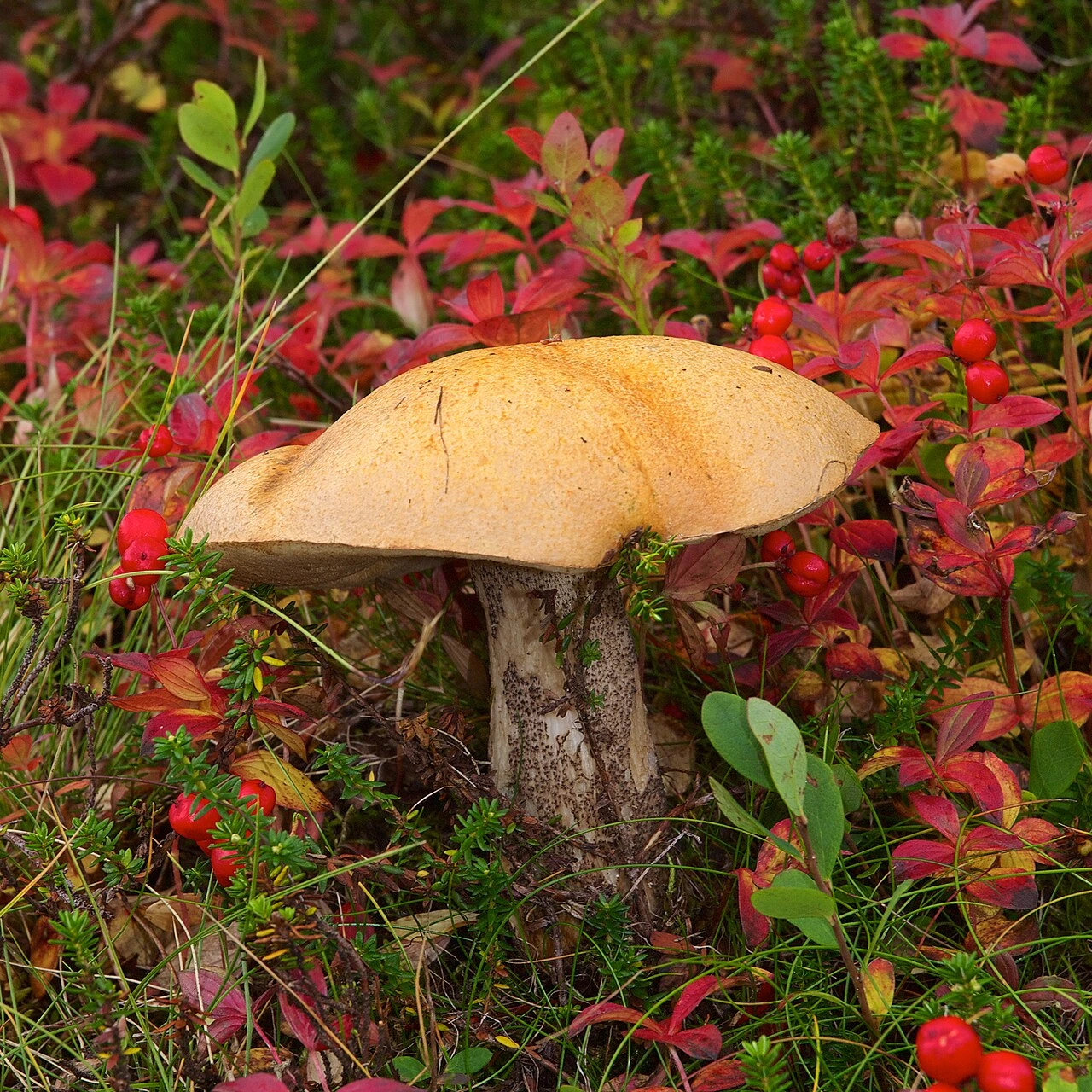
The cap is usually broadly convex and can become large, commonly reaching around 8–20 cm in diameter. Its surface is finely downy rather than strongly sticky or polished, and color usually ranges from yellow-orange through orange-brown to deeper reddish orange.
Cap color is not completely reliable because pale forms occur. Some specimens can be almost whitish with only subtle pink or orange tones, so the tree association, stem scabers, and staining reaction remain important.
A particularly useful character is the overhanging cap cuticle. The skin commonly extends roughly 2–4 mm beyond the pore layer and may form a slightly ragged margin, especially in mature fruiting bodies.
Pores and Tubes
Like other boletes, the Orange Birch Bolete has pores rather than gills. The tubes are initially pale to mouse-gray, while the small pore openings tend to become more ochre or brownish as the mushroom matures.
The pore surface is much less brightly colored than the cap. This difference is useful because some bolete identifications go wrong when cap color and pore color are treated as if they should match.
Stem
The stem is usually long and comparatively slender for the size of the cap. It can reach around 20 cm in height and roughly 2–4 cm in diameter, often narrowing somewhat toward the top.
Its pale surface is covered with numerous dark brown to blackish scabers. These rough woolly dots are one of the defining field characteristics of Leccinum and immediately separate the group from boletes with a reticulated or smooth stem.
Flesh and Staining
Fresh flesh is initially white or very pale. Once cut, however, it can gradually turn grayish and eventually darker, sometimes with a violet cast.
The stem base is especially useful. Cut flesh near the base can develop blue-green coloration before becoming darker or nearly black, a reaction that helps separate L. versipelle from the common Brown Birch Bolete [Leccinum scabrum].
Staining can take time, so a freshly cut specimen should not necessarily be judged after only a few seconds.
Spore Print
The spore print is ochraceous brown. Spores are spindle-shaped, smooth, and approximately 11–16 × 3.5–4.5 μm according to European descriptions.
A spore print can support identification as a bolete but usually does not distinguish this species from its closest Leccinum relatives. Host tree, scabers, staining, and microscopic details are more informative when species-level identification is difficult.
Habitat and Ecology
Leccinum versipelle is an ectomycorrhizal fungus associated with birch trees. In European habitats it occurs beneath species such as Silver Birch [Betula pendula] and Downy Birch [Betula pubescens], including woodland, heathland, scrub, and woodland edges.
This host relationship is one of the most useful practical clues. Many orange-capped Leccinum species look superficially similar but associate with different trees, so learning to identify the tree can sometimes be more helpful than comparing subtle shades of orange.
The fruiting body may appear several meters from the visible trunk because birch roots extend well beyond the base of the tree. Always check the wider area for birches rather than looking only at the closest tree.
Season
In Britain and Ireland, L. versipelle is most commonly reported from July through September. Fruiting periods vary geographically, and the season can extend depending on rainfall, temperature, and latitude.
In northern Europe it is primarily a summer and autumn mushroom. Like many ectomycorrhizal boletes, fruiting can vary greatly from year to year even when the underground mycelium remains present.
Distribution
The Orange Birch Bolete is widely recorded across Europe, from Scandinavia through Britain and Ireland to parts of southern Europe. It has also historically been reported from North America.
North American Leccinum taxonomy is complicated, however. Molecular studies have shown that superficially similar leccinoid mushrooms can represent distinct lineages, so old North American records should not automatically be assumed to refer to the same species understood from European collections.
Taxonomy
The accepted name is Leccinum versipelle (Fr. & Hök) Snell in the family Boletaceae. Species Fungorum currently treats Leccinum versipelle as accepted and lists several former names and described forms as synonyms, including Leccinum percandidum, L. roseotinctum, L. rufescens, and L. atrostipitatum.
The species was originally described in 1835 as Boletus versipellis. Walter H. Snell transferred it to Leccinum in 1944, producing the name used today.
Some older field guides may therefore use names such as Leccinum testaceoscabrum or L. rufescens. Modern identification is better based on the current accepted name while keeping those synonyms in mind when consulting older literature.
Is Leccinum versipelle Edible?
The Orange Birch Bolete has traditionally been collected as an edible mushroom in northern, central, and eastern Europe, and European field guides often describe it as a good edible species. It is particularly popular in regions where Leccinum species form part of established mushroom-foraging traditions.
That simple “edible” label needs qualification. Modern reviews note that some Leccinum species can cause gastrointestinal symptoms when poorly cooked, while poisoning reports involving mushrooms identified as Leccinum demonstrate that identification and preparation are not trivial.
Very large repeated portions of several traditionally edible mushrooms, including Leccinum, have also been associated with rare reports of muscle injury or rhabdomyolysis. These cases do not establish L. versipelle as a conventional poisonous species, but they argue against treating large repeated meals of wild mushrooms as harmless simply because a species is traditionally eaten.
For MushroomID, the practical recommendation is conservative: only consume a wild Leccinum after reliable identification and adequate cooking, and do not use a photo match as proof of edibility.
Why Does Orange Birch Bolete Turn Black When Cut?
The darkening is an enzymatic chemical reaction triggered when mushroom tissue is damaged and exposed to air. In L. versipelle, discoloration can progress from pale flesh through gray or violet tones and eventually become very dark.
Near the stem base, blue-green staining may appear before the flesh blackens. This reaction is useful for identification, but it is not a toxicity test; blue or dark staining in boletes does not tell you whether a mushroom is poisonous.
Cooking and drying can also darken Leccinum versipelle. Dark flesh after preparation is therefore characteristic of the mushroom and does not automatically indicate spoilage.
Look-Alikes
Leccinum scabrum — Brown Birch Bolete
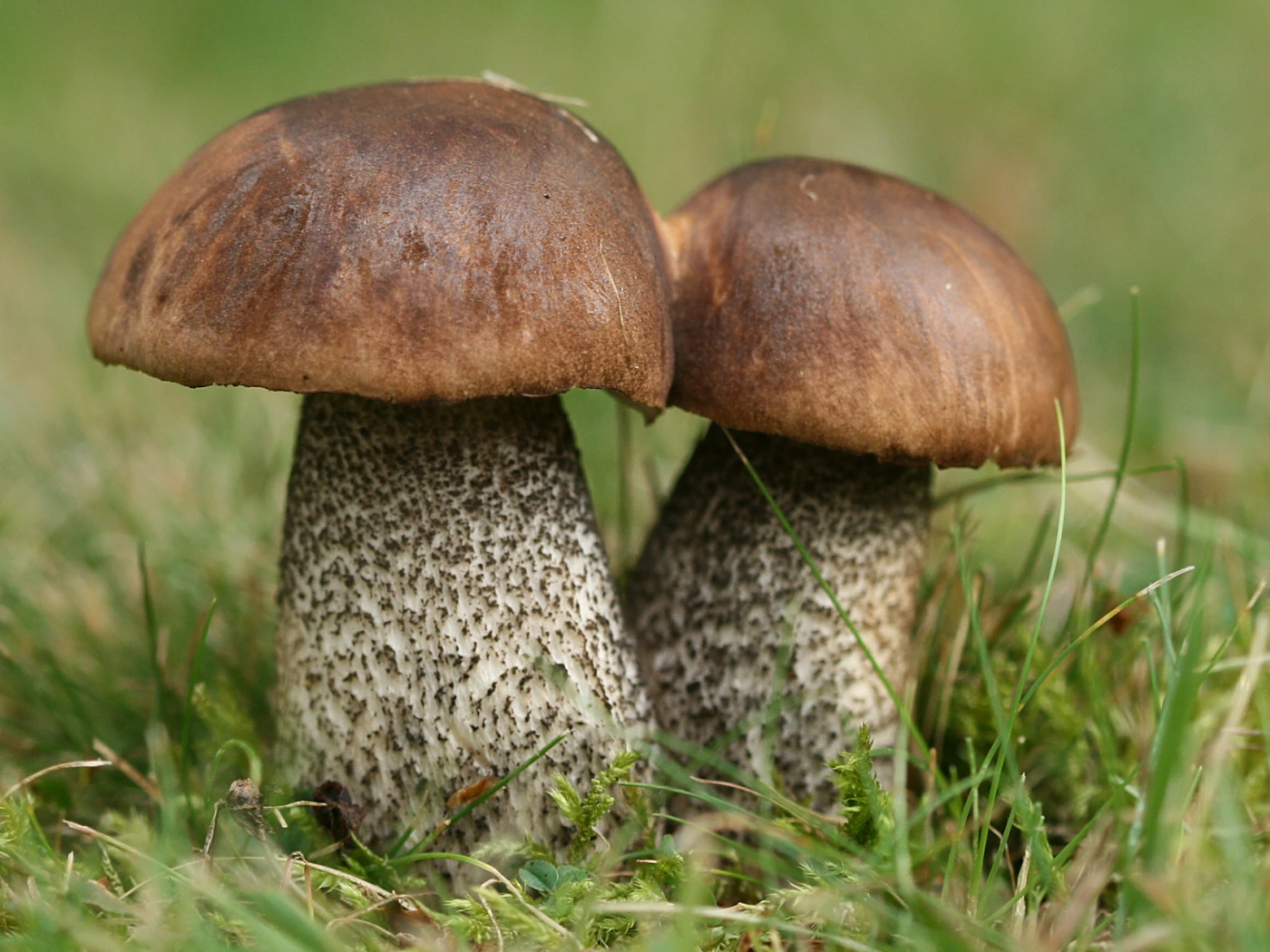
The Brown Birch Bolete [Leccinum scabrum] is probably the most relevant look-alike because it also forms mycorrhiza specifically with birches. Both species have pale stems covered in dark scabers and can fruit in the same woodland.
Identification
L. scabrum typically has a gray-brown to brown cap rather than the conspicuously orange cap of L. versipelle. Its flesh can change somewhat after cutting but normally lacks the pronounced blue-green reaction near the stem base associated with Orange Birch Bolete.
Main Difference
Orange cap + blue-green staining near stem base favors L. versipelle. Brown cap + little or no strong basal blue-green staining favors L. scabrum.
Leccinum aurantiacum — Orange Oak Bolete
The Orange Oak Bolete [Leccinum aurantiacum] can look extremely similar because it also produces a large orange cap and a scabered stem. The most useful distinction is ecological rather than purely visual.
Identification
European L. aurantiacum is associated primarily with poplars, aspens, and oaks rather than being specifically tied to birch. Its coloration can overlap substantially with L. versipelle.
Main Difference
Check the host tree carefully. Birch strongly supports L. versipelle, while oak, aspen, or poplar points toward L. aurantiacum or another orange-capped Leccinum.
Leccinum cyaneobasileucum — Greyshank Bolete
The Greyshank Bolete [Leccinum cyaneobasileucum] also occurs with birch and develops blue coloration near the base of the stem. This overlap makes it a more challenging comparison than cap color alone might suggest.
Identification
Its cap is usually gray-brown rather than orange, and the entire mushroom tends to have a less vividly colored appearance. Microscopic characters can be needed in atypical collections.
Main Difference
Both can show basal blue-green staining, but the distinctly orange cap strongly favors L. versipelle.
Leccinum leucopodium — Aspen Bolete
The Aspen Bolete [Leccinum leucopodium] is another orange-capped member of the group and can resemble Orange Birch Bolete strongly at first glance. It has historically appeared under several names in the European literature.
Identification
The most important clue is again the host relationship. L. leucopodium is associated primarily with aspens and other Populus, while L. versipelle is characteristically associated with birch.
Main Difference
Do not identify either species from cap color alone. Birch vs aspen/poplar is often the most practical field distinction.
Leccinum versipelle vs Leccinum scabrum
These two mushrooms can literally occur under the same birch tree, so the comparison is especially useful.
| Feature | Orange Birch Bolete | Brown Birch Bolete |
|---|---|---|
| Species | L. versipelle | L. scabrum |
| Cap | Orange to yellow-brown | Gray-brown to brown |
| Host | Birch | Birch |
| Stem | Dark scabers | Dark scabers |
| Basal staining | Often blue-green then dark | Usually lacks strong blue-green reaction |
| Flesh | Grays and darkens strongly | Usually less dramatic staining |
| Pores | Grayish → ochraceous | Whitish → gray/brownish |
The host cannot separate these two because both associate with birch. In this particular comparison, cap color and staining reaction become much more important.
Common Identification Mistakes
The most common mistake is identifying every orange Leccinum as the same mushroom. Several species produce orange or reddish caps, and the host tree can be more diagnostic than differences in cap shade.
Another mistake is overlooking the base of the stem. Cutting the mushroom lengthwise and observing the basal flesh can reveal blue-green staining that may be invisible from the intact exterior.
Collectors also sometimes interpret blackening flesh as decay or toxicity. In L. versipelle, substantial darkening after cutting or cooking is normal and should be treated as an identification character rather than a simple safety signal.
Finally, do not assume that every nearby tree is relevant. Roots can extend far from a trunk, and mixed woodland may contain birch, aspen, oak, and other possible hosts within a small area.
How to Photograph Leccinum versipelle for Identification
Photograph the entire mushroom before cutting it, including the cap, stem, and substrate. A close-up of the stem is particularly important because the shape and color of the scabers are much easier to evaluate in a sharp image.
Next, photograph the pore surface rather than only the top of the cap. Then cut the mushroom lengthwise and take another image immediately, followed by a second photograph after several minutes so any staining reaction is documented.
Finally, include the nearby trees. A clear photograph of birch bark and leaves can sometimes provide more useful identification information than another close-up of the mushroom cap.
Can AI Identify Leccinum versipelle?
A typical specimen beneath birch with a vivid orange cap and dark stem scabers is a strong visual candidate for Leccinum versipelle. AI image recognition can therefore often narrow the mushroom to the orange-capped Leccinum group.
Species-level identification becomes harder when the host tree is not shown, the cap is unusually pale, or the staining reaction is missing from the photographs. Several Leccinum species overlap strongly in appearance, so a single image should not be treated as definitive identification.
For a stronger result, provide photographs of the cap, pores, stem scabers, cut flesh, staining reaction, and host tree.
FAQ
What is the common name of Leccinum versipelle?
The standard English common name is Orange Birch Bolete. The name reflects both its characteristic orange cap and its strong ecological association with birch trees.
Does Leccinum versipelle always have an orange cap?
No. Most specimens are orange, orange-brown, or yellow-brown, but unusually pale forms are known and may be almost whitish. Host tree, scabers, pore color, and staining therefore remain important when cap color is atypical.
Does Orange Birch Bolete grow only under birch?
European descriptions regard L. versipelle as strongly associated with birch. Because fungal mycelium connects with roots underground, the relevant birch may not always be immediately beside the mushroom.
Why does Leccinum versipelle turn blue-green when cut?
The reaction occurs particularly in flesh near the stem base after damage and exposure to air. It can progress from blue-green through darker tones and is a useful identification clue, but it does not indicate whether the mushroom is poisonous.
Is Leccinum versipelle edible?
It is traditionally regarded as edible in many European countries and has a long history of consumption. However, Leccinum species have also been associated with gastrointestinal illness and occasional other adverse reactions, so correct identification, thorough cooking, and moderation are important.
How do I distinguish Orange Birch Bolete from Orange Oak Bolete?
Start with the tree rather than the cap. Orange Birch Bolete is associated with birch, whereas European Orange Oak Bolete [Leccinum aurantiacum] is more typically associated with oak, aspen, and poplar.
Can Leccinum versipelle and Leccinum scabrum grow together?
Yes. Both form ectomycorrhiza with birch and can occur in the same habitat, sometimes beneath the same trees. Cap color and staining reactions therefore become especially useful when separating them.
Final Identification Notes
[Leccinum versipelle] — the Orange Birch Bolete — is best recognized by the combination of an orange to orange-brown cap, pale pore surface, whitish stem covered with dark scabers, strong association with birch, and flesh that develops gray to violet and blue-green-to-dark staining after cutting.
The host tree is especially valuable because several orange-capped Leccinum species are visually similar. An orange bolete beneath birch strongly supports L. versipelle, while similar mushrooms beneath oak, aspen, or poplar require other possibilities to be considered.
Although the species has traditionally been eaten across much of Europe, Leccinum identification can be difficult and adverse reactions have been reported from the genus. Do not use cap color, a single photograph, or an AI result alone to decide that a wild mushroom is safe to eat.
Sources
- Species Fungorum — Leccinum versipelle
- First Nature — Leccinum versipelle, Orange Birch Bolete
- PubMed — Molecular revision of leccinoid fungi
- PMC — The genus Leccinum: taxonomy, ecology and edibility
- PMC — Mercury in Leccinum versipelle fruiting bodies
Upload a photo and get possible matches in seconds.