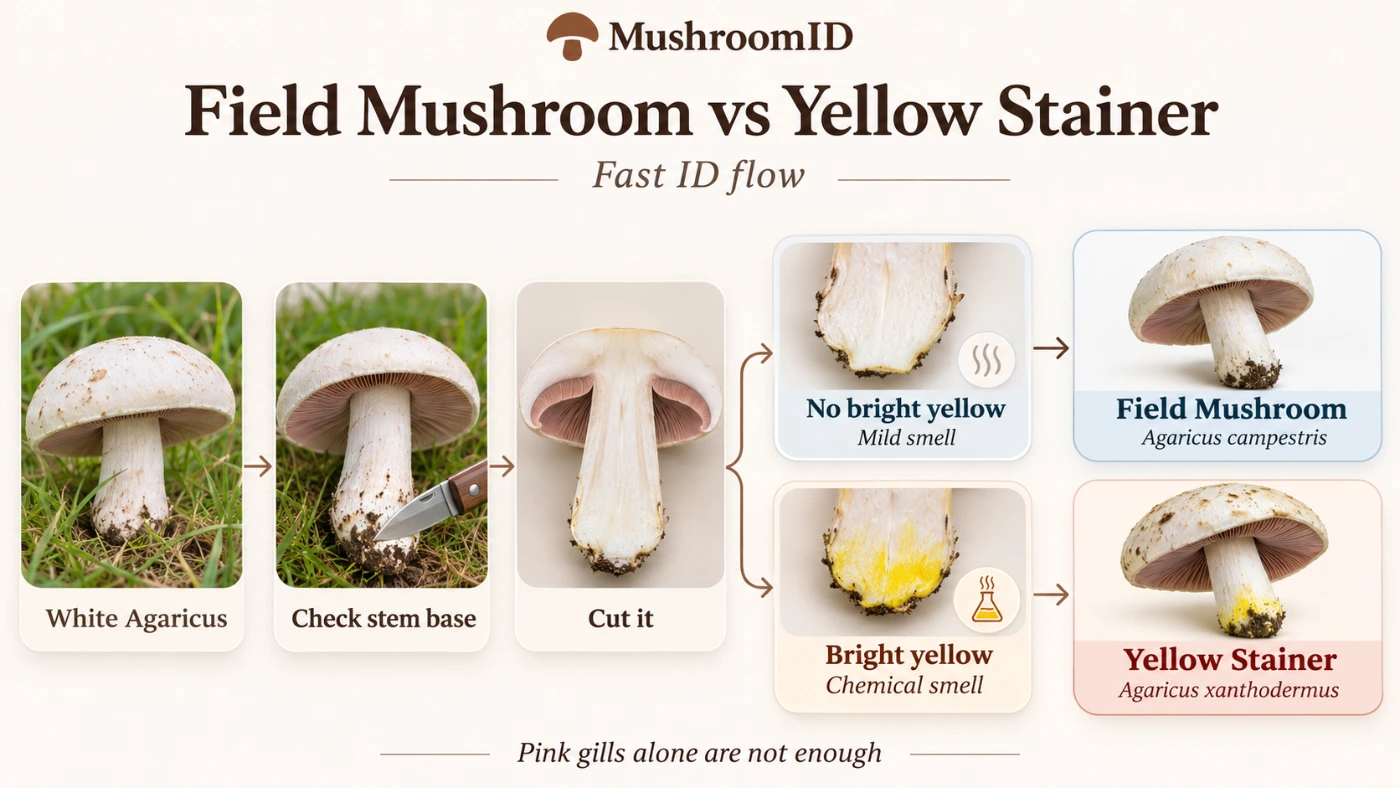
The Field Mushroom [Agaricus campestris] and the Yellow Stainer [Agaricus xanthodermus] can look remarkably similar when young. Both can have smooth white caps, pink gills that darken with age, a stem ring, and dark chocolate-brown spores, and both may appear in lawns, parks, gardens, and other grassy places.
The fastest differences are found at the base of the stem and in the odor. A Yellow Stainer typically turns vivid chrome yellow very quickly when the stem base is cut or bruised and often develops a strong phenolic, ink-like, iodine-like, or chemical smell. A Field Mushroom does not show this intense yellow reaction and normally has no strong chemical odor.
⚠️ Important: Yellow Stainers can cause significant gastrointestinal poisoning. Never identify a white Agaricus as edible from cap color, pink gills, or habitat alone; check the stem base, odor, gills, ring, and overall staining reaction.
Quick Comparison
| Feature | Field Mushroom — Agaricus campestris | Yellow Stainer — Agaricus xanthodermus |
|---|---|---|
| Edibility | Traditionally edible | Poisonous / gastrointestinal irritant |
| Cap | White to cream, sometimes lightly scaled | White to grayish, often smooth |
| Bruising | Little or no yellow staining | Rapid bright chrome-yellow staining |
| Strongest yellowing | Usually absent | Especially strong at stem base |
| Odor | Mild, mushroom-like, not distinctive | Phenol, ink, iodine, disinfectant-like |
| Young gills | Pink | Pale pink to pinkish |
| Mature gills | Chocolate brown | Gray-brown to dark brown |
| Stem base | Usually not bulbous | Often noticeably bulbous |
| Ring | Thin, delicate, often disappearing | Larger, persistent, pendulous |
| Spore print | Dark chocolate brown | Very dark brown |
| Habitat | Grassland, pastures, lawns, parks | Parks, gardens, lawns, hedges, disturbed ground |
The single best field test is to cut through the lower stem and immediately watch the flesh. Bright yellow staining that develops quickly at the base, especially together with a chemical odor, strongly favors the Yellow Stainer.
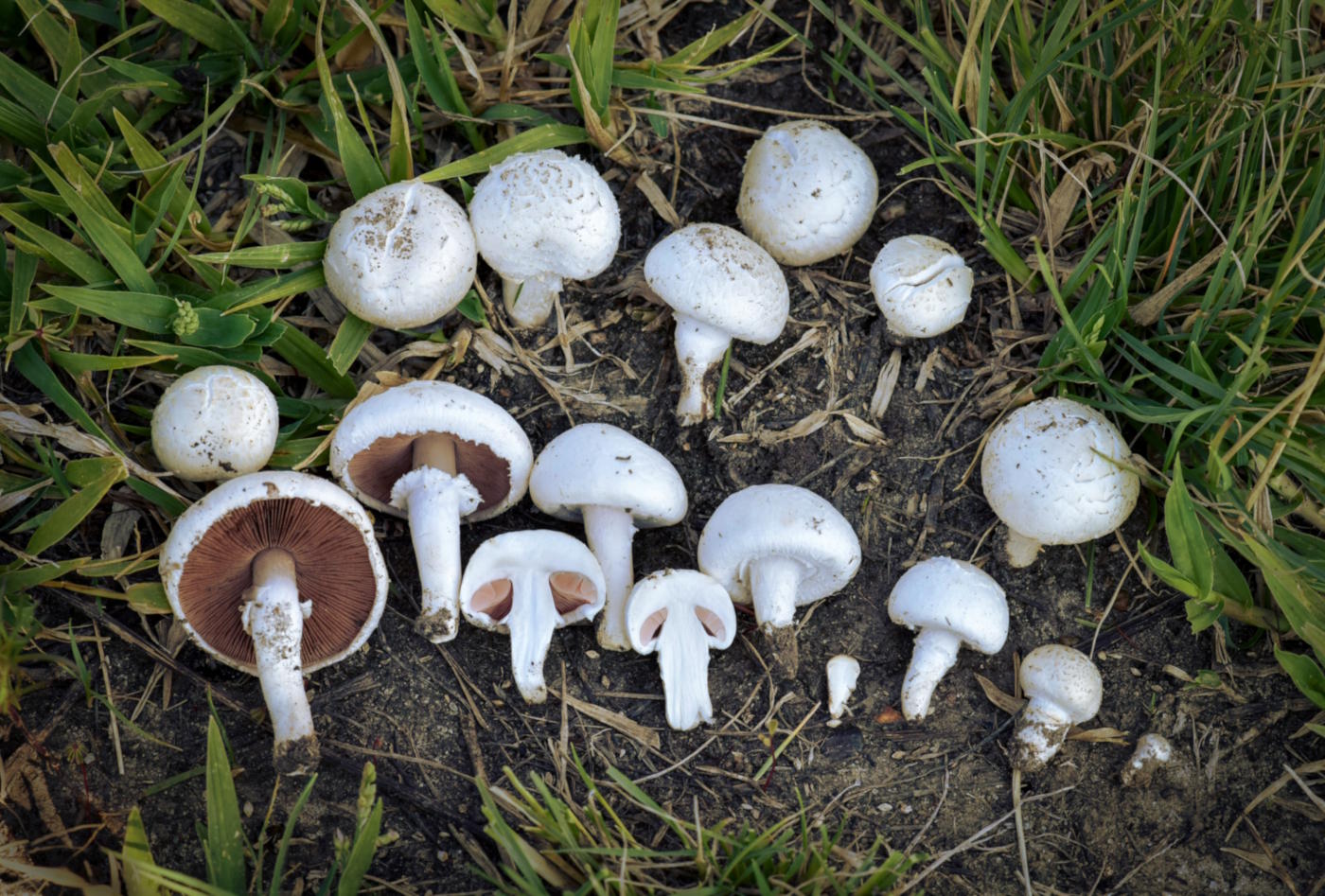
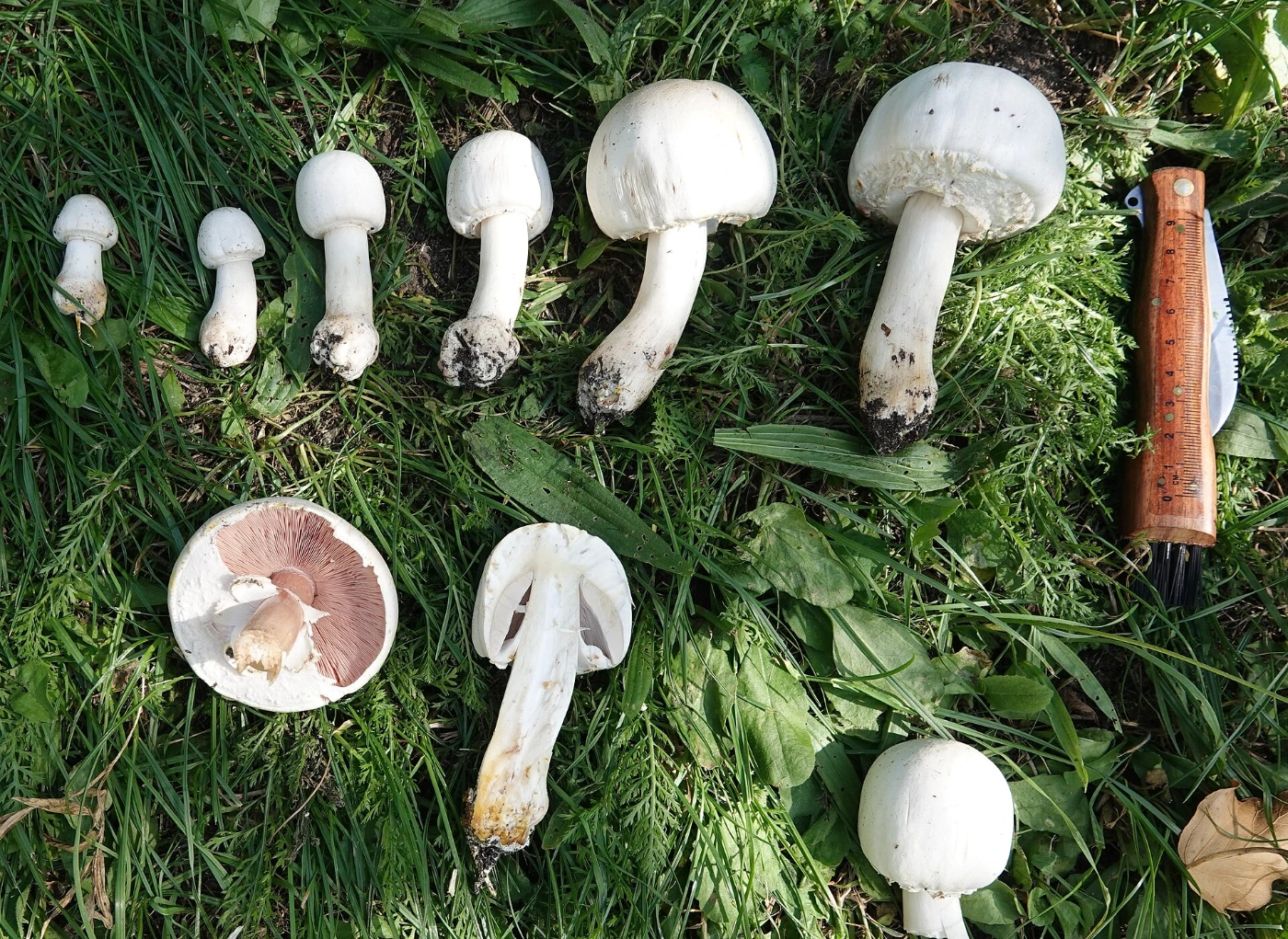
Fastest Differences
1. Cut the Stem Base
Cut vertically through the bottom of the stem rather than testing only the cap. In Agaricus xanthodermus, the flesh at the base commonly changes almost immediately from white to a striking chrome or lemon yellow.
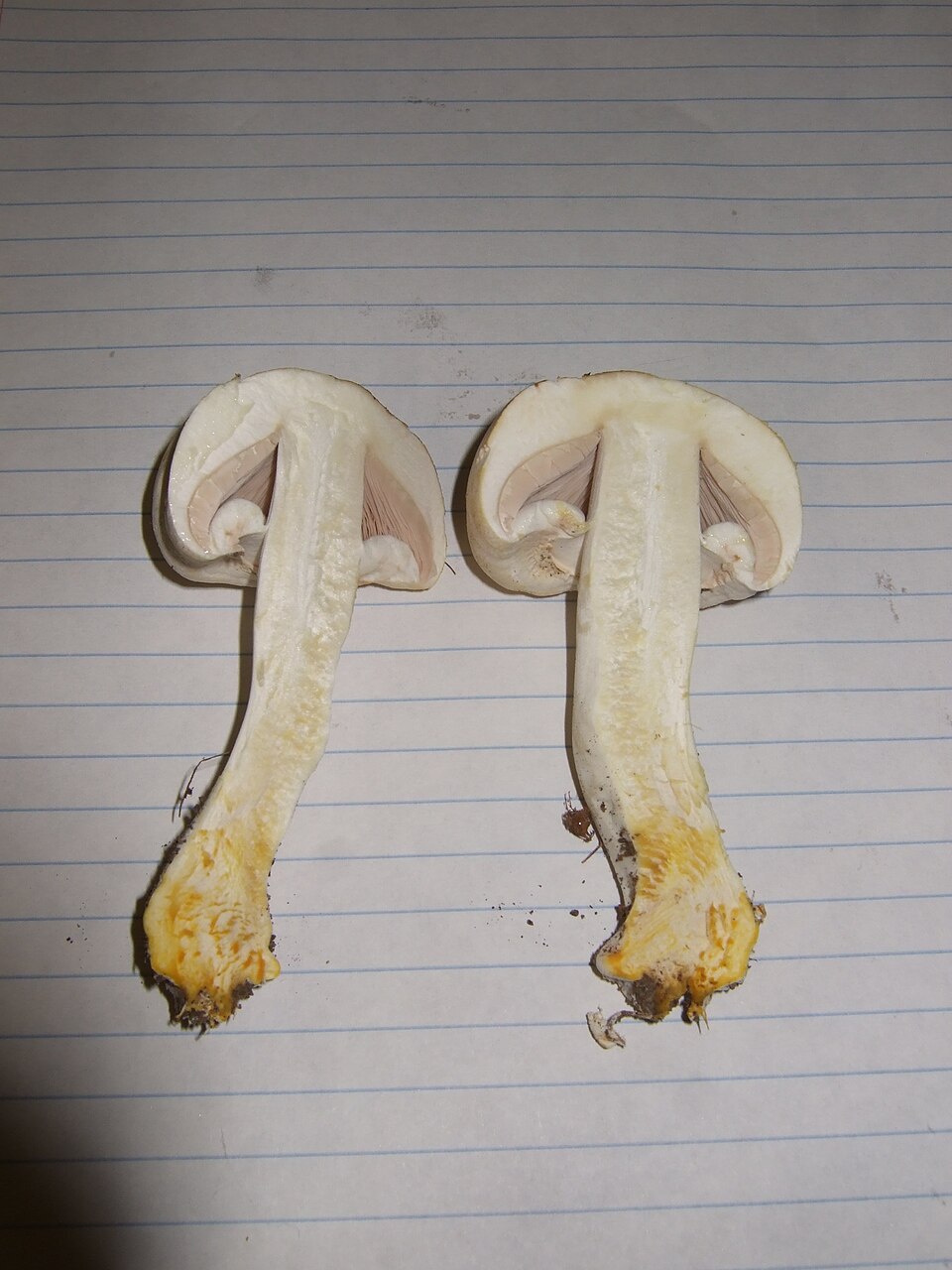
The Field Mushroom does not normally produce this intense reaction. Slight discoloration elsewhere should not be overinterpreted because several edible Agaricus species can show some yellowing, but the combination of rapid vivid yellow at the base + chemical odor is the classic Yellow Stainer pattern.
2. Smell the Cut Mushroom
A Field Mushroom usually has a mild and ordinary mushroom smell without a strong diagnostic odor. The Yellow Stainer often smells unpleasantly of phenol, ink, iodine, disinfectant, or another artificial chemical.
The odor may become much stronger when the stem base is crushed or cut. Heating can intensify the phenolic smell further, but cooking should never be used as an identification test.
3. Look at the Shape of the Stem Base
The stem of A. xanthodermus often broadens into a bulbous base. This is not as reliable as yellow staining or odor, but it is a useful supporting feature when several characters agree.
A. campestris usually has a more even, relatively parallel-sided stem. Its ring is also generally thinner and less persistent than the substantial ring commonly seen on a mature Yellow Stainer.
Cap
Agaricus campestris — Field Mushroom
The Field Mushroom typically has a white to cream cap that begins rounded and expands until it is broadly convex or almost flat. Depending on age and weather, the surface can remain smooth or develop fine scales, and some specimens become slightly brownish toward the center.
Cap color alone is not a safe identification feature. White Agaricus species frequently overlap strongly in appearance, especially while young and before their gills and staining reactions become obvious.
Agaricus xanthodermus — Yellow Stainer
The Yellow Stainer also begins with a whitish cap and can look almost identical from above. Caps are commonly around 5–15 cm wide, initially rounded or somewhat flattened on top, then becoming broadly convex with age.
Scratching the cap edge may cause rapid yellow staining, particularly in fresh young mushrooms. However, testing the stem base is usually more informative because the yellow reaction is often strongest there.
Gills
Both mushrooms have free gills, meaning the gills end before reaching the stem. Both also undergo the characteristic Agaricus progression from pale young gills toward dark chocolate-brown or almost blackish-brown gills as the spores mature.
In the Field Mushroom, young exposed gills are typically a conspicuous deep pink and later become reddish brown and chocolate brown. This pink-to-brown progression is useful for confirming Agaricus, but it does not safely distinguish an edible Field Mushroom from a toxic Yellow Stainer because A. xanthodermus follows a similar general pattern.
This is why the common shortcut “pink gills = edible field mushroom” is unsafe.
Stem and Ring
Field Mushroom
The Field Mushroom usually has a white stem around 3–10 cm tall. It is fairly smooth above the ring and may be slightly scaly below, while the base generally remains fairly even rather than forming a pronounced bulb.
The ring is thin and delicate and may disappear as the mushroom matures. In older specimens there may be little obvious ring tissue remaining.
Yellow Stainer
The Yellow Stainer commonly has a somewhat more substantial stem with a swollen or bulbous base. It also tends to retain a larger, white, pendulous ring that is more conspicuous than the fragile ring of a typical Field Mushroom.
These differences are helpful, but neither ring size nor stem shape should be trusted alone. Staining and odor remain much stronger characters.
The Yellow Staining Test
The name Yellow Stainer describes its most famous identification feature. When the cap or stem is bruised, the mushroom can rapidly develop a brilliant yellow color, with the reaction usually strongest in the flesh at the base of the stem.
The yellow can later fade or turn brown, so an old mushroom may no longer display the dramatic reaction visible in a freshly cut specimen. Photographing the cut immediately and again after several minutes can help document the change.
A Field Mushroom does not normally turn bright chrome yellow when the stem base is cut. Its flesh generally remains whitish, although minor age-related or environmental discoloration can occur.
Do not use “any yellow = Yellow Stainer” as a rule. Several other Agaricus species can bruise yellow, including edible species. The relevant pattern is very rapid, vivid basal yellowing combined with a phenolic odor.
The Smell Test
Odor provides one of the best secondary checks. Agaricus xanthodermus belongs to a group of Agaricus associated with phenolic compounds, and a cut specimen can produce a distinctly artificial smell reminiscent of ink, iodine, phenol, hospital disinfectant, or chemicals.
The intensity varies between specimens. Research on Australian A. xanthodermus found substantial variation in phenol concentration between fruiting bodies, developmental stages, tissues, and substrates, which helps explain why both odor and toxicity can vary.
A Field Mushroom generally lacks this chemical odor. If a supposedly edible Field Mushroom smells strongly of disinfectant when the stem base is crushed, reconsider the identification.
Spore Print
Both species produce dark brown spores, which is typical of Agaricus. The Field Mushroom has a deep chocolate-brown spore print, while the Yellow Stainer is described as producing a very dark brown deposit.
A spore print can therefore help distinguish either mushroom from white-spored look-alikes such as many Amanita, but it cannot reliably separate these two Agaricus species from each other.
Habitat
Where Field Mushrooms Grow
Agaricus campestris is characteristically associated with open grassland. It grows saprotrophically in pastures, meadows, playing fields, lawns, parks, and other grassy places rather than forming a mycorrhizal relationship with trees.
It can grow singly or in groups and may form arcs or fairy rings. Historically, grazed pasture is one of the classic Field Mushroom habitats.
Where Yellow Stainers Grow
Yellow Stainers also thrive in human-modified environments. They are commonly found in lawns, parks, gardens, along hedges, beneath scattered trees, and in disturbed soil.
This habitat overlap is precisely why location alone is unreliable. A white mushroom growing in a lawn is not automatically a Field Mushroom.
Season
Both species can overlap substantially during their fruiting seasons. In Britain and Ireland, Yellow Stainers are commonly recorded from approximately June through October, while Field Mushrooms also fruit during the warmer and wetter parts of the year.
Rain can trigger large flushes of both species. In parks and suburban lawns, several fruiting bodies may appear at once, making it tempting to identify the entire group quickly from appearance alone.
Is Agaricus campestris Edible?
The Field Mushroom is a traditional edible species and is closely related to cultivated Agaricus mushrooms. Correctly identified, fresh specimens have long been collected for food in Europe and elsewhere.
However, “edible species” does not mean that every mushroom resembling it is edible. White Agaricus species can be difficult to separate, and even edible mushrooms can cause gastrointestinal symptoms when spoiled, eaten raw, poorly cooked, or consumed in unusually large amounts.
For MushroomID, identification should therefore be based on the full character set rather than a photograph of the cap.
Is the Yellow Stainer Poisonous?
Yes. Agaricus xanthodermus is a well-established cause of gastrointestinal mushroom poisoning and is frequently eaten after being mistaken for edible Agaricus species. Symptoms commonly include nausea, vomiting, abdominal cramps, and diarrhea.
A retrospective study from Victoria, Australia found that A. xanthodermus and other Agaricus species accounted for most deliberate food-related mushroom ingestions in the study, with gastrointestinal illness occurring frequently. A more recent chemical study confirms that Yellow Stainers contain phenol and related compounds, with concentrations varying among mushrooms.
Some people apparently tolerate the mushroom better than others, but variable toxicity does not make it edible. It should be treated as a poisonous species.
What Happens After Eating a Yellow Stainer?
Symptoms are usually dominated by gastrointestinal irritation. Abdominal pain, cramps, nausea, vomiting, diarrhea, and occasionally sweating or dizziness may occur, often relatively soon after ingestion.
If a Yellow Stainer or another unidentified wild mushroom has been eaten and symptoms develop, stop eating it and contact a poison center or medical service. Keep leftover mushrooms, cooked food, and photographs if available, and record approximately when and how much was eaten.
Do not induce vomiting unless instructed by a medical professional.
Other Agaricus That Can Cause Confusion
The Field Mushroom and Yellow Stainer are not the only white or pale Agaricus. A confident identification must consider the possibility of several other species, especially when expected features do not fit neatly.
Agaricus arvensis — Horse Mushroom
The Horse Mushroom [Agaricus arvensis] is generally considered edible and can also develop some yellow coloration. Its staining tends to be slower and weaker than that of the Yellow Stainer, while its odor is usually described as pleasant and aniseed-like rather than phenolic.
This comparison demonstrates why yellow staining alone is insufficient. The speed, intensity, location of staining, and odor must be considered together.
Agaricus moelleri — Inky Mushroom
The Inky Mushroom [Agaricus moelleri] is another toxic member of the yellow-staining group. It commonly has darker gray or brownish scales on the cap and can produce a strong chemical odor.
It should not be treated as an edible Field Mushroom merely because the cap is darker than a classic Yellow Stainer. Toxic Agaricus species are more diverse than the name “Yellow Stainer” might suggest.
Field Mushroom vs Yellow Stainer: Practical Identification
When you find a white Agaricus in grass, begin with the stem base rather than the cap. Dig or lift the entire mushroom carefully enough to preserve the bottom of the stem because cutting it off in the ground removes one of the most important identification areas.
Cut through the base and watch for yellowing, then smell the freshly exposed flesh. Next check the gills, ring, overall stem shape, and habitat.
A practical rule is:
Field Mushroom: pink → chocolate gills + mild odor + no vivid yellow stem-base reaction.
Yellow Stainer: rapid chrome-yellow stem base + phenol/ink/iodine odor + often bulbous stem + gastrointestinal toxicity.
If those features do not fit cleanly, do not force the specimen into either species.
Common Identification Mistakes
One common mistake is identifying the mushroom from its pink gills. Pink young gills are characteristic of several Agaricus species, including toxic ones, so they confirm the genus much better than they confirm edibility.
Another mistake is testing only the top of the cap. The strongest yellow staining in A. xanthodermus often occurs at the base of the stem, so a mushroom picked with its base missing has already lost valuable identification information.
A third mistake is deciding that a weak-smelling mushroom cannot be a Yellow Stainer. Phenol concentration and odor intensity vary, meaning the identification should use several characters rather than requiring one dramatic smell.
Finally, do not assume a familiar lawn produces the same species every year. Several Agaricus species can occupy similar habitats, and multiple species can occur in the same park or garden.
How to Photograph Them for Identification
Photograph the intact mushroom from above and from the side before cutting it. Include close photographs of the gills, ring, and especially the complete stem base.
Then cut the mushroom lengthwise through the stem base and photograph the flesh immediately. Take a second image after a minute or two to document any staining, and note the odor in words because a photograph cannot capture this crucial character.
A useful photo set therefore contains the cap, gills, ring, whole stem, intact base, cut base, and habitat.
Can AI Tell a Field Mushroom from a Yellow Stainer?
A photo can sometimes strongly suggest one species, particularly when a Yellow Stainer shows obvious bright yellow bruising. However, two of the best distinguishing characters — odor and the speed of the staining reaction — cannot be reliably reconstructed from a single finished image.
AI identification becomes much more useful when the user provides several photographs taken before and after cutting the stem base. Even then, the result should be treated as a candidate identification rather than proof that a wild mushroom is safe to eat.
FAQ
What is the easiest way to tell a Field Mushroom from a Yellow Stainer?
Cut the bottom of the stem and watch the exposed flesh. Rapid vivid chrome-yellow staining at the base, especially together with a phenol, iodine, or ink-like smell, strongly favors the Yellow Stainer.
Do Field Mushrooms turn yellow when cut?
Typical Agaricus campestris does not show the intense rapid yellow reaction characteristic of A. xanthodermus. Minor discoloration can occur, so the important distinction is the conspicuous rapid yellowing at the stem base combined with a chemical odor.
Do Yellow Stainers have pink gills?
Young Yellow Stainers can have pale to pinkish gills that darken toward brown as the mushroom matures. Pink gills therefore do not prove that a mushroom is an edible Field Mushroom.
What does a Yellow Stainer smell like?
The odor is commonly described as phenolic, inky, iodine-like, medicinal, or similar to disinfectant. It can become stronger after the mushroom is cut, bruised, or heated.
Is Agaricus xanthodermus deadly?
It is mainly associated with acute gastrointestinal poisoning rather than the delayed organ-failure syndromes caused by mushrooms such as Death Caps. Nevertheless, vomiting and diarrhea can be significant, and suspected poisoning should be discussed with a poison center or medical professional.
Can Yellow Stainers grow in the same places as Field Mushrooms?
Yes. Both can occur in lawns, parks, and other grassy or disturbed areas, making habitat alone insufficient for identification.
Does cooking remove the toxicity of Yellow Stainers?
Do not rely on cooking to make Agaricus xanthodermus safe. Heating can actually make its unpleasant phenolic odor more obvious, and the species is treated as poisonous rather than as an edible mushroom requiring a particular cooking method.
Final Identification Notes
The Field Mushroom and Yellow Stainer demonstrate why Agaricus identification cannot be reduced to white cap + pink gills. Both species can share those characteristics, while their habitat and season also overlap substantially.
The most useful distinction is the combination of stem-base staining and odor. Agaricus campestris normally lacks intense yellow staining and a chemical smell, whereas Agaricus xanthodermus typically turns vivid yellow rapidly at the stem base and produces a phenolic, ink-like, or iodine-like odor.
For practical identification, preserve the entire stem, cut through its base, observe the reaction, smell the exposed flesh, and then confirm the gills, ring, and habitat. If the result remains uncertain, do not use a photograph or a single field character to make an edibility decision.
Sources
- Species Fungorum — Agaricus campestris
- Species Fungorum — Agaricus xanthodermus
- First Nature — Agaricus campestris, Field Mushroom
- First Nature — Agaricus xanthodermus, Yellow Stainer
- PubMed — Phenol variation in Agaricus xanthodermus
- PMC — Mushroom Poisoning
Upload a photo and get possible matches in seconds.