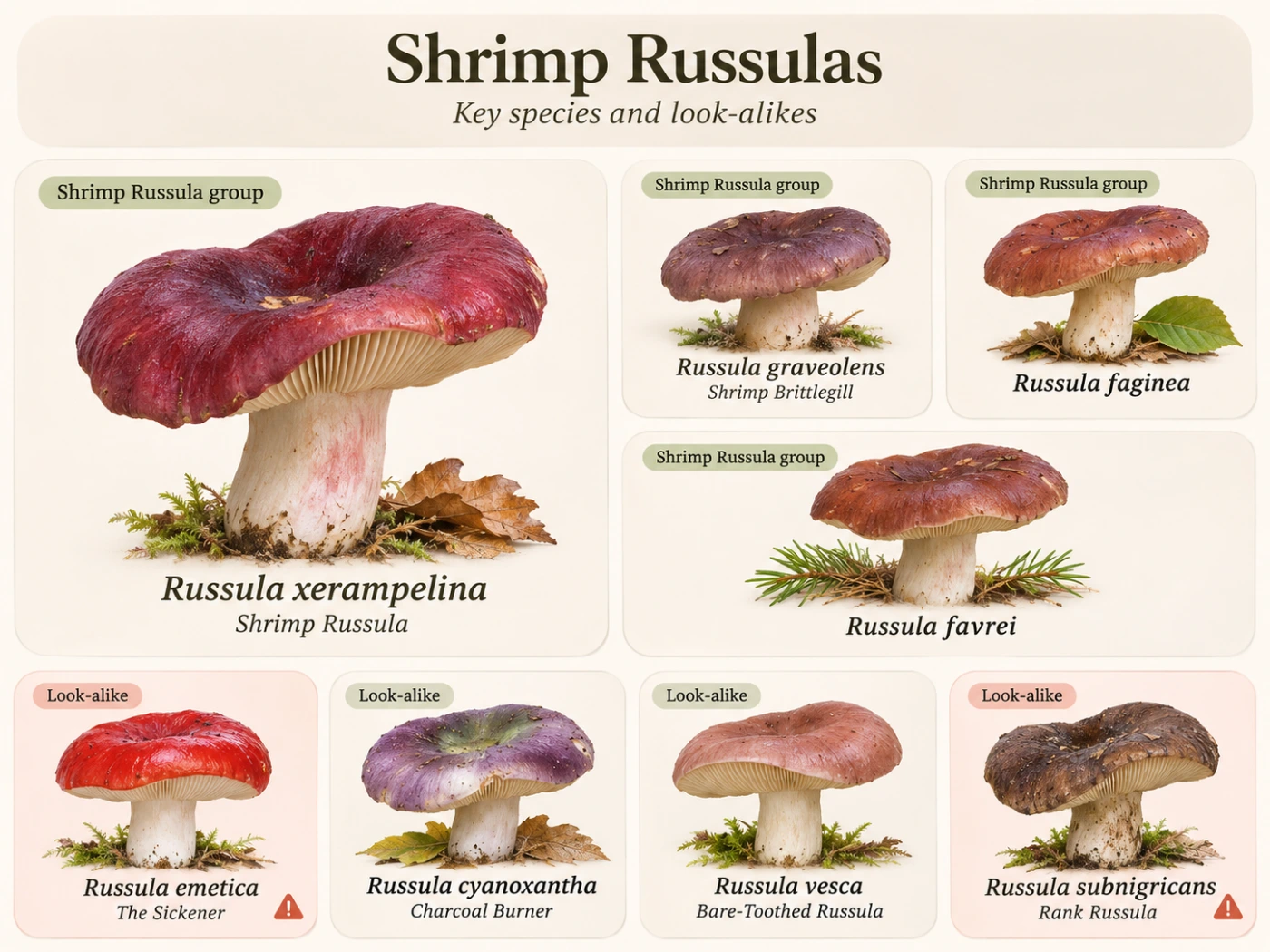
Shrimp Russulas are a group of Russula mushrooms recognized by an unusual combination of features: a fishy, crab-like, or cooked-shrimp odor, flesh that slowly stains brown when handled, a mild taste, and cream to yellowish spores. The best-known member is Russula xerampelina, commonly called the Shrimp Russula or Crab Brittlegill, but the name “shrimp russula” is also used more broadly for related species in Russula subsection Xerampelinae.
This distinction matters because identifying every shrimp-scented russula as R. xerampelina is an oversimplification. Modern phylogenetic work recognizes a group of closely related species with different geographic ranges and host-tree associations, while cap colors can range from red and purple through brown, olive, orange, and other shades.
The best field identification therefore comes from a combination of odor, browning flesh, mild taste, spore color, brittle Russula structure, and habitat, rather than from cap color alone.
⚠️ Important: Russulas can be difficult to identify to species, and some members of the genus cause gastrointestinal poisoning while other Russula species have been associated with severe toxicity. Do not use cap color, a photograph, or the “shrimp smell” alone to decide whether a wild mushroom is safe to eat.
Quick Identification
A typical Shrimp Russula is a medium to large, sturdy brittlegill with flesh that snaps rather than bends. Mature specimens develop a distinctive seafood-like odor, while damaged areas of the stem, gills, and flesh gradually become yellow-brown to brown.
| Feature | Shrimp Russulas |
|---|---|
| Main group | Russula subsection Xerampelinae |
| Best-known species | Russula xerampelina |
| Common names | Shrimp Russula, Crab Brittlegill |
| Cap | Extremely variable in color |
| Gills | Cream, becoming yellowish with age |
| Stem | White, often pinkish or reddish |
| Bruising | Slowly yellow-brown to brown |
| Flesh | Brittle, chalk-like |
| Odor | Fishy, shrimp-like, crab-like or shellfish-like |
| Taste | Mild rather than acrid |
| Spore print | Cream to buff-yellow |
| FeSO₄ reaction | Green to gray-green / olive |
| Ecology | Ectomycorrhizal |
| Hosts | Conifers and/or hardwoods depending on species |
The most useful combination is shellfish odor + browning flesh + mild taste + cream/yellowish spores. A green reaction to ferrous sulfate provides an additional characteristic clue for the group.
What Are Shrimp Russulas?
Shrimp Russulas belong to the genus Russula, a large group of ectomycorrhizal mushrooms commonly known as brittlegills. Their distinctive brittle texture results from rounded cells in the flesh that cause the mushroom to snap somewhat like chalk rather than bend into tough fibers.
The shrimp russulas form a more specific evolutionary group, subsection Xerampelinae. Recent phylogenetic research recognizes approximately 17 species in this subsection across the Northern Hemisphere.
Historically, many mushrooms with the characteristic seafood odor were simply called Russula xerampelina. This name is still useful for the European species itself, but it should not automatically be applied to every shrimp-smelling russula in North America or other regions.
Why Do Shrimp Russulas Smell Like Shrimp?
The odor can range from faintly fishy in young mushrooms to distinctly reminiscent of cooked shrimp, crab, or shellfish in mature specimens. It often becomes stronger as the fruiting body ages, and dried specimens may retain or intensify the smell.
Chemical analysis of Russula xerampelina has identified trimethylamine and trimethylamine N-oxide among the compounds associated with this odor. Trimethylamine is well known for producing fishy and cooked-shellfish aromas.
Young mushrooms may smell surprisingly weak. If the other characters fit, the absence of a strong shrimp smell in a fresh button does not necessarily rule out the group.
How to Identify Shrimp Russulas
Cap
Cap color is one of the least reliable characters for identifying a Shrimp Russula. Traditional descriptions of R. xerampelina emphasize wine-red, maroon, reddish-purple, or deep purple caps, but members of the broader group can also be brown, olive, greenish, yellowish, orange, or combinations of several colors.
The cap begins convex and normally becomes broadly convex, flat, or somewhat depressed with age. Mature specimens can be substantial, and R. xerampelina itself commonly reaches roughly 5–15 cm across, occasionally larger.
The surface may be slightly sticky when wet and becomes drier as conditions change. Because the group shows such extensive color variation, a reddish-purple cap should be treated as supporting evidence rather than a diagnostic feature.
Gills
The gills begin whitish to cream and gradually acquire stronger cream, yellowish, or ochre tones as the spores mature. They may also develop brownish spots where bruised or damaged.
This gradual yellowing helps distinguish Shrimp Russulas from some white-spored red russulas. The Sickener [Russula emetica], for example, typically has white gills and a white spore print rather than the cream-to-yellowish spore deposit expected in the Shrimp Russula group.
Stem
The stem is usually stout, dry, and white to cream. Many specimens show a pink, rose, or purplish-red flush, particularly in classic reddish or purple forms of R. xerampelina.
One of the more important features appears after handling. Scratched, bruised, or aging areas gradually become yellowish brown, ochre-brown, or brown rather than remaining clean white.
This reaction can take time. Examine both freshly collected specimens and mushrooms that have been handled for several minutes before deciding that browning is absent.
Flesh
The flesh is firm and brittle, characteristic of Russula. Breaking the stem should produce a relatively clean snap rather than the stringy fibers found in many other gilled mushrooms.
Fresh flesh is white but gradually develops yellow-brown to brown discoloration when cut or bruised. The gills and stem can show the same general reaction.
Unlike milkcaps in the related genera Lactarius and Lactifluus, a broken Shrimp Russula does not release milky latex.
Odor
The odor is among the group’s best field characters. Mature fruiting bodies typically smell of fish, shellfish, cooked crab, or shrimp, although different people may describe the aroma differently.
Do not expect every young mushroom to produce a dramatic smell immediately. The odor generally becomes stronger with maturity and can sometimes become more apparent after the mushroom has been handled or kept for a while.
Taste
Members of the Shrimp Russula group are characteristically mild rather than sharply acrid or peppery. This contrasts with several red russulas associated with gastrointestinal illness.
Taste testing wild mushrooms is not necessary for casual identification, and MushroomID does not recommend using taste as a shortcut for determining edibility. Odor, bruising, spore color, habitat, morphology, and microscopic characters provide safer supporting evidence.
Spore Print
The spore deposit is generally cream, yellowish cream, or buff-yellow. This is useful because many superficially similar Russula species have much whiter spores.
Spore color still does not identify a species by itself. Within Russula, microscopic examination of spore ornamentation and structures in the cap surface is often needed for reliable species-level identification.
The Green Iron-Salt Reaction
One of the more interesting identification characters of subsection Xerampelinae is its reaction to ferrous sulfate (FeSO₄). Applied to fresh flesh or the stem surface, iron salts typically produce a green, gray-green, olive-green, or dark greenish reaction.
This differs from the pinkish or salmon reactions seen in many other Russula. For serious field identification, the FeSO₄ test can therefore provide valuable confirmation that a specimen belongs to the Shrimp Russula group.
It does not usually tell you the exact species. Separating individual members of Xerampelinae can still require host information, geography, spores, pileipellis characters, and occasionally DNA sequencing.
Habitat and Ecology
Shrimp Russulas are ectomycorrhizal fungi, meaning their underground mycelium forms a symbiotic relationship with living tree roots. Different species within the group have different preferred host trees.
European Russula xerampelina is principally associated with conifers, particularly pine and sometimes spruce. Other European Shrimp Russulas occur with oak, beech, birch, willow, or other hosts.
Modern phylogenetic work shows that host associations help divide Xerampelinae into several ecological groups. Some lineages specialize in conifers such as pine, spruce, and Douglas-fir, while others occur with birch, willow, oak, beech, and other hardwoods.
For this reason, photographing the nearby trees is particularly useful when identifying a Shrimp Russula.
Season
Shrimp Russulas generally fruit from summer through autumn in temperate and boreal forests. Local timing depends on latitude, elevation, rainfall, temperature, and host trees.
North American records also include winter fruiting in warmer climates. Season should therefore be considered a supporting ecological clue rather than a strict identification rule.
Distribution
The Shrimp Russula group occurs broadly across the Northern Hemisphere. Modern research indicates that some species have relatively wide boreal or arctic distributions, while others appear restricted to particular continents or smaller geographic regions.
This has important consequences for identification. A North American mushroom resembling the European Russula xerampelina should not automatically receive the European species name merely because its cap and odor look similar.
Older field guides often applied European names widely in North America. DNA studies are increasingly showing that geographic separation and host relationships can correspond to genuinely different species.
Russula xerampelina — Shrimp Russula / Crab Brittlegill
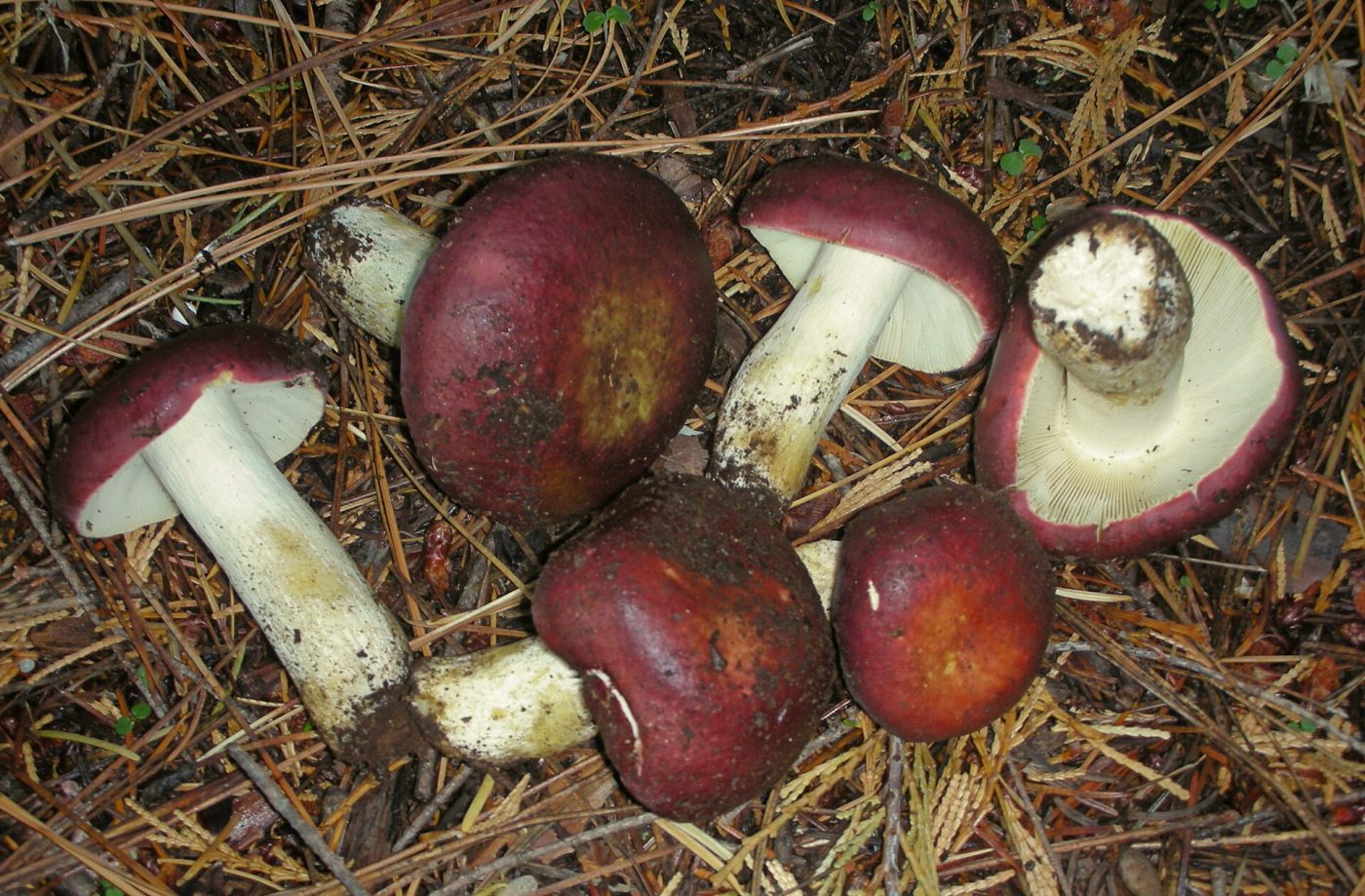
[Russula xerampelina], commonly called the Shrimp Russula or Crab Brittlegill, is the species from which the group takes its familiar name. In its classic European form it usually has a wine-red to reddish-purple cap and a white stem that commonly develops pink or reddish coloration.
The stem and flesh slowly brown after handling, and mature mushrooms develop the characteristic shellfish-like odor. The gills mature from cream toward yellowish tones, while the taste is mild.
European R. xerampelina is primarily associated with conifers, particularly pine. Although the name has historically been used much more broadly, modern identification should take geography into account.
Other Shrimp Russulas
The broader Xerampelinae contains multiple species that share the same basic odor-and-browning pattern. Some can look strikingly different from classic reddish-purple R. xerampelina because cap color varies enormously.
Russula graveolens — Shrimp Brittlegill
[Russula graveolens] is a European member of the Shrimp Russula group associated primarily with deciduous trees, including oak and other hardwoods. Caps are typically brownish, purple-brown, vinaceous-brown, or combinations of these colors.
Like other members of the group, it develops the characteristic brown discoloration and fishy or shellfish-like odor. Host tree becomes especially valuable because color alone overlaps heavily with related species.
Russula faginea — Beechwood Sickener / Beech Brittlegill
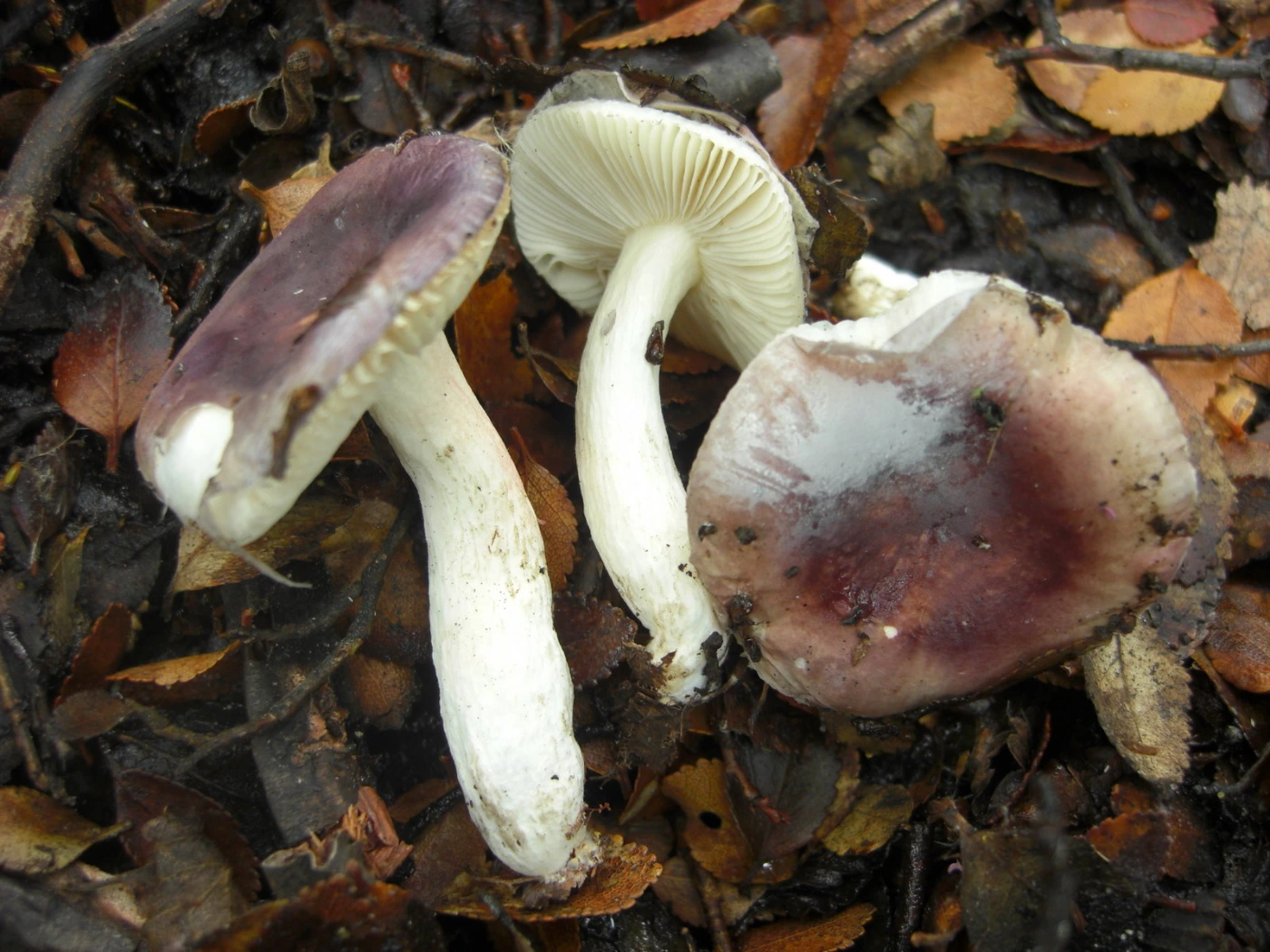
[Russula faginea] is associated particularly with beech and belongs within the same broader Shrimp Russula lineage. Its cap can be brown, reddish-brown, or purple-brown, making it another example of why the group cannot be defined as simply “purple russulas.”
Species-level determination can require microscopic characters. The host association nevertheless provides a useful field clue when specimens occur consistently beneath mature beech.
Russula favrei
[Russula favrei] is another European member of subsection Xerampelinae, generally associated with conifers in montane or high-elevation habitats. A widely established English common name is not consistently used, so the scientific name is preferable.
Its cap is commonly described as brown to reddish-brown. As with other Shrimp Russulas, browning reactions, odor, spore characteristics, and ecology are more useful than the exact shade of the cap.
Why Cap Color Is a Poor Identification Feature
Few mushroom groups demonstrate the limitations of color-based identification as clearly as Shrimp Russulas. Mushrooms belonging to Xerampelinae can appear red, maroon, purple, brown, olive, green, orange, yellowish, or mixtures of these colors.
Recent phylogenetic research also found that morphological variation in cap color historically contributed to an overestimation of species diversity within the group. In other words, dramatically different colors do not necessarily indicate different species.
At the same time, two specimens with very similar caps can belong to different species. Reliable identification therefore needs multiple characters.
A useful hierarchy is:
- Confirm that it is a Russula.
- Check for the seafood-like odor and gradual brown staining.
- Look at spore-print color and, when appropriate, the FeSO₄ reaction.
- Identify the host trees and geographic region.
- Use microscopy or DNA when exact species identification matters.
Look-Alikes
Russula emetica — The Sickener
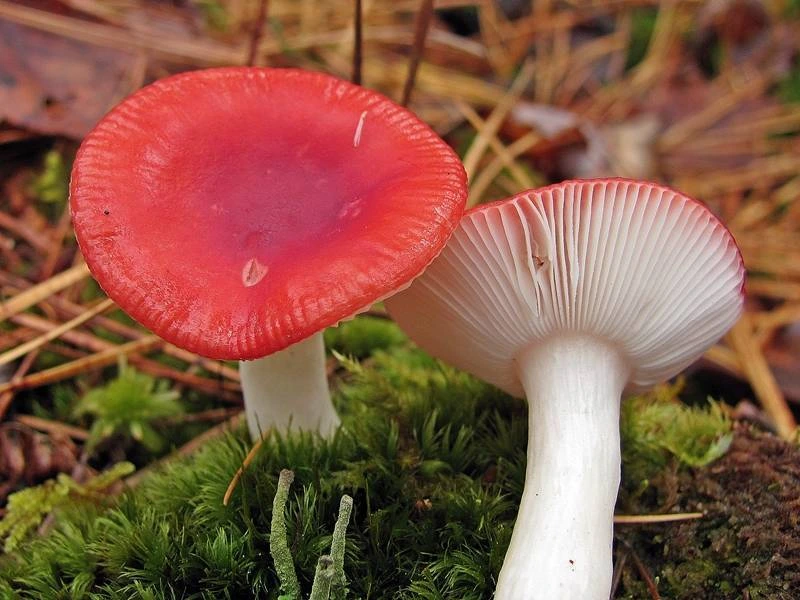
The Sickener [Russula emetica] is one of the most important comparisons because its bright red cap can overlap visually with reddish members of the Shrimp Russula group. It is associated with gastrointestinal poisoning and should not be confused with edible Shrimp Russulas.
Identification
The Sickener typically has a bright red cap, white stem, white gills, and white spore print. Its flesh does not develop the characteristic gradual yellow-brown staining of Xerampelinae, and it lacks the typical shrimp or crab odor.
It is also known for a strongly acrid, burning character rather than the mild flesh characteristic of Shrimp Russulas.
Main Difference
Shrimp Russula group = shellfish smell + browning flesh + cream/yellow spores.
The Sickener = no shrimp smell + little characteristic browning + white spores + strongly acrid character.
Cap redness alone cannot distinguish them.
Russula cyanoxantha — Charcoal Burner
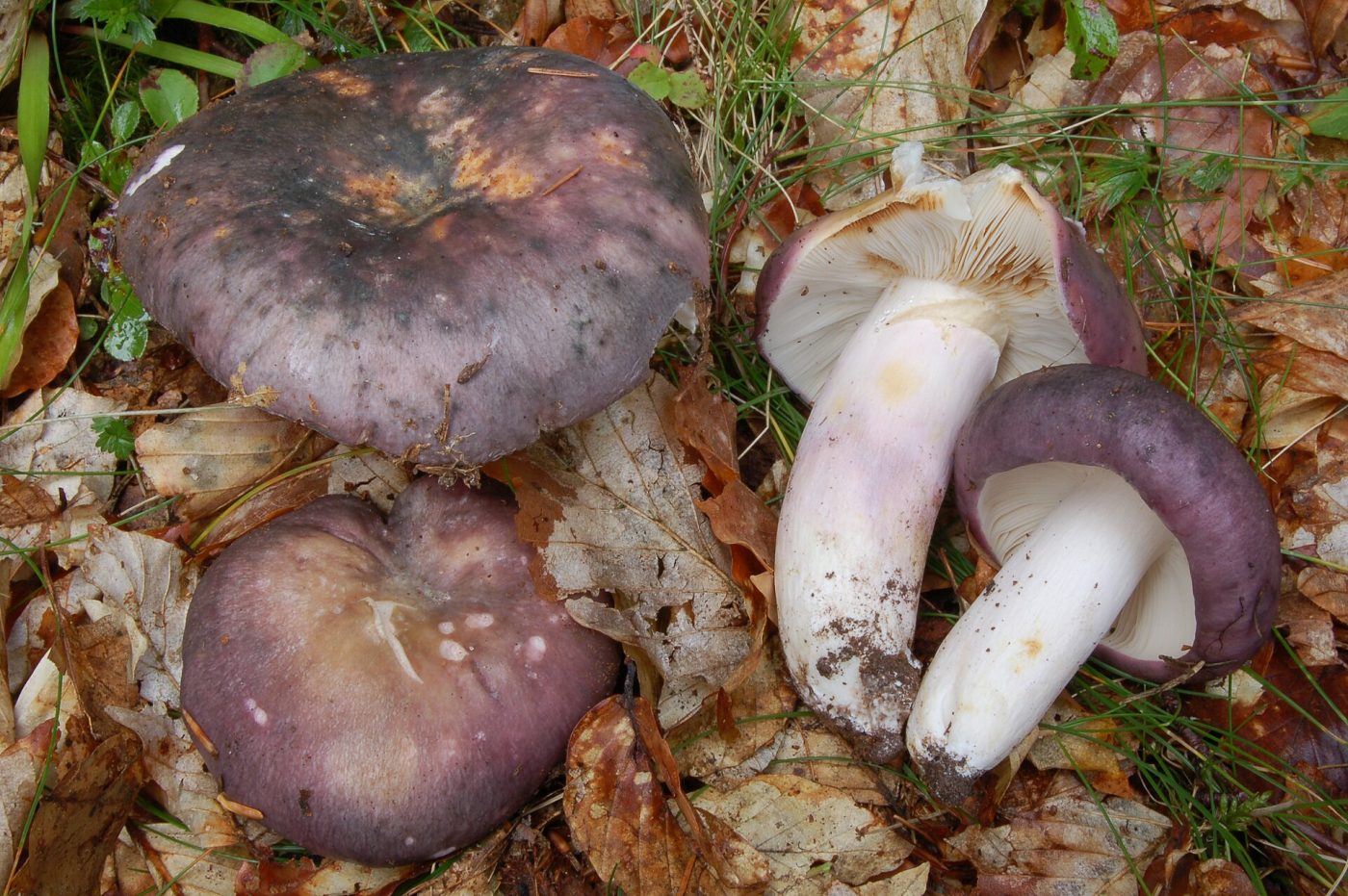
The Charcoal Burner [Russula cyanoxantha] can produce purple, violet, green, gray, or mixed-colored caps that overlap with some Shrimp Russulas. It is another ectomycorrhizal woodland species and can appear deceptively similar in photographs.
Identification
Its most distinctive macroscopic feature is the unusually flexible, almost greasy-feeling gills. Most Russula gills are brittle, while those of the Charcoal Burner can often be rubbed without immediately breaking.
It also lacks the characteristic shellfish odor and brown staining combination of the Shrimp Russula group.
Main Difference
Shrimp Russulas brown and smell fishy or shellfish-like. Charcoal Burners have unusually flexible gills and lack that characteristic odor-and-browning combination.
Russula vesca — Bare-Toothed Russula
The Bare-Toothed Russula [Russula vesca] may have muted pinkish, reddish-brown, or flesh-colored caps and is another mild-tasting edible russula that can superficially resemble some Shrimp Russulas.
Identification
A characteristic feature is that the cap skin often fails to reach the edge completely, leaving the tips of the gills exposed around the margin. It does not develop the distinctive seafood odor expected from Xerampelinae.
Main Difference
Look for the exposed gill tips around the cap edge in R. vesca. Shrimp Russulas are better recognized by their seafood odor and gradual brown discoloration.
Russula subnigricans — Rank Russula
The Rank Russula [Russula subnigricans] belongs to a very different group but deserves mention because it demonstrates why “browning or darkening Russula” should never be treated as an automatic edibility rule.
This Asian species has been associated with severe and potentially fatal rhabdomyolysis. Its flesh undergoes characteristic discoloration, but the pattern, ecology, morphology, and overall identification differ from the Shrimp Russula group.
Main Difference
Do not reduce Russula identification to a single staining reaction. The Shrimp Russula combination requires shellfish odor, gradual brown staining, appropriate spore coloration, and the broader Xerampelinae morphology and ecology.
Shrimp Russula vs The Sickener
This is one of the most useful comparisons for beginners because both can have conspicuously red caps.
| Feature | Shrimp Russula Group | Russula emetica — The Sickener |
|---|---|---|
| Cap color | Highly variable | Often bright red |
| Odor | Fishy / shrimp / shellfish | Weak or ordinary |
| Bruising | Slowly brown | Usually little characteristic browning |
| Gills | Cream → yellowish | White |
| Spore print | Cream to buff-yellow | White |
| Taste | Mild | Strongly acrid |
| FeSO₄ | Greenish | Different reaction |
| Edibility | Some recognized edible species | Poisonous / GI irritant |
The strongest clue is not the red cap. A combination of shellfish odor, brown staining, and cream-yellow spores points toward the Shrimp Russula group.
Are Shrimp Russulas Edible?
Russula xerampelina and several close members of the group have long been regarded as edible mushrooms, and some regional guides consider them among the better culinary Russula. Their firm texture and distinctive aroma have contributed to their popularity with experienced foragers.
The difficulty is identification rather than the culinary reputation of correctly identified species. Russula is a large and taxonomically difficult genus, and cap color alone is almost useless for confirming membership in Xerampelinae.
For MushroomID, the practical approach is therefore conservative. A mushroom should not be considered edible simply because an image-recognition system labels it “Shrimp Russula.”
⚠️ Important: Do not use a photo match, seafood odor, or red-purple cap alone as proof of edibility. Confirm the complete character combination and local species before considering consumption.
Common Identification Mistakes
The biggest mistake is treating purple-red cap = Russula xerampelina. Cap colors within the group are highly variable, and many unrelated Russula species can produce similar shades.
Another mistake is expecting a strong shrimp odor from every young specimen. The smell can be faint at first and often intensifies as mushrooms age.
It is equally risky to identify the species solely from the smell. Several members of subsection Xerampelinae share this odor, so it is much better for confirming the group than confirming the exact species.
Finally, do not ignore the trees. Because these fungi are ectomycorrhizal and different species show different host preferences, tree identification can materially improve a species-level determination.
How to Photograph Shrimp Russulas for Identification
Start with the intact mushroom from above and from the side, making sure the cap color and entire stem are visible. Then photograph the gills and any pink or reddish coloration on the stem.
After handling the mushroom, photograph the same stem or damaged flesh again after several minutes. This makes the gradual yellow-brown or brown staining much easier to document.
Also photograph nearby trees, leaves, bark, and the surrounding forest. If species-level identification matters, a spore print and microscopic photographs are much more valuable than additional cap photographs.
Can AI Identify Shrimp Russulas?
AI image recognition can often recognize a mushroom as a Russula from its general shape, brittle-looking stem, gills, and cap. It may also suggest the R. xerampelina group when a robust reddish-purple mushroom has a pinkish stem and characteristic habitat.
However, two of the group’s most important clues — odor and slow browning — cannot normally be determined from a single photograph. Host-tree information and spore color may also be missing.
The safest AI result is therefore often “Shrimp Russula group / subsection Xerampelinae” rather than a confident species-level identification. Exact identification may require microscopy, chemical tests, geographic information, or DNA.
FAQ
Is Shrimp Russula the same as Russula xerampelina?
Russula xerampelina is the classic species known as Shrimp Russula or Crab Brittlegill, but “shrimp russulas” can also refer more broadly to related species in subsection Xerampelinae. Modern phylogenetic work confirms that this is a diverse group rather than a single globally distributed mushroom.
What do Shrimp Russulas smell like?
The odor is usually described as fishy, shrimp-like, crab-like, or reminiscent of cooked shellfish. It is generally stronger in older mushrooms and may be weak in fresh young specimens.
Why do Shrimp Russulas turn brown when touched?
Their stem, flesh, and gills develop a gradual yellow-brown to brown discoloration following bruising or aging. Together with the seafood odor, this is one of the most useful characteristics of subsection Xerampelinae.
Are all Shrimp Russulas purple?
No. Cap color can range through red, purple, brown, olive, greenish, orange, and other shades. Modern research specifically indicates that cap color is unreliable for separating species in this group.
What color is a Shrimp Russula spore print?
Members of the group generally produce cream, yellowish, or buff-yellow spore deposits rather than a pure white print. This helps distinguish them from some red russulas such as Russula emetica.
Do Shrimp Russulas grow under pine trees?
Classic European Russula xerampelina is strongly associated with conifers, particularly pine, but other members of the group grow with hardwoods including oak, beech, birch, and willow. Identifying the host tree can therefore help narrow down the species.
Are Shrimp Russulas edible?
Several members of the group, including correctly identified Russula xerampelina, are traditionally considered edible. The main problem is reliable identification, so a photograph or seafood-like odor alone should not be used to make an edibility decision.
Final Notes
Shrimp Russulas are best understood as a recognizable ecological and morphological group rather than one universally identifiable mushroom. Their most useful field signature is a seafood-like odor combined with gradually browning flesh, mild character, cream-to-yellowish spores, and brittle Russula structure.
The cap may be red or purple, but it can just as easily move toward brown, olive, green, orange, or other shades. For this group, color should therefore be one of the last characters you trust rather than the first.
For broad identification, Shrimp Russula group / Russula subsection Xerampelinae is often a more defensible result than forcing every specimen into Russula xerampelina. Host tree, geography, microscopy, chemical reactions, and sometimes DNA are needed when the exact species matters.
Sources
- Index Fungorum — current accepted name and nomenclatural record for Russula xerampelina. Index Fungorum — Russula xerampelina
- New Phytologist — modern phylogenetic study of biogeography and host associations in Russula subsection Xerampelinae. Biogeography and host associations of Russula subsection Xerampelinae
- UBC Beaty Biodiversity Museum — practical identification, odor, staining, spore color, and discussion of the R. xerampelina complex. Russula xerampelina — Mushrooms Up!
- MushroomExpert — field characters and discussion of North American Shrimp Russulas. North American Shrimp Russulas
- U.S. Forest Service — comparison of Shrimp Russula with other Russula, including The Sickener. Mushrooms of the National Forests in Alaska
Upload a photo and get possible matches in seconds.