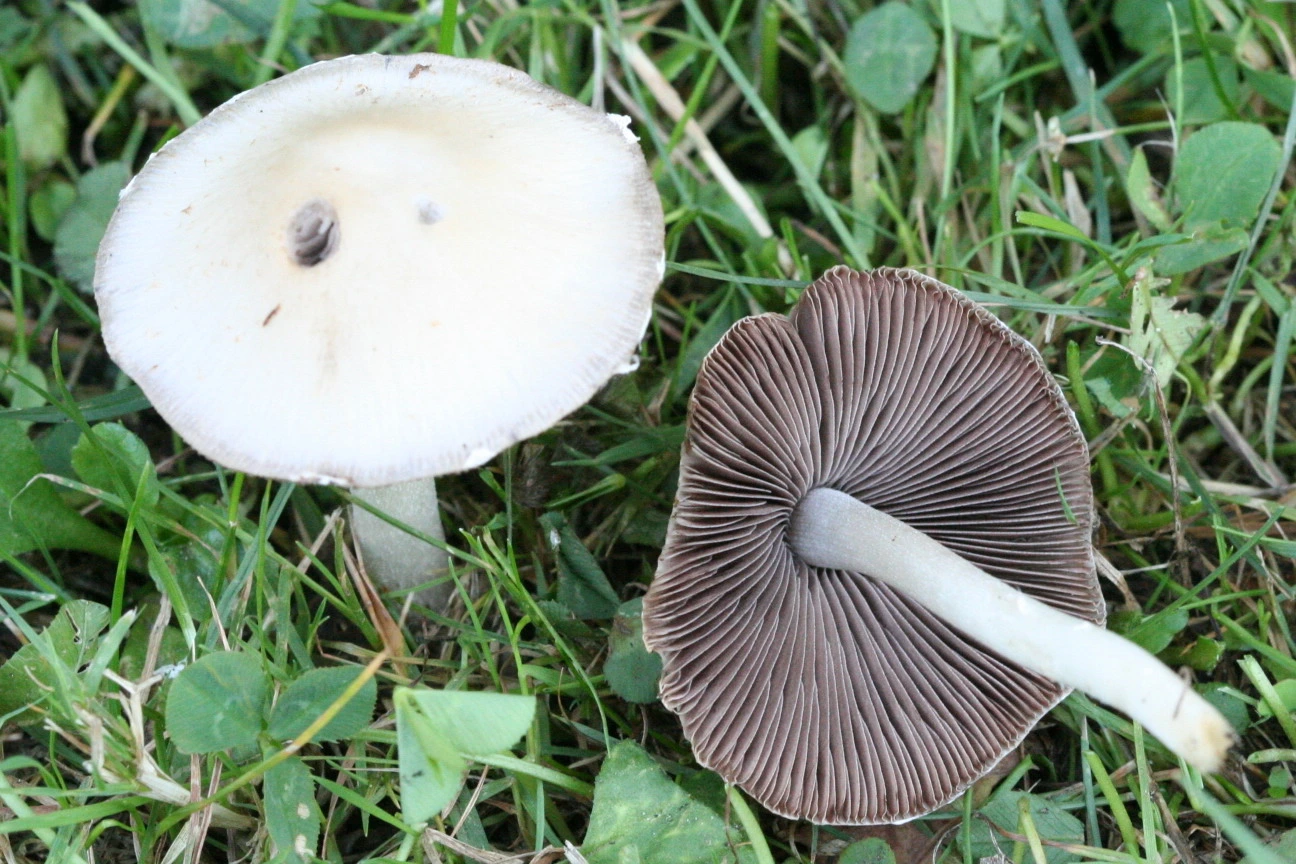
Psathyrella candolleana, commonly known as the Pale Brittlestem, is a delicate pale-brown mushroom that often appears in lawns, parks, woodland edges, gardens, and around buried wood. Its thin cap fades dramatically as it dries, the stem is white and extremely fragile, and young specimens often show ragged white veil fragments around the cap margin.
The currently accepted scientific name is Candolleomyces candolleanus. Psathyrella candolleana remains widely used in field guides, websites, older literature, and mushroom identification searches, so both names are important to recognize.
The strongest field pattern is fragile pale-brown cap + white veil fragments around the young cap edge + crowded gills that darken with age + brittle white stem + growth around decaying or buried wood. Older mushrooms can look very different from young ones because the cap often fades almost to cream or whitish.
⚠️ Important: Pale Brittlestem is difficult to identify confidently from cap color alone. Several small brown or gray-brown mushrooms grow in the same habitats, and some require microscopic examination for reliable separation.
Quick Identification
| Feature | Pale Brittlestem |
|---|---|
| Scientific name | Candolleomyces candolleanus |
| Widely used synonym | Psathyrella candolleana |
| Common name | Pale Brittlestem |
| Cap | Pale brown to honey-brown, fading cream or whitish |
| Cap size | Usually about 3–6 cm, sometimes larger |
| Surface | Smooth, thin-fleshed, hygrophanous |
| Cap margin | Often with white veil fragments when young |
| Gills | Crowded, pale at first, becoming gray-brown to dark brown |
| Stem | White, slender, very brittle |
| Ring | Usually absent; veil rarely leaves a persistent ring |
| Spore print | Dark brown to purplish-brown |
| Ecology | Saprobic |
| Substrate | Decaying wood, buried wood, roots, wood-rich soil |
| Habitat | Lawns, parks, gardens, woodland, clearings |
| Season | Mainly summer to autumn |
| Edibility | Reported inconsistently; not recommended |
Current Name: Candolleomyces candolleanus
Modern taxonomy places Pale Brittlestem in the genus Candolleomyces rather than Psathyrella. Species Fungorum lists Psathyrella candolleana as a synonym of the accepted name Candolleomyces candolleanus, a combination published in 2020.
The older name remains extremely common in identification literature. For practical purposes, Psathyrella candolleana and Candolleomyces candolleanus refer to the same species concept in current databases.
What Does Pale Brittlestem Look Like?
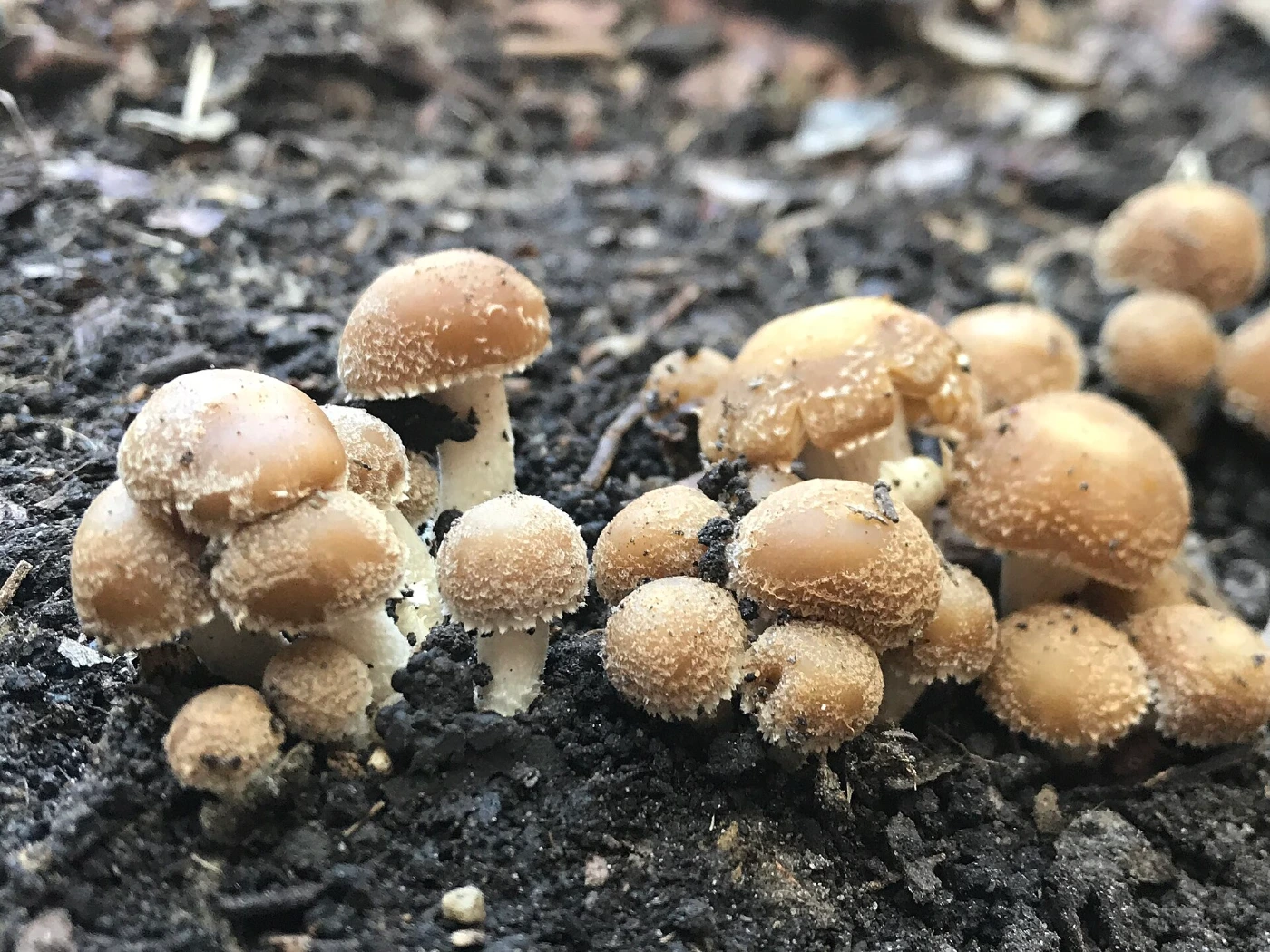
Pale Brittlestem is a thin, fragile mushroom whose appearance changes considerably with age and moisture. Young specimens can have warm honey-brown or tan caps, while mature dry mushrooms may fade almost completely to cream.
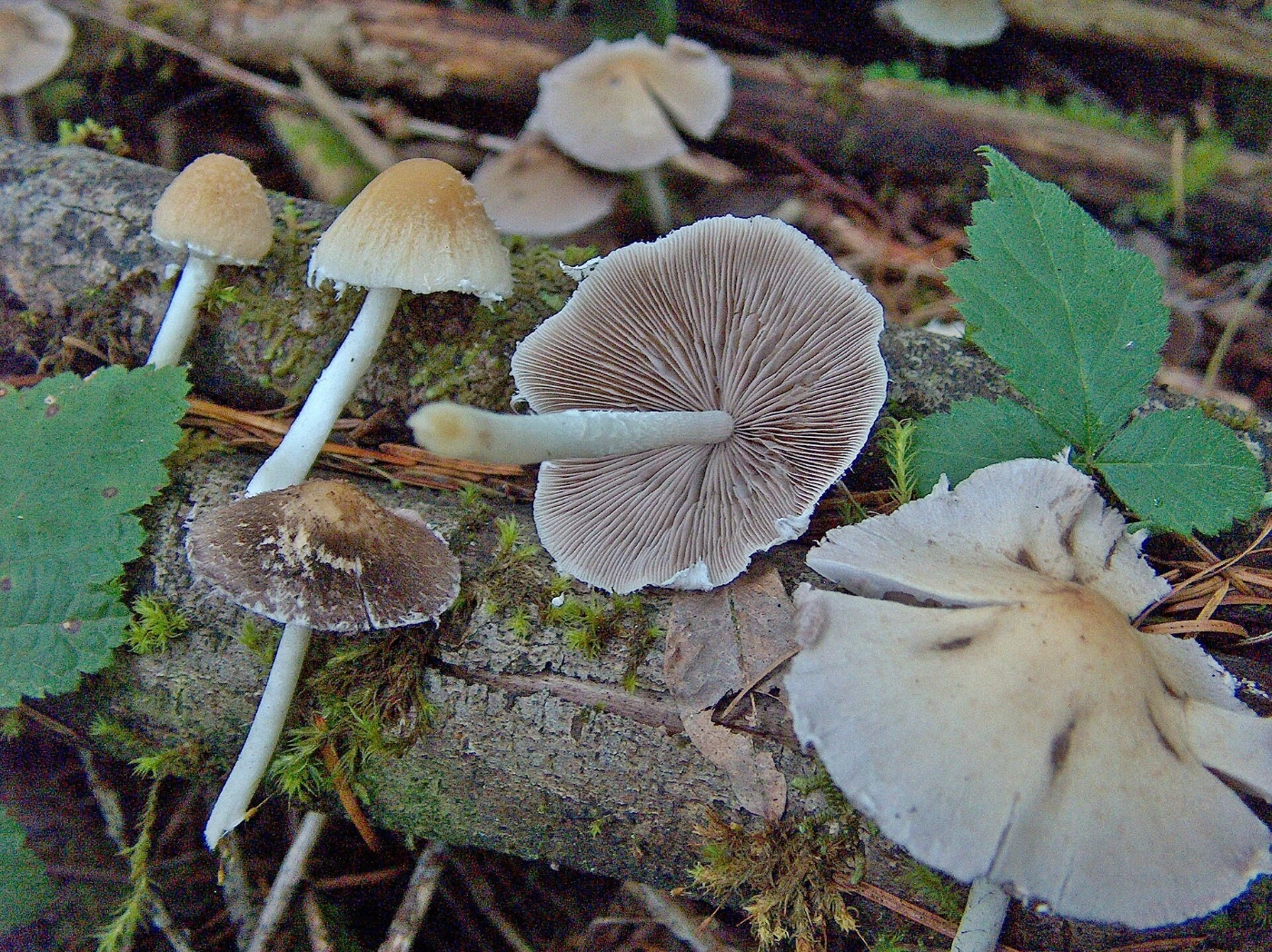
The remnants of the partial veil are particularly useful on young specimens. Small white fragments often hang from the cap margin, producing a ragged or fringed appearance that may disappear as the mushroom expands or after rain.
Cap
The cap is thin-fleshed and very brittle. It typically measures around 3–6 cm across, although larger specimens are possible, and often begins convex before expanding to broadly convex or nearly flat with a low central bump.
Fresh caps may be brownish, honey-yellow, tan, or pale buff. As they lose moisture, they become much paler, sometimes reaching cream or nearly white, which makes one patch of mushrooms appear to contain several different species.
Hygrophanous Color Change
Pale Brittlestem is strongly hygrophanous, meaning its color changes as water leaves the cap. Moist areas stay darker while drying areas become pale, sometimes creating bands or irregular zones.
This rapid fading is one of the most useful field clues. Cap color should therefore never be recorded without also noting whether the mushroom is wet, partly dry, or completely dry.
Veil Fragments Around the Cap
Young fruit bodies possess a delicate partial veil. As the cap expands, the veil tears and frequently leaves small white fragments around the margin.
These fragments can make the cap look fringed or slightly toothed. They are often conspicuous in fresh young mushrooms but may disappear quickly through age, handling, wind, or rain.
A persistent stem ring is unusual. If a small brown mushroom has a strong durable ring, another species should be considered.
Gills
The gills are crowded and attached to the stem. Young gills begin whitish and gradually become grayish, pinkish-gray, and finally dark brown as the spores mature.
Unlike classic inkcaps, they do not dissolve into black liquid at maturity. Their progressive darkening is caused mainly by the developing dark spores.
Stem
The stem is slender, white, and conspicuously fragile. It may break from very light handling, which explains the English name Brittlestem.
The surface can appear smooth or slightly silky. A substantial permanent ring is normally absent, although fleeting veil material can sometimes remain near the upper stem.
Flesh
The flesh is very thin and delicate, particularly in the cap. The entire mushroom can collapse or break apart quickly after collection.
Odor and taste are not considered distinctive. This limits their usefulness compared with substrate, veil remnants, cap fading, and gill development.
Spore Print
The spore print is dark brown, often described more broadly as brown to purplish-brown. Mature gills become correspondingly dark as spores accumulate.
This feature helps separate Pale Brittlestem from white-spored wood-growing mushrooms. However, many Psathyrellaceae also have dark spores, so spore color alone does not establish the species.
Microscopic Features
Spores are smooth, ellipsoid, and possess a germ pore. British descriptions give a size of approximately 6.5–9.5 × 4–5 µm.
Microscopic examination can be important because the traditional P. candolleana concept has historically included considerable variation. Modern DNA-based taxonomy has clarified some of these boundaries, but visually similar Candolleomyces can still be challenging.
Where Does Pale Brittlestem Grow?
Pale Brittlestem is a saprobic mushroom that decomposes dead organic material. It is strongly associated with decaying wood, including material buried beneath soil or turf.
This explains why it frequently appears to grow directly from lawns. The mycelium may actually be feeding on buried roots, old stumps, wood chips, or other woody debris beneath the grass.
Lawns and Parks
Urban lawns and parks are classic habitats. Mushrooms may appear in scattered groups or loose clusters after wet weather, particularly where old trees or buried roots are present.
A seemingly terrestrial lawn specimen should therefore be checked for hidden woody substrate. This ecological clue can be more useful than cap color.
Woodland and Woodland Edges
Pale Brittlestem also occurs in woodland, clearings, and shaded grassy places. It can fruit around decaying stumps or from soil enriched with woody material.
The species is not mycorrhizal and does not depend on a specific living host tree. Its association is with decomposing material rather than a root partnership.
Growth Pattern
Fruit bodies may appear singly, scattered, or in groups. Groups can sometimes contain many mushrooms, especially where a substantial buried root or stump provides food.
Because the fruit bodies are short-lived and delicate, a patch can change dramatically within only a few days. Young dark-capped mushrooms may soon be replaced visually by pale expanded specimens.
Season
In Britain and Ireland, Pale Brittlestem is most often recorded from June to November. Fruiting dates vary by climate and can extend outside this period in warmer regions.
Rainfall is an important trigger because the mushrooms develop quickly when woody substrate and surrounding soil become moist.
Distribution
Pale Brittlestem is widespread in Britain, Ireland, mainland Europe, North America, and many other regions. It is particularly familiar in human-modified habitats because buried wood, gardens, lawns, and parks provide abundant substrate.
Records from distant regions should still be interpreted with modern taxonomy in mind. Species once identified broadly as Psathyrella candolleana may sometimes belong to closely related taxa.
Why Is It Called Pale Brittlestem?
The name Brittlestem describes the exceptionally fragile stem and thin fruit body. Even carefully collected mushrooms often break before they reach a basket or laboratory.
“Pale” reflects the dramatic fading of the cap. Fresh young mushrooms may be relatively brown, but mature dry specimens can become almost cream-colored.
Taxonomic History
Elias Magnus Fries described the species in 1818 as Agaricus candolleanus. It was later transferred into Psathyrella, where it became widely known as Psathyrella candolleana.
Molecular and morphological work eventually resulted in transfer to the genus Candolleomyces. Species Fungorum now accepts Candolleomyces candolleanus as the current name.
The epithet honors the Swiss botanist Augustin Pyramus de Candolle. It is not related to candles despite the similarity of the name.
Is Pale Brittlestem Edible?
The edibility of Pale Brittlestem is reported inconsistently. Some field guides have described it as edible but insignificant, while others list it as inedible or of uncertain edibility.
For practical purposes, it is not recommended for consumption. The fruit bodies are small and fragile, identification within this group can be difficult, and there is little culinary reason to collect them.
This is primarily an identification species rather than a food mushroom. Similar-looking small brown mushrooms can also belong to completely different genera.
Look-Alikes
Pale Brittlestem belongs to a large group of fragile brown-spored mushrooms that can be difficult to identify from photographs alone. Substrate, veil remnants, cap fading, growth pattern, and microscopy may all become important.
Psathyrella piluliformis — Common Stump Brittlestem
Identification
Psathyrella piluliformis usually grows densely clustered on or immediately beside broadleaf stumps and buried wood. Its caps are typically darker brown, especially when moist.
The fruit bodies often occur in much larger and tighter groups than Pale Brittlestem. The cap also lacks the same characteristic pale mature appearance in many specimens.
Main Difference
Pale Brittlestem often has a paler, strongly fading cap with conspicuous veil fragments at the margin, while P. piluliformis typically forms dense clusters around broadleaf stumps and has darker caps.
Habitat overlap is possible because both can grow from buried wood. Growth pattern and cap development should therefore be examined together.
Other Candolleomyces Species
Identification
Other Candolleomyces can closely resemble C. candolleanus. They may share fragile stems, hygrophanous caps, dark spores, and growth on woody debris.
Some differences are microscopic rather than obvious in the field. A single pale brown mushroom cannot always be assigned confidently to species level.
Main Difference
There is no universal macroscopic character that separates Pale Brittlestem from every related Candolleomyces. When morphology is ambiguous, microscopy or DNA sequencing may be necessary.
Agrocybe Species
Identification
Some pale or tan Agrocybe can occur in lawns, gardens, and wood-rich habitats. They generally have more substantial flesh and less fragile stems than Pale Brittlestem.
Gill development and spore color can overlap broadly in appearance. The overall sturdiness of the mushroom is therefore useful when comparing them.
Main Difference
Pale Brittlestem is exceptionally delicate and thin-fleshed. Agrocybe generally feels more robust and substantial.
A thick persistent ring or strongly developed stem structure also argues against typical Pale Brittlestem.
Small Hypholoma
Identification
Some Hypholoma species grow in groups on stumps and buried wood and may have tan or brownish caps. Their gill colors and clustered growth can create superficial similarities.
Many Hypholoma are more robust and have different veil, cap, and gill characteristics. Ecology and mature gill color help narrow the possibilities.
Main Difference
Pale Brittlestem typically has thin, fragile flesh and a cap that fades strongly toward cream. Many Hypholoma remain more strongly pigmented and structurally tougher.
Pale Brittlestem vs Common Stump Brittlestem
| Feature | Pale Brittlestem | Common Stump Brittlestem |
|---|---|---|
| Scientific name | Candolleomyces candolleanus | Psathyrella piluliformis |
| Young cap | Honey-brown to tan | Darker brown |
| Dry cap | Very pale, cream | Usually remains darker |
| Veil fragments | Often visible around margin | Less characteristic |
| Growth | Scattered to grouped | Often dense clusters |
| Substrate | Buried wood, lawns, woodland | Usually broadleaf stumps/roots |
| Stem | White, very fragile | Pale, fragile |
| Spore print | Dark brown | Dark brown |
The two can still overlap in appearance. The strongest combination for Pale Brittlestem is a rapidly fading cap, marginal veil remnants, and looser growth associated with buried woody material.
Young vs Mature Pale Brittlestems
Young mushrooms often have richer brown or honey-colored caps and conspicuous white veil fragments. The gills are still pale, so the fruit body can look surprisingly light underneath.
As the cap expands, it fades while the gills darken. A mature specimen can therefore have almost the reverse contrast: a pale cream cap above dark brown gills.
This transformation is important for photo identification. Two mushrooms from the same patch can look unrelated if photographed at different stages.
Why the Cap Margin Matters
The cap margin is one of the most useful areas to photograph. Young Pale Brittlestems often carry white, irregular veil fragments that hang from the edge.
Those fragments are temporary and can vanish quickly. Their presence is more informative than their absence, especially on fresh fruit bodies.
A smooth mature cap with no veil material does not rule out the species. It simply removes one of the easiest field clues.
Why Buried Wood Matters
Pale Brittlestem frequently appears in places where no wood is visible. This can lead observers to describe it incorrectly as a mushroom that simply grows from lawn soil.
In reality, old roots, buried branches, stump remains, or landscaping wood may lie below the surface. The fungus decomposes this material and sends fruit bodies through the grass.
If a patch repeatedly appears in exactly the same lawn location, buried woody substrate is a reasonable possibility.
Does Pale Brittlestem Dissolve Like an Inkcap?
No. Pale Brittlestem belongs to Psathyrellaceae, a family that also contains many inkcap-related fungi, but its gills do not normally deliquesce into black liquid at maturity.
Instead, the mushroom simply becomes increasingly fragile and eventually collapses or decays. Mature gills darken because of brown spores rather than liquefying.
Common Identification Mistakes
One common mistake is identifying only from the pale cap. Mature specimens can be almost white, but young mushrooms from the same colony may be considerably darker.
Another mistake is assuming that a specimen growing in grass is unrelated to wood. Buried woody debris is a classic substrate for Pale Brittlestem.
A third mistake is ignoring the cap margin. White veil remnants on young fruit bodies are among the most useful visible characters.
A fourth mistake is using the old scientific name without recognizing modern taxonomy. Psathyrella candolleana remains useful for searches, but the accepted name is now Candolleomyces candolleanus.
How to Photograph Pale Brittlestem
Photograph young and mature mushrooms together whenever possible. The contrast between darker young caps and pale mature caps can be highly informative.
Take a close photograph of the cap margin to capture any remaining veil fragments. Then photograph the gills, complete stem, growth pattern, and surrounding substrate.
A wider habitat photograph can reveal old stumps, trees, mulch, or other signs of buried wood. These ecological details can improve identification considerably.
Can AI Identify Pale Brittlestem?
AI can often recognize a likely Pale Brittlestem group when several specimens, veil remnants, gills, and habitat are visible. The dramatic variation in cap color can nevertheless make single-image identification unreliable.
Closely related Candolleomyces and other Psathyrellaceae can be extremely similar macroscopically. AI should therefore provide a probability or shortlist rather than absolute species certainty when diagnostic details are missing.
Microscopic examination may be necessary for difficult specimens. A top-down cap photograph alone is not sufficient for dependable identification.
Interesting Facts
Pale Brittlestem can appear to change from brown to almost white without any true pigment transformation. Much of the visual change results from the cap losing moisture as it dries.
Its accepted genus, Candolleomyces, also preserves the connection with Augustin Pyramus de Candolle in the genus name. The species has therefore retained its historical namesake even after leaving Psathyrella.
The mushroom is also a good example of why habitat observations can be deceptive. A fungus that appears to grow from a perfectly ordinary lawn may actually be digesting a hidden tree root several centimeters below the surface.
Frequently Asked Questions
What is the current scientific name of Psathyrella candolleana?
The currently accepted name is Candolleomyces candolleanus. Species Fungorum lists Psathyrella candolleana as a synonym.
What is the common name of Psathyrella candolleana?
The standard English common name is Pale Brittlestem. Older sources may also use Common Psathyrella or Common Crumblecap.
How do you identify Pale Brittlestem?
Look for a fragile hygrophanous cap that fades from brown or honey-colored to cream, white veil fragments around the young cap margin, crowded gills that darken with age, and a thin white brittle stem. Growth near decaying or buried wood provides additional support.
Does Pale Brittlestem grow in lawns?
Yes. It commonly appears in lawns, parks, and grassy areas, but hidden roots or buried woody debris are often the actual substrate.
What color is the spore print?
The spore print is dark brown to purplish-brown. Mature gills also become very dark as spores accumulate.
Does Pale Brittlestem have a ring?
Usually not. The partial veil generally breaks into fragments around the cap margin rather than leaving a persistent stem ring.
Is Pale Brittlestem edible?
Field guides disagree, with descriptions ranging from edible but insignificant to inedible or uncertain. Because identification can be difficult and the mushroom has little culinary value, it is not recommended for consumption.
Is Pale Brittlestem poisonous?
It is not generally regarded as a major poisonous mushroom, but that does not make an uncertain identification safe to eat. Small fragile brown mushrooms can be difficult to separate reliably.
Why does the cap turn white?
The cap is hygrophanous and becomes much paler as it loses moisture. A wet young mushroom and a dry mature mushroom can therefore look strikingly different.
What is the main look-alike?
Psathyrella piluliformis, the Common Stump Brittlestem, is an important comparison. It usually has darker caps and grows in denser clusters around broadleaf stumps or buried roots.
Final Identification Notes
Psathyrella candolleana, currently accepted as Candolleomyces candolleanus, is best recognized by the combination of a fragile hygrophanous cap, dramatic fading from brown to cream, temporary white veil fragments around the cap margin, crowded gills that mature dark brown, a slender white brittle stem, and an association with decaying or buried wood.
The mushroom is especially common in lawns, parks, gardens, woodland edges, and other places where hidden woody material is present. Its appearance changes substantially with age, so comparing several fruit bodies from the same group is much more useful than examining a single mature specimen.
The practical identification pattern is: fragile pale-brown mushroom + cap fading strongly as it dries + ragged white veil fragments on young margins + darkening gills + buried wood = strong Pale Brittlestem candidate. Closely related species can still require microscopic examination, so difficult specimens should not be forced into a species-level identification from photographs alone.
Upload a photo and get possible matches in seconds.