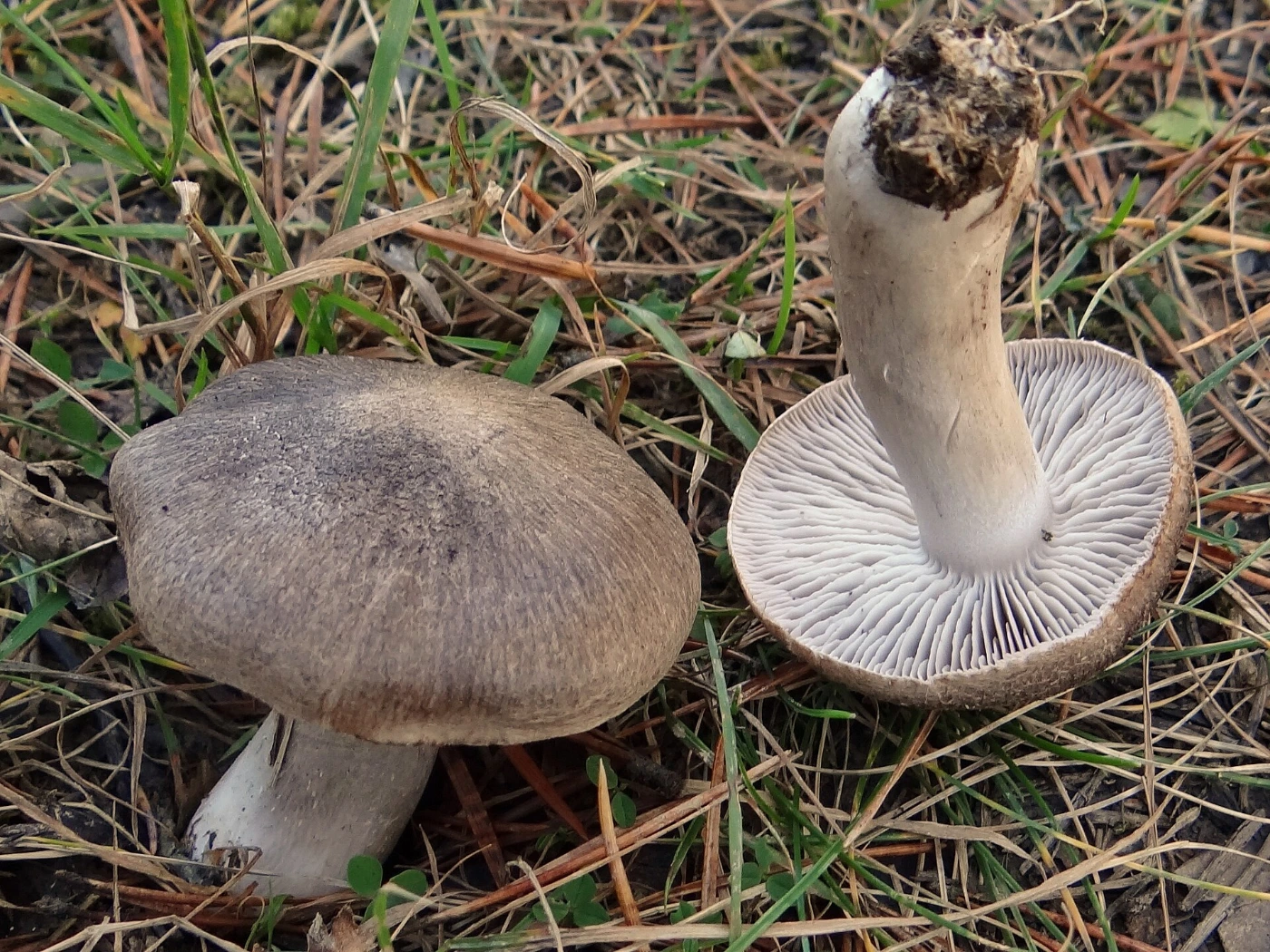
Tricholoma terreum, commonly known as the Grey Knight, is a gray-capped woodland mushroom associated mainly with pine. It has a dry fibrous cap, crowded pale gills, a smooth white stem without a ring, and a white spore print.
The most useful field pattern is gray fibrillose cap + crowded notched pale gills + smooth ringless white stem + pine habitat. The species is usually found in groups rather than alone and can occur abundantly in suitable conifer woodland.
Grey Knight has a long history of being eaten in parts of Europe, but its edibility is now controversial. Some field guides advise against consumption because of toxicological research suggesting a possible rhabdomyolysis risk, while later studies have questioned whether the proposed toxins are actually present in typical T. terreum fruit bodies.
⚠️ Important: Do not eat an uncertain gray Tricholoma. Several similar species are difficult to separate in the field, and some members of the genus are poisonous or associated with serious adverse reactions.
Quick Identification
| Feature | Tricholoma terreum |
|---|---|
| Common name | Grey Knight |
| Cap | Gray to mouse-gray, fibrous or woolly |
| Cap size | About 3–10 cm |
| Cap shape | Conical to convex, later flatter, often with an umbo |
| Gills | White to pale gray, crowded |
| Gill attachment | Sinuate / notched |
| Stem | White, smooth, ringless |
| Flesh | White |
| Odor | Weak, not distinctive |
| Taste | Mild to indistinct |
| Spore print | White |
| Ecology | Ectomycorrhizal |
| Main host | Pine |
| Soil | Often neutral to calcareous |
| Season | Late summer to autumn |
| Main look-alikes | Tricholoma pardinum, T. scalpturatum, other gray Tricholoma |
| Edibility | Historically eaten; now controversial and not recommended |
What Does Grey Knight Look Like?
Grey Knight is usually a medium-sized mushroom with a dry gray cap and pale gills. The overall appearance can seem plain, which is one reason it is easily confused with other gray members of Tricholoma.
The cap surface is covered with fine darker fibers that radiate outward from the center. These fibers give the mushroom a slightly woolly or mouse-fur appearance, especially in fresh specimens.
Cap
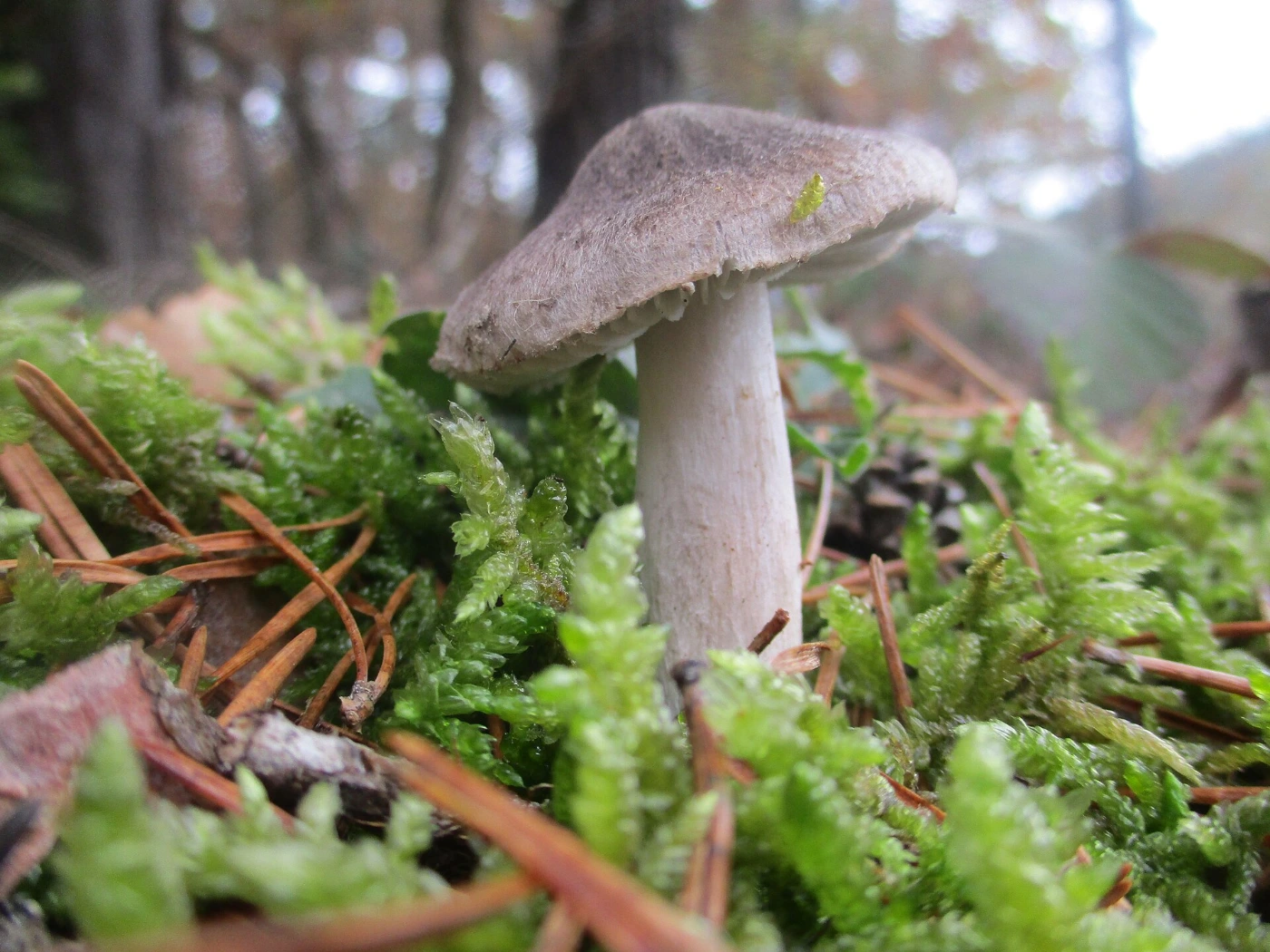
The cap is generally 3–10 cm across and begins conical or broadly convex. As it matures, it becomes flatter but often retains a low central umbo.
Color ranges from pale gray to darker mouse-gray or gray-brown. Fine dark fibrils radiate from the center, while the margin is usually paler and can become somewhat irregular with age.
The surface is dry rather than slimy. Rain and age can flatten the fibers and make old specimens less obviously textured.
Gills
The gills are white when young and can become pale gray or slightly yellowish with age. They are broad, crowded, and usually notched where they meet the stem.
This notched or sinuate attachment is typical of many Tricholoma. The gills may appear almost free at first glance, so a close side view is useful.
Stem
The stem is smooth, white, and usually fairly even in width. It lacks both a ring and a volva.
The interior can become somewhat hollow with age, but this is not a defining character. The stem surface is generally much less ornamented than the fibrous gray cap.
Flesh
The flesh is white and relatively thin compared with more robust Tricholoma species. It usually does not show a dramatic bruising or color-change reaction when cut.
Odor and taste are generally described as weak or not particularly distinctive. This is useful because some related species have a much stronger mealy or unpleasant smell.
Spore Print
The spore print is white. The spores are smooth, ellipsoid, and approximately 6–7 × 3.5–5 µm in British descriptions.
A white spore print supports identification as a Tricholoma-type mushroom, but many close look-alikes share the same spore color. It should therefore be treated as supporting evidence rather than a final identification feature.
Where Does Tricholoma terreum Grow?
Grey Knight is an ectomycorrhizal mushroom that forms a partnership with living tree roots. It is especially associated with pine, including Scots Pine in Europe.
The species often grows along dry woodland paths, forest edges, and open pine plantations. Neutral to calcareous soils appear particularly favorable in many European habitats.
Pine Association
Pine is one of the strongest field clues for Grey Knight. A gray fibrous Tricholoma growing beneath pine is a much better candidate than an otherwise similar mushroom found beneath broadleaf trees.
Host association is still not enough by itself because several other gray Tricholoma also grow with conifers. Cap texture, size, odor, gill color, and overall robustness must be considered together.
Growth Pattern
Grey Knights are often gregarious and may appear in large groups. They are rarely limited to a single isolated fruit body in productive habitat.
Several mushrooms of different ages can therefore often be examined together. This is useful because young specimens show the cap shape and fibers more clearly, while mature specimens reveal the full gill attachment and stem proportions.
Season
In Britain and Ireland, Grey Knight is typically found from August through October. Fruiting can extend later in milder parts of Europe depending on rainfall and temperature.
Like many ectomycorrhizal autumn mushrooms, emergence depends heavily on seasonal moisture. A dry year can greatly reduce visible fruiting even where the mycelium remains present.
Distribution
Tricholoma terreum is widespread across much of Europe. It has also been reported from Australia, probably introduced together with European pine trees.
Similar mushrooms are reported from North America, but regional records should be treated carefully because gray Tricholoma are taxonomically difficult. A European name should not automatically be applied to a visually similar mushroom from another continent.
Taxonomy
The species was originally described as Agaricus terreus by Jacob Christian Schaeffer in 1762. Paul Kummer transferred it to the genus Tricholoma in 1871, creating the current name Tricholoma terreum.
Older literature may also use names such as Tricholoma myomyces for closely related or historically confused material. Modern identification should therefore consider both current taxonomy and regional species concepts.
Why Is It Called Grey Knight?
The common name reflects the gray cap and its membership in the genus Tricholoma, whose English members are often called “knights.” The accepted British common name is Grey Knight.
The species epithet terreum refers to earthy or soil-like coloration. Fresh mushrooms often have exactly this muted gray-brown appearance.
Is Tricholoma terreum Edible?
Historically, Grey Knight was widely regarded as edible and is still traditionally consumed in some parts of Europe. Older field guides often describe it as a mild edible mushroom.
Its current safety status is controversial, however. A 2014 study isolated several compounds from material identified as T. terreum and found that two of them increased creatine kinase levels in mice, leading the authors to propose a possible rhabdomyolysis risk.
The Rhabdomyolysis Controversy
The 2014 study attracted considerable attention because rhabdomyolysis had already been associated with repeated consumption of another Tricholoma, T. equestre. Rhabdomyolysis involves breakdown of skeletal muscle and can lead to severe systemic complications.
That study did not document human cases caused by T. terreum. Its conclusion was based primarily on chemical isolation and experiments in mice rather than confirmed clinical poisoning from correctly identified Grey Knight.
Later Research Challenged the Toxicity Claim
A 2024 study specifically searched for the previously reported terreolides, terreumols, and saponaceolides in T. terreum fruit bodies but did not detect them. The authors also noted that no documented clinical cases of rhabdomyolysis caused by T. terreum had been reported in the medical literature.
An earlier published scientific comment had already questioned the toxicological interpretation and argued that T. terreum should remain regarded as edible. This demonstrates that the safety question is genuinely disputed rather than settled in one direction.
Practical Edibility Recommendation
For MushroomID, the most defensible practical advice is to avoid recommending Grey Knight for consumption. The species is difficult to separate from other gray Tricholoma, and its toxicological status remains disputed.
This does not mean there is strong evidence that ordinary consumption of correctly identified T. terreum causes fatal poisoning. It means the combination of identification difficulty and unresolved toxicology makes it a poor species for casual foraging.
What Is Rhabdomyolysis?
Rhabdomyolysis is the breakdown of skeletal muscle tissue. Damaged muscle cells release intracellular substances such as myoglobin and creatine kinase into the bloodstream.
Severe cases can cause weakness, muscle pain, dark urine, electrolyte disturbances, kidney injury, and cardiac complications. The syndrome has been documented after repeated consumption of Tricholoma equestre, although the toxicology of that species is itself complex and debated.
Look-Alikes
Grey Knight belongs to a difficult group of gray-capped Tricholoma. Several species overlap in size, habitat, cap color, and spore-print characteristics.
Tricholoma pardinum — Tiger Tricholoma
Identification
Tricholoma pardinum is generally larger, more robust, and more strongly patterned than Grey Knight. The cap has coarse gray scales rather than the fine radial fibers typical of T. terreum.
The mushroom also has a stronger mealy odor. It is known to cause gastrointestinal poisoning.
Main Difference
Fine mouse-gray fibers + smaller build favor T. terreum, while a large robust mushroom with coarse tiger-like scales favors T. pardinum.
Size and cap texture should be considered together. A single gray cap photograph is not enough for reliable separation.
Tricholoma scalpturatum — Yellowing Knight
Identification
Tricholoma scalpturatum is another gray fibrous knight that can look extremely similar. The cap is gray-brown and finely fibrillose, while the gills and flesh can gradually develop yellowish tones.
Older specimens often show yellow staining more clearly than fresh young mushrooms. This color change is one of the most useful field clues.
Main Difference
Noticeable yellowing of gills or flesh favors T. scalpturatum. Grey Knight normally remains predominantly white and gray.
Habitat can overlap, so yellowing should be checked carefully rather than relying only on nearby trees.
Other Gray Tricholoma
Identification
Several other gray-capped knights occur beneath conifers and broadleaf trees. Many have white spores, pale gills, ringless stems, and similar cap shapes.
Differences may involve cap fibers, scales, smell, taste, staining, host tree, and microscopic features. Species-level identification can therefore be difficult even for experienced mushroom identifiers.
Main Difference
There is no universal shortcut for gray Tricholoma. When several species are possible, a genus-level identification is safer than forcing an exact species from appearance alone.
Grey Knight vs Tiger Tricholoma
| Feature | Grey Knight | Tiger Tricholoma |
|---|---|---|
| Scientific name | T. terreum | T. pardinum |
| Cap | Fine gray fibers | Coarse gray scales |
| Size | Small to medium | Larger and robust |
| Gills | White to gray | Pale |
| Odor | Weak | More mealy |
| Stem | Smooth, white | Thick, pale |
| Spore print | White | White |
| Toxicity | Controversial | Poisonous |
| Best clue | Fine fibrillose cap | Large tiger-scaled cap |
The two should never be separated by size alone. Cap texture and overall robustness provide a much stronger combination.
Grey Knight vs Yellowing Knight
| Feature | Grey Knight | Yellowing Knight |
|---|---|---|
| Scientific name | T. terreum | T. scalpturatum |
| Cap | Gray, finely fibrillose | Gray-brown, fibrillose |
| Gills | White to pale gray | Pale, often yellowing |
| Flesh | White | Can yellow |
| Stem | White | Pale, sometimes yellowing |
| Spore print | White | White |
| Best clue | Little yellowing | Yellow discoloration with age |
Fresh young specimens can still be difficult to separate. Observing several fruit bodies at different ages is often more useful than examining only one.
Why the Cap Texture Matters
Grey Knight does not simply have a gray cap. The surface is characteristically covered with fine radial fibers that create a woolly or mouse-fur texture.
Coarse scales point toward other species. A smooth cap or strongly spotted surface should also make the identification less convincing.
Cap texture should be photographed in diffuse light because strong reflections can hide the fine fibers.
Why the Host Tree Matters
Tricholoma species are ectomycorrhizal and depend on living host trees. Grey Knight is especially associated with pine, so identifying surrounding trees can significantly improve confidence.
This ecological clue becomes particularly valuable when comparing visually similar species. A mushroom found well away from conifers deserves additional scrutiny before being called T. terreum.
Young vs Mature Grey Knights
Young mushrooms often have a distinctly conical cap with a visible central point. The gray fibers are usually sharp and well defined at this stage.
Mature caps become flatter and may lose some of their strongly conical appearance. Gills can also shift from white toward pale gray or faint yellowish tones as the mushroom ages.
Old fruit bodies can become faded, damaged, or waterlogged. These are much harder to identify reliably than fresh specimens.
Common Identification Mistakes
One common mistake is calling every small gray Tricholoma Grey Knight. Several related species share nearly the same overall color and habitat.
Another mistake is focusing on the cap color while ignoring texture. Fine fibrils, coarse scales, yellow staining, and odor are more informative than whether the mushroom is light or dark gray.
A third mistake is assuming that a historical edible reputation proves modern safety. The toxicology of Grey Knight is disputed, and the genus contains difficult look-alikes.
A fourth mistake is treating the 2014 mouse study as proof of documented fatal human poisoning. The proposed toxicity has been challenged, and later research did not reproduce the reported chemical findings.
How to Photograph Tricholoma terreum
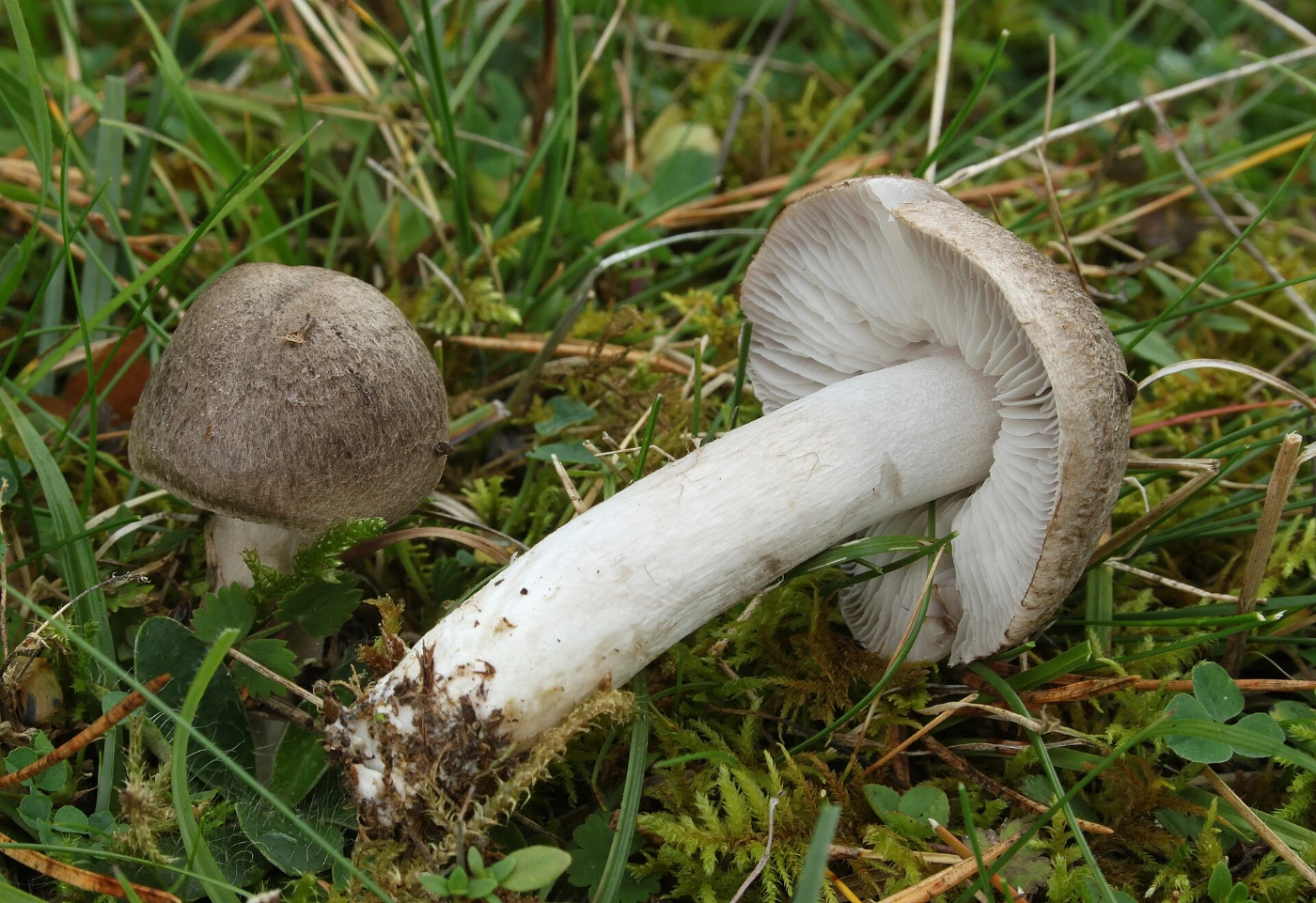
Photograph the mushroom from above to show the radial cap fibers and central umbo. Then take a side view showing the cap profile, crowded gills, and complete ringless stem.
Include a habitat image with nearby pine needles, cones, bark, and trees. Host information can be especially useful for Tricholoma identification.
Photograph several specimens of different ages when available. This makes it easier to assess cap shape, yellowing, gill changes, and overall consistency within the patch.
Can AI Identify Grey Knight?
AI can often recognize a gray Tricholoma-type mushroom when the cap fibers, pale gills, stem, and pine habitat are visible. Species-level confidence should remain limited because multiple gray knights are extremely similar.
A top-down photograph of a gray cap is not sufficient. The underside, stem, host tree, smell, and age-related color changes can all affect the identification.
Because some look-alikes are poisonous, an AI result should never be used to establish edibility.
Interesting Facts
Grey Knight has been eaten traditionally in parts of continental Europe and is known in Italy as moretta. Its continued culinary use is one reason the modern toxicity debate has attracted unusual attention.
The controversy is scientifically interesting because different studies reached very different conclusions. One study isolated compounds that caused muscle-related biochemical changes in mice, while later researchers failed to detect those compounds in analyzed fruit bodies and emphasized the absence of confirmed human poisoning cases.
Grey Knight is also an example of why fungal safety information can change over time. Traditional edibility, experimental toxicology, clinical evidence, and taxonomic certainty all need to be considered separately.
Frequently Asked Questions
What is the common name of Tricholoma terreum?
The standard English common name is Grey Knight. The name refers to its gray cap and its membership in the genus Tricholoma, whose species are commonly called knights.
Is Grey Knight poisonous?
Its toxicity is disputed. A 2014 mouse study suggested potential rhabdomyolysis risk, but later work failed to detect the proposed toxins and noted that confirmed human cases have not been documented.
Is Tricholoma terreum edible?
It has historically been eaten and is still consumed in some European regions. Because of unresolved toxicology and difficult look-alikes, MushroomID does not recommend it for casual foraging.
What trees does Grey Knight grow with?
It is most strongly associated with conifers, especially pine. Scots Pine woodland is a classic habitat in Europe.
Does Grey Knight have a ring?
No. The stem is smooth and white without a ring.
What color is the spore print?
The spore print is white. This is typical of Tricholoma but does not distinguish Grey Knight from many related species.
How can Grey Knight be distinguished from Tiger Tricholoma?
Grey Knight has finer gray radial fibers and a smaller, less robust build. Tiger Tricholoma typically has a larger cap with coarse, obvious gray scales.
Does Grey Knight cause rhabdomyolysis?
This has not been demonstrated conclusively in humans. Experimental research raised the possibility, while later chemical work questioned the original findings.
Final Identification Notes
Tricholoma terreum, the Grey Knight, is best recognized by the combination of a gray finely fibrillose cap, crowded pale sinuate gills, smooth white ringless stem, white spore print, gregarious growth, and strong association with pine. These features should be considered together because several gray Tricholoma share individual parts of the same appearance.
The most important look-alikes include Tricholoma pardinum, T. scalpturatum, and other gray knights. Coarse scales, strong yellowing, unusual odor, greater size, or a different host association should prompt comparison with another species.
The practical identification pattern is: fine mouse-gray cap fibers + pale notched gills + ringless white stem + pine habitat = strong Tricholoma terreum candidate. Because both identification and edibility remain complicated, Grey Knight is better treated as an identification species than as a recommended food mushroom.
Upload a photo and get possible matches in seconds.