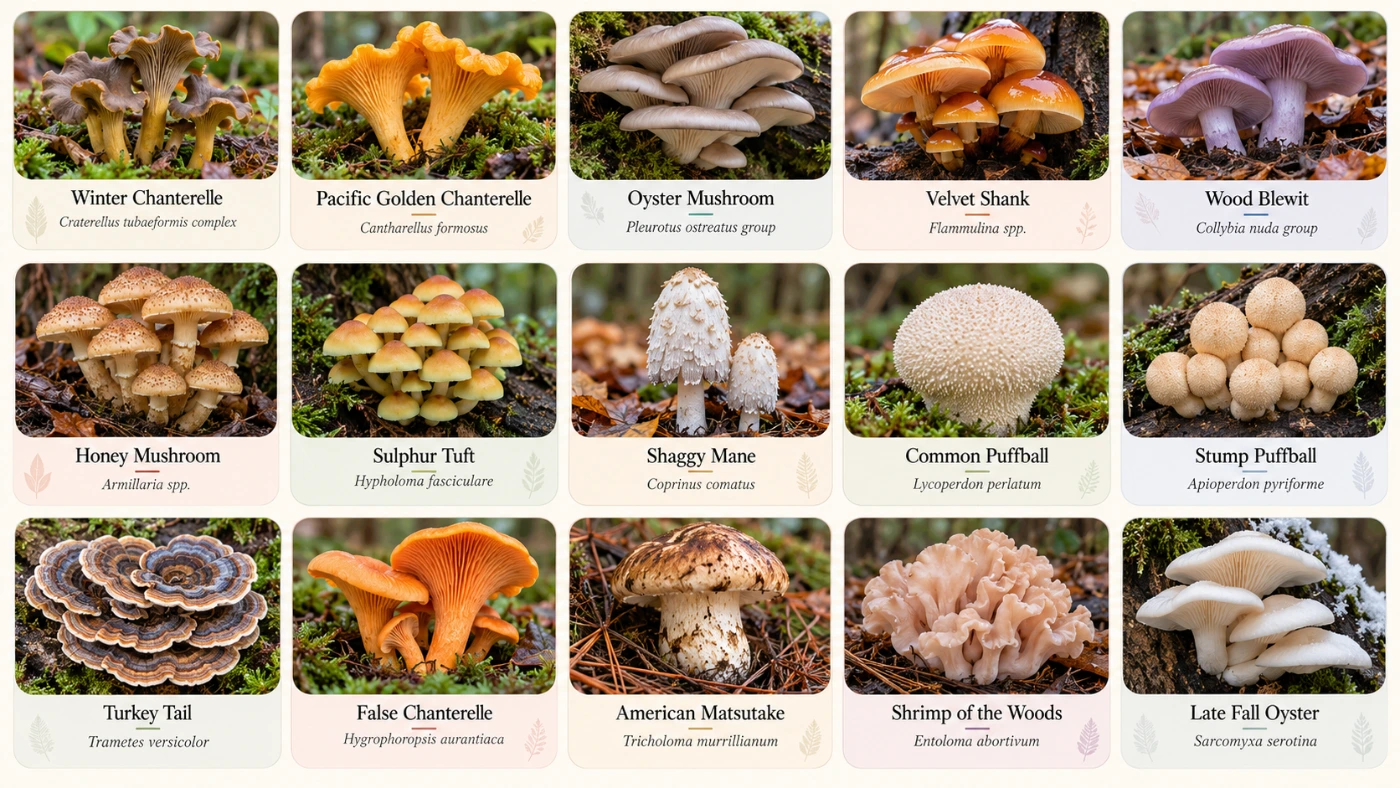
November is an unusually varied month for mushroom hunting in North America. In northern and inland regions, frost may already be ending the main woodland season, while the Pacific Northwest and coastal California can be entering some of their most productive weeks.
Late-autumn mushrooms also differ from the species that dominate September and October. Oyster Mushrooms, Velvet Shanks, Wood Blewits, Honey Mushrooms, puffballs, and wood-decaying fungi become increasingly noticeable, while winter chanterelles and other Pacific Northwest species can thrive in cool wet forests.
⚠️ Important: Fruiting time is only a supporting identification clue. Never identify a mushroom as edible based only on season, location, or resemblance to a photograph.
Quick Guide to November Mushrooms
| Mushroom | Scientific name | Region where especially relevant | Typical habitat |
|---|---|---|---|
| Winter Chanterelle | Craterellus tubaeformis complex | Pacific Northwest | Mossy conifer forest |
| Pacific Golden Chanterelle | Cantharellus formosus | Pacific Northwest | Conifer forest |
| Oyster Mushroom | Pleurotus ostreatus group | Widespread | Dead hardwood |
| Velvet Shank | Flammulina spp. | Widespread | Dead deciduous wood |
| Wood Blewit | Collybia nuda group | Widespread | Woodland litter |
| Honey Mushroom | Armillaria spp. | Widespread | Trees, roots, stumps |
| Sulphur Tuft | Hypholoma fasciculare | Widespread | Dead wood |
| Shaggy Mane | Coprinus comatus | Widespread | Lawns, paths, disturbed soil |
| Common Puffball | Lycoperdon perlatum | Widespread | Woodland floor |
| Stump Puffball | Apioperdon pyriforme | Widespread | Decaying wood |
| Turkey Tail | Trametes versicolor | Widespread | Dead hardwood |
| False Chanterelle | Hygrophoropsis aurantiaca | Northern and western forests | Conifer debris |
| American Matsutake | Tricholoma murrillianum | Western North America | Conifer forest |
| Shrimp of the Woods | Entoloma abortivum | Eastern North America | Woodland |
| Late Fall Oyster | Sarcomyxa serotina | Northern and eastern regions | Hardwood logs |
Why November Is Different in North America
North America covers such a wide range of climates that there is no single November mushroom season. A forest in Minnesota may already be frozen while western Oregon remains wet, mild, and highly productive.
California creates another pattern altogether. The first substantial autumn rains can restart fungal activity after a long dry summer, meaning November may feel more like the beginning of the season than its end.
1. Craterellus tubaeformis — Winter Chanterelle Complex
Winter Chanterelles are among the most characteristic late-season mushrooms of the Pacific Northwest. They grow in cool, wet conifer forests and can occur in large troops among moss, decomposed wood, and forest litter.
The small cap is brown to yellow-brown and becomes funnel-shaped, while the stem is hollow and usually yellowish. Instead of thin true gills, the underside has low blunt ridges that run toward the stem.
Where to Look
Moist forests of western Washington, Oregon, northern California, British Columbia, and parts of Alaska provide particularly suitable habitat. Mossy old conifer forests are much more promising than dry open woodland.
November can mark the beginning of a long fruiting period rather than its end. In favorable coastal forests, winter chanterelles may continue well into winter.
2. Cantharellus formosus — Pacific Golden Chanterelle
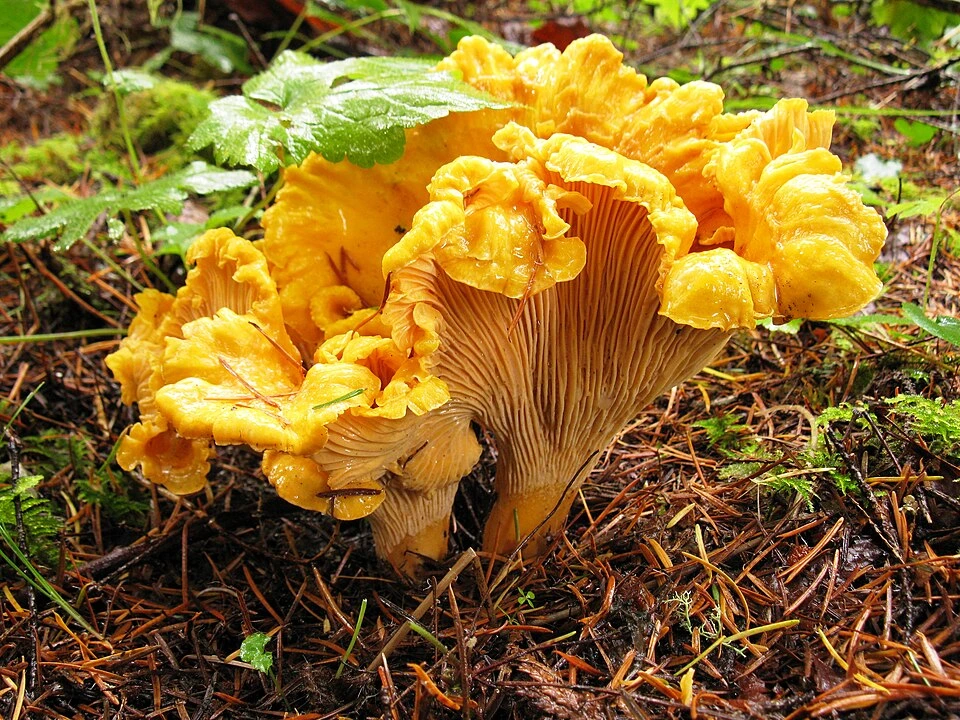
The Pacific Golden Chanterelle is one of the signature edible mushrooms of the Pacific Northwest. It grows with conifers and is particularly associated with the moist forests west of the Cascade Range.
Caps are yellow to orange-yellow, often with irregular wavy margins. The underside has blunt forked ridges rather than thin blade-like gills.
November Season
October is often a major month, but fruiting commonly continues into November when temperatures remain mild and rainfall is adequate. Elevation matters considerably because higher areas may become too cold while coastal forests remain productive.
This species also demonstrates why North American chanterelles should not all be called Cantharellus cibarius. Western North America has its own important chanterelle species.
3. Pleurotus ostreatus Group — Oyster Mushroom
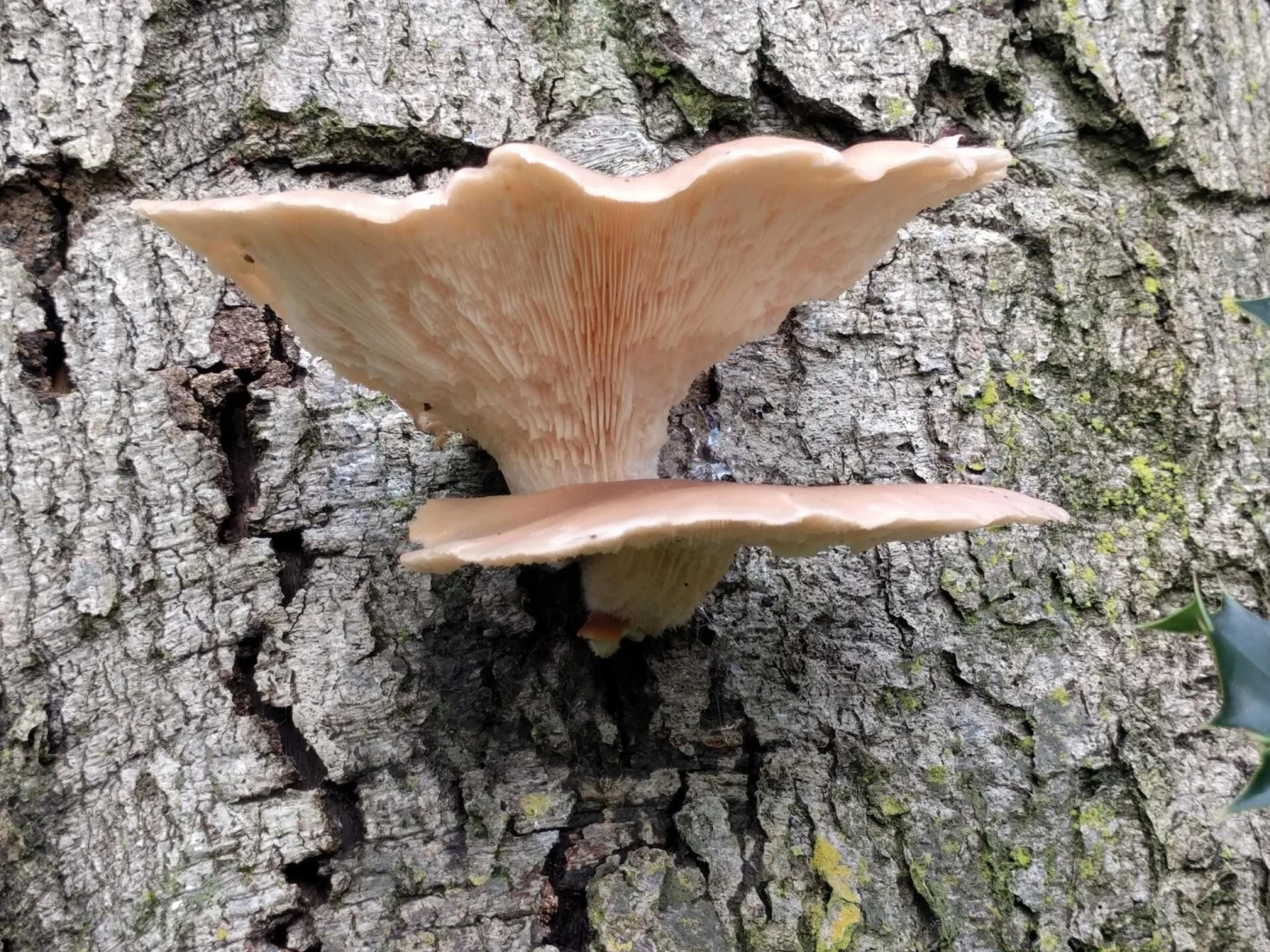
Oyster Mushrooms are among the most dependable cold-weather mushrooms across much of North America. They form overlapping gray, brown, blue-gray, or pale caps on dead or weakened hardwood.
The white gills run strongly down toward the short lateral stem. Large clusters can appear after cool wet periods and may grow surprisingly quickly.
Why November Is Good
Cooling temperatures favor many Oyster Mushroom flushes. Fallen logs and standing dead hardwood become particularly worthwhile places to inspect after rain.
Fruiting can continue into winter in many regions. In warmer southern areas, oysters may occur through much of the cool season.
4. Flammulina Species — Velvet Shank / Wild Enoki
Wild Flammulina species are classic cold-weather wood decomposers. Their caps are yellow-orange to honey-brown and often shiny or sticky, while the lower stem becomes dark and velvety.
They grow in clusters from dead or weakened deciduous trees. Several closely related Flammulina species occur in North America, so identifying every collection as European F. velutipes can oversimplify the taxonomy.
Important Look-Alike
Deadly Galerina can occur on wood in overlapping seasons and habitats. Galerina marginata has rusty-brown spores, whereas Flammulina produces a pale spore print.
November is a good time to learn this distinction because both groups may be encountered on cool, wet days. Small brown mushrooms on wood should always be examined carefully.
5. Collybia nuda Group — Wood Blewit
Wood Blewits are particularly associated with late autumn and often appear after many earlier woodland mushrooms have declined. Fresh fruit bodies can show violet or lilac caps, gills, and stems.
Older specimens fade dramatically and may become brownish or beige. This color change makes mature mushrooms much less obvious than the striking young examples shown in field guides.
Important Look-Alike
Purple Cortinarius species are the main concern. Wood Blewits produce pale pinkish-buff spores, while Cortinarius develops rusty-brown spores and may show remnants of a cobweb-like cortina.
November is one of the best times to encounter blewit-type mushrooms. Leaf litter, compost-rich ground, parks, and woodland edges are all worth checking.
6. Armillaria Species — Honey Mushrooms
Honey Mushrooms form substantial clusters around tree trunks, roots, stumps, and buried wood. Caps are commonly honey-yellow, tan, or brown and may carry darker scales.
North America contains several Armillaria species, so “Honey Mushroom” is more useful as a group concept than assuming every collection is Armillaria mellea. Ring structure, host, geography, and other features help narrow the identification.
November Fruiting
Late-autumn fruiting is common in many regions. California can have Honey Mushroom activity well into the cool rainy season, while northern populations may finish earlier after hard frost.
Large colonies can be especially conspicuous because dozens of fruit bodies may emerge around a single tree or root system. Their presence can also indicate living or dead woody tissue colonized by the fungus.
7. Hypholoma fasciculare — Sulphur Tuft
Sulphur Tuft forms dense yellow clusters on stumps, logs, buried roots, and other dead wood. Young gills often have a noticeable greenish-yellow or olive tone before becoming darker with maturity.
The mushroom is poisonous and can cause significant gastrointestinal illness. Its bright coloration makes it an especially useful species to recognize when learning clustered wood-growing mushrooms.
November Habitat
Cool wet woodland favors persistent flushes on decaying timber. Even after many ground mushrooms disappear, old stumps can continue producing conspicuous colonies.
Do not confuse it with edible mushrooms merely because it grows abundantly. Cluster structure and the greenish young gills are especially useful clues.
8. Coprinus comatus — Shaggy Mane
Shaggy Mane is a tall white inkcap covered with shaggy scales. It commonly grows in lawns, parkland, roadsides, compacted ground, and disturbed soil.
The cap starts white and cylindrical before the gills darken and the mushroom begins dissolving into black liquid. This rapid transformation can occur within a very short period.
November Occurrence
Late fall can still produce Shaggy Manes after rain, particularly in relatively mild regions. Urban lawns and grassy roadside areas can be surprisingly productive.
The species is widespread across North America. Its preference for disturbed ground makes it one of the easier mushrooms to encounter without visiting deep forest.
9. Lycoperdon perlatum — Common Puffball
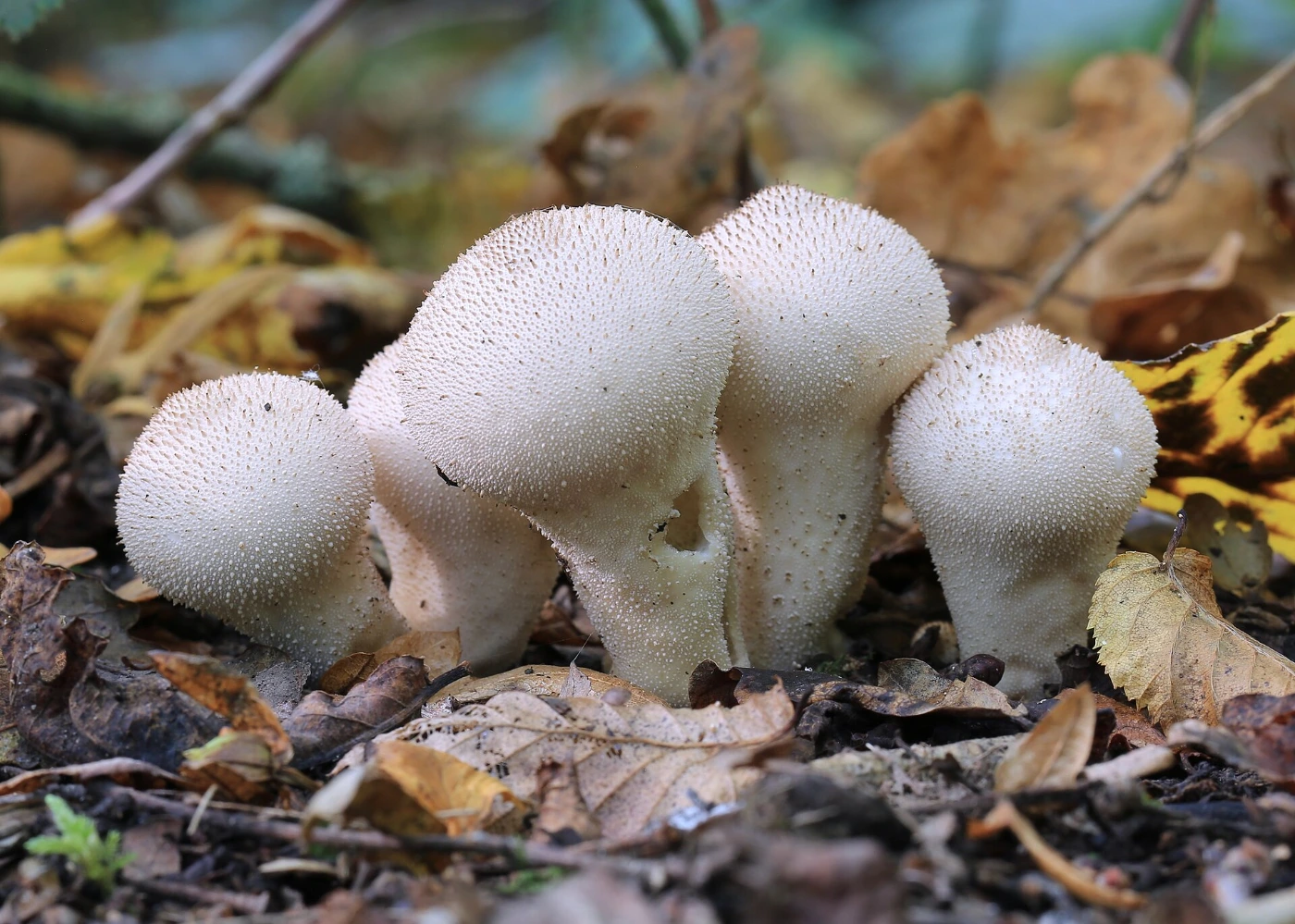
Common Puffball is a small pear-shaped woodland mushroom with numerous pale pointed warts. When these projections fall away, they leave a fine net-like pattern over the surface.
Young fruit bodies contain completely white homogeneous flesh. As the mushroom matures, the inside becomes olive-brown and eventually turns into a powdery spore mass.
November Condition
By November, both young and mature specimens may be present depending on climate. Brown old puffballs can remain visible long after active growth has stopped.
Any young puffball considered for food must be cut vertically. There should be no developing cap, gills, or stem inside.
10. Apioperdon pyriforme — Stump Puffball
Stump Puffball grows in dense groups from decaying logs, stumps, and buried wood. This substrate preference immediately distinguishes it from many terrestrial puffballs.
Fruit bodies are small and pear-shaped, usually pale when young and brown with maturity. Colonies can contain dozens or even hundreds of individual puffballs.
November Colonies
Late-autumn woodland is an excellent time to notice these groups. Even mature fruit bodies can persist on old logs after surrounding fleshy mushrooms have disappeared.
Buried wood sometimes makes the species look terrestrial. Examining the base of the colony often reveals the hidden woody substrate.
11. Trametes versicolor — Turkey Tail
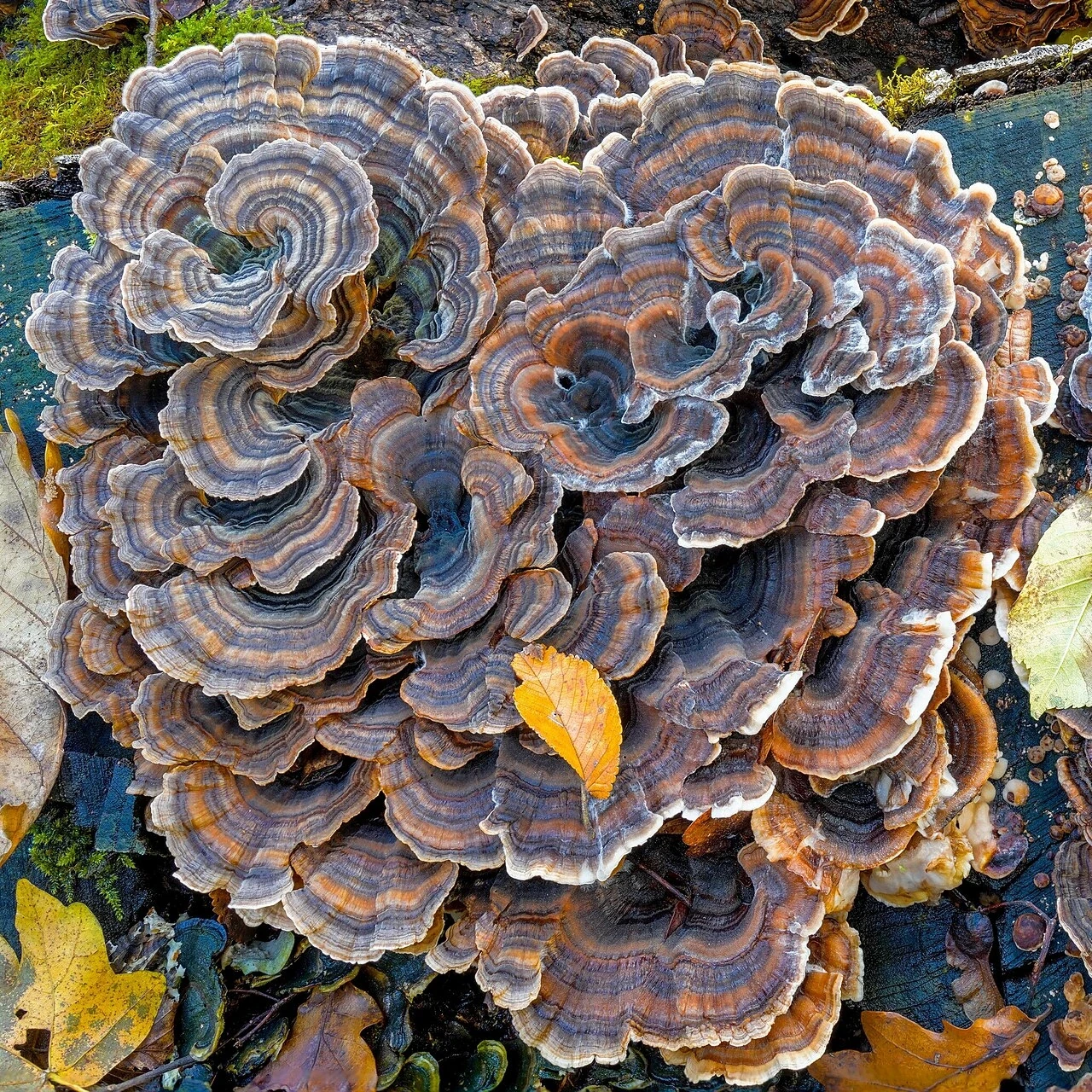
Turkey Tail forms thin, leathery brackets with concentric bands of brown, gray, cream, orange, or bluish tones. Colonies commonly cover fallen hardwood logs and dead branches.
The underside contains tiny pores rather than gills. This is one of the easiest ways to separate true Turkey Tail from several superficially similar Stereum species.
Why Include It in November?
Turkey Tail is much more persistent than typical fleshy mushrooms. Fruit bodies may remain visible for long periods and can be found after frost when many soft species have disappeared.
Wet November weather often makes the colors especially vivid. Dead hardwood provides the most productive habitat.
12. Hygrophoropsis aurantiaca — False Chanterelle
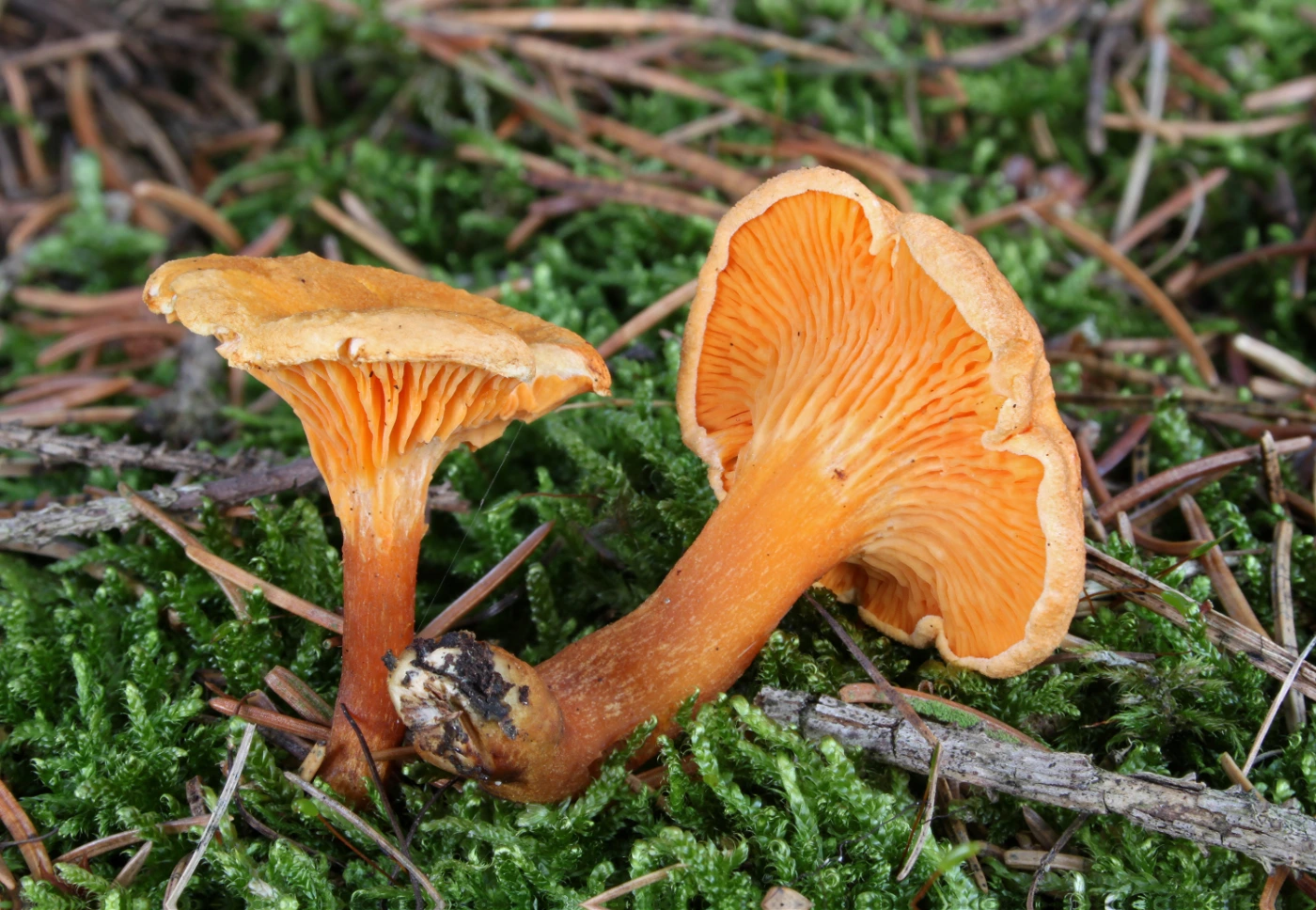
False Chanterelle is an orange woodland mushroom with thin, closely spaced, strongly forked true gills. It frequently grows among conifer litter, decomposing wood, and forest debris.
Its appearance can suggest a true chanterelle at first glance. True chanterelles have blunt ridges rather than thin blades and usually have a firmer, more solid structure.
Late-Season Occurrence
False Chanterelles can remain visible late into autumn in cool moist forests. Northern and western conifer habitats are especially relevant.
November specimens may be faded or rain-damaged. Underside structure is therefore more useful than the exact shade of orange.
13. Tricholoma murrillianum — American Matsutake
American Matsutake is one of western North America’s most notable autumn mushrooms. It forms a large firm white to cream fruit body, often with brownish staining or scales as it matures.
The species is strongly associated with conifer forests and develops partly buried in litter or soil. Its distinctive spicy aromatic odor is an important supporting character.
November in the West
In suitable western habitats, the season can extend into November depending on elevation and weather. Lower elevations and coastal regions may remain productive after colder mountain areas have finished.
Western North American Matsutake should not automatically be called Tricholoma magnivelare. The western species is generally treated as Tricholoma murrillianum.
14. Entoloma abortivum — Shrimp of the Woods
Shrimp of the Woods is a particularly North American autumn mushroom with an unusual appearance. The commonly collected form consists of irregular white to pinkish masses rather than conventional caps and stems.
These structures result from an interaction involving Entoloma abortivum and Honey Mushroom species. Normal grayish Entoloma fruit bodies may also occur nearby.
November Timing
In eastern North America, the season often peaks earlier in autumn, but November finds remain possible during mild years. Late fruit bodies are more likely in areas that have not experienced repeated hard frost.
The species is especially interesting because its unusual form does not look like a typical mushroom. Woodland around Armillaria colonies is the habitat to watch.
15. Sarcomyxa serotina — Late Fall Oyster
Late Fall Oyster, sometimes called Olive Oysterling, grows in overlapping clusters on hardwood logs. Caps are usually olive-green, yellow-green, brownish, or ochre and have a short lateral attachment.
Its season is reflected in the common name. The mushroom is particularly associated with cool late-autumn conditions and may remain visible when many other fleshy species have stopped fruiting.
How It Differs From Oyster Mushroom
Late Fall Oyster generally has more olive or yellow-green coloration than typical Pleurotus ostreatus. Its texture and overall appearance are also somewhat different.
Both grow on hardwood and can occur in overlapping seasons. A careful examination of cap color, gills, and attachment is useful when they share the same forest.
Pacific Northwest in November
The Pacific Northwest is arguably the most productive major North American region in November. Coastal Washington, Oregon, British Columbia, northern California, and parts of Alaska receive abundant moisture while temperatures can remain suitable for fungal growth.
Winter Chanterelles, Pacific Golden Chanterelles, Oyster Mushrooms, American Matsutake, Flammulina, and numerous wood-decaying species may still be active. Elevation matters greatly, with coastal lowlands often remaining productive after mountain sites become cold or snowy.
California in November
November can mark the beginning of significant fungal activity in many parts of California because the first sustained autumn rains arrive after the dry season. The exact timing varies sharply between the north coast, Sierra Nevada, Central Coast, southern California, and inland regions.
Woodlands, lawns, wood-chip beds, and dead wood can all respond rapidly to rainfall. Honey Mushrooms, Oyster Mushrooms, lawn fungi, and numerous mulch species may appear as moisture returns.
Northeast and Midwest in November
In the Northeast and upper Midwest, November is much more dependent on frost. Early in the month, woodland and grassland mushrooms may still be active, while repeated freezes can sharply reduce diversity later.
Wood-growing fungi become increasingly important as temperatures decline. Oyster Mushrooms, Velvet Shanks, Turkey Tail, puffballs, and late wood decomposers are often more realistic targets than classic early-autumn boletes.
Southern United States in November
November can remain very productive across parts of the Southeast and other mild southern regions. Lower temperatures may actually improve conditions compared with hot late summer, particularly when rainfall is adequate.
The species mix differs substantially from northern forests. Local guides and regional taxonomy become particularly important because many southern species have ranges that do not extend far north.
Canada in November
Coastal British Columbia can retain excellent mushroom conditions well into November, particularly in moist conifer forests. Interior and eastern Canadian regions generally become much colder much earlier.
Snow and frozen ground can quickly end conventional terrestrial mushroom hunting. Persistent brackets and wood-growing species remain visible long after many ground-fruiting fungi disappear.
Are Porcini Still Found in November?
King boletes can occasionally persist into November in mild western or coastal areas, but they are no longer dependable across most of North America. Their main season usually occurs earlier.
A November porcini is therefore better treated as a late-season possibility than a primary target. Weather, elevation, and regional species determine whether fruiting continues.
Can Chanterelles Still Be Found in November?
Yes, particularly in western North America. Pacific Golden Chanterelles can continue during mild wet autumn weather, while winter chanterelles become increasingly important as the season progresses.
The situation is very different in cold inland regions. By November, local chanterelle seasons may already have ended completely.
What Happens After the First Frost?
A light frost does not instantly end the mushroom season. Oyster Mushrooms, Velvet Shanks, and several other cold-tolerant species can continue growing in very cool conditions.
Repeated freeze-thaw cycles are more damaging to soft mushrooms. Old fruit bodies can become watery, discolored, and difficult to identify accurately.
Best Habitats to Search in November
Dead hardwood is one of the most dependable November substrates because Oyster Mushrooms, Turkey Tail, Velvet Shanks, and other decomposers can continue producing fruit bodies late in the season. Stumps, logs, buried roots, and fallen branches deserve close attention.
In the Pacific Northwest, damp mossy conifer forest is particularly productive. In California, recently rain-soaked woodland, lawns, and mulch beds become more important as the wet season begins.
Why Rain Matters More in November
Late-autumn temperatures are already cool across much of the continent, so moisture often becomes the other major limiting factor. A sustained period of rain can produce a dramatic flush when temperatures remain above freezing.
This is especially important on the West Coast, where autumn rain follows a dry summer. A few wet systems can transform previously dry ground into productive fungal habitat.
Common November Identification Mistakes
One common mistake is using European mushroom calendars for North America without adjustment. The Pacific Northwest, California, eastern forests, and northern interior all have very different November patterns.
Another mistake is assuming that any late mushroom must be a cold-weather species. Ordinary autumn mushrooms can persist during mild years, especially before sustained frost.
Weather damage also creates confusion. Frost and repeated rain can remove veil remnants, fade caps, darken gills, and alter textures that would be obvious in a fresh specimen.
Interesting Facts
In much of western North America, November is not really the end of mushroom season. Winter Chanterelles can be entering their main fruiting period just as northern inland forests are shutting down.
California creates an even more striking contrast because the fungal calendar is strongly influenced by the arrival of winter rain. A dry October can be relatively quiet, while November rains suddenly produce numerous fruit bodies.
Late-autumn mushroom hunting also shifts attention toward wood. Logs, stumps, and dead branches become increasingly useful because many wood-decaying fungi tolerate cold conditions better than short-lived terrestrial mushrooms.
North America’s size makes mushroom season a moving target. On the same November day, one person may be hunting chanterelles in a rainy Oregon forest while another is walking across frozen ground in northern Minnesota.
Frequently Asked Questions
Is November a good month for mushroom hunting in North America?
Yes, but the answer depends heavily on region. The Pacific Northwest and parts of California can be very productive, while colder northern and interior areas may already be near the end of the season.
What are the best November mushrooms in the Pacific Northwest?
Winter Chanterelles are one of the most characteristic late-season targets, and Pacific Golden Chanterelles may also continue. Oyster Mushrooms, Matsutake, and numerous wood-growing fungi can remain active as well.
Are there mushrooms in California in November?
Yes. Autumn rain can start a major fungal season after the dry summer, particularly in wetter coastal and northern regions.
Can Oyster Mushrooms grow after frost?
Yes. Oyster Mushrooms tolerate cool weather well and can fruit after light frosts, although severe repeated freezing eventually damages individual fruit bodies.
Can I still find puffballs in November?
Yes, especially early in the month or in milder climates. Mature brown puffballs may also remain visible long after their growth has finished.
Are chanterelles still available in November?
In western North America, yes, particularly in the Pacific Northwest. In colder eastern and inland regions, local chanterelle seasons may already be over.
Does snow end mushroom season completely?
Snow and frozen soil greatly reduce ground-fruiting activity, but persistent wood fungi remain visible. Mild periods can also allow some cold-tolerant species to resume growth.
Why does California have a later mushroom season?
Much of California has dry summers and receives more moisture during the cool season. The arrival of autumn and winter rain can therefore trigger fungal activity at a time when colder continental regions are already freezing.
Final Notes
November mushroom hunting in North America is defined by geography. Winter Chanterelles and Pacific Golden Chanterelles remain important in the Pacific Northwest, California begins responding to autumn rains, while colder northern and interior regions increasingly shift toward Oyster Mushrooms, Velvet Shanks, Turkey Tail, puffballs, and other late wood-growing fungi.
The best November strategy is therefore not simply to search for the same autumn mushrooms found in September. Follow rainfall, temperature, elevation, and habitat, and pay increasing attention to logs, stumps, mossy conifer forests, and other places where cold-tolerant fungi thrive.
Season should always remain secondary to morphology. A November mushroom still needs to match its cap, underside, stem, substrate, spore characters, and relevant look-alikes before a species identification is accepted.
Upload a photo and get possible matches in seconds.