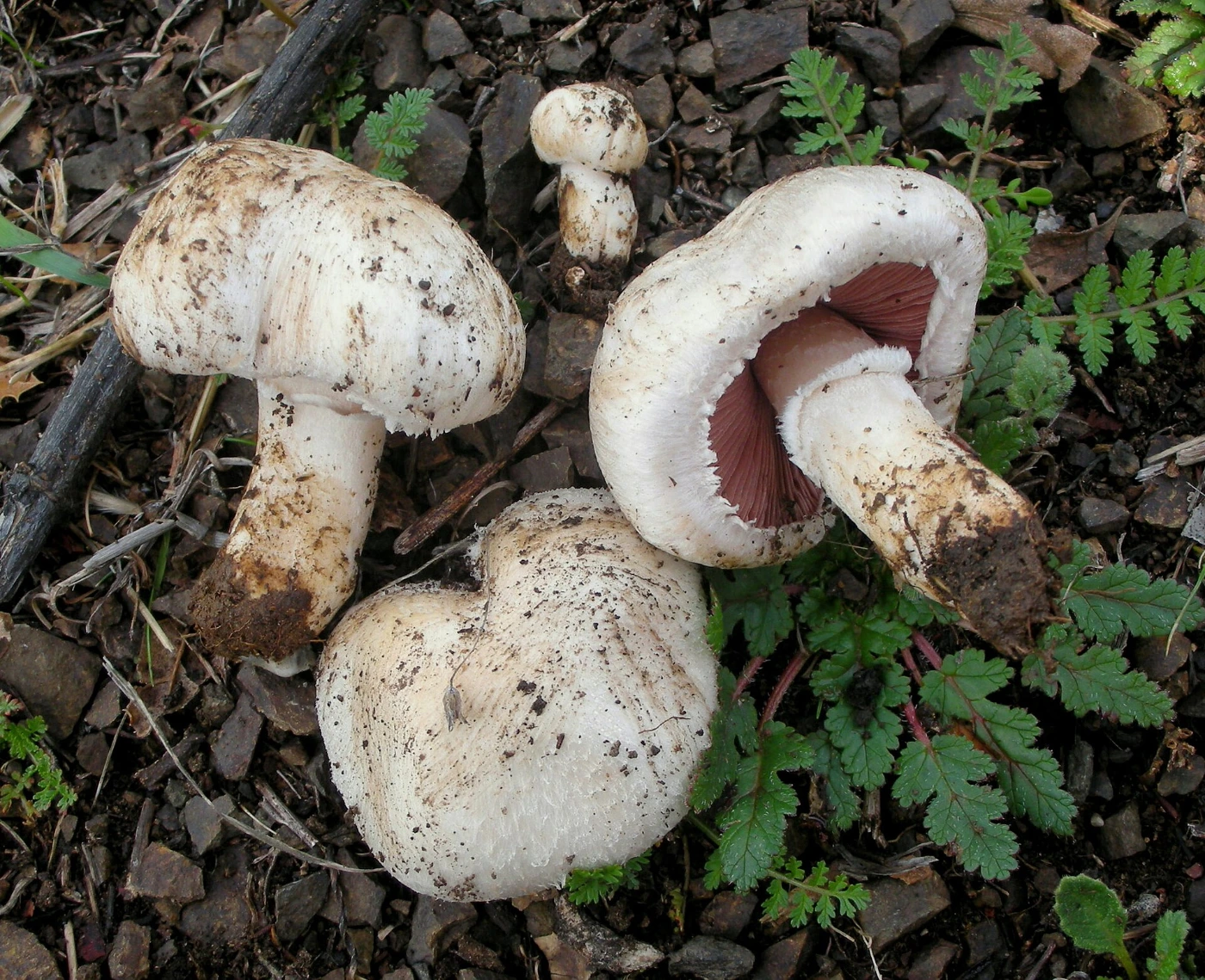
Agaricus bisporus, commonly known as the Button Mushroom, is the familiar cultivated mushroom sold in supermarkets around the world. White Button Mushrooms, brown Cremini, and mature Portobello mushrooms all belong to the same species, although cultivated strains differ in color and they are harvested at different stages of development.
Wild Agaricus bisporus is less obvious than the packaged form from a grocery store. It usually has a white to brown cap, free gills that begin pink and mature to chocolate-brown, a stem ring, dark brown spores, and no volva at the base.
The strongest identification pattern is pink-to-brown free gills + stem ring + dark brown spore print + no volva + slight pinkish or reddish bruising. These features should be considered together because several other Agaricus species can look surprisingly similar.
⚠️ Important: Never identify a wild Button Mushroom only because it resembles supermarket mushrooms. Poisonous Agaricus, especially the Yellow Stainer group, can have a very similar white cap and ring, while dangerous white Amanita species can superficially resemble young buttons before their gills are visible.
Quick Identification
| Feature | Agaricus bisporus |
|---|---|
| Common name | Button Mushroom |
| Other market names | White Button, Cremini, Portobello |
| Cap | White, cream, tan, or brown |
| Cap size | About 2.5–14 cm |
| Young cap | Round to convex |
| Mature cap | Broadly convex to almost flat |
| Gills | Free, pink when young, dark chocolate-brown when mature |
| Stem | White to pale, relatively stout |
| Ring | Present, usually thin |
| Volva | Absent |
| Flesh | White, firm |
| Bruising | Often pinkish to reddish, later brownish |
| Odor | Mild, pleasant, mushroom-like |
| Spore print | Dark brown |
| Ecology | Saprobic |
| Habitat | Compost-rich soil, lawns, disturbed ground |
| Edibility | Edible when correctly identified |
What Does Agaricus bisporus Look Like?
The Button Mushroom has the classic cap-and-stem form familiar from supermarkets. Young fruit bodies are compact and rounded, while mature mushrooms expand and expose increasingly dark gills.
Wild specimens can be white, cream, tan, or brown depending on strain, age, moisture, and local population. The surface may be smooth or covered with fine flattened fibers or very small scales.
The most important features are underneath the cap and at the stem base. The gills change from pink to deep brown, a ring is usually present on the stem, and there should be no sack-like volva surrounding the base.
Cap
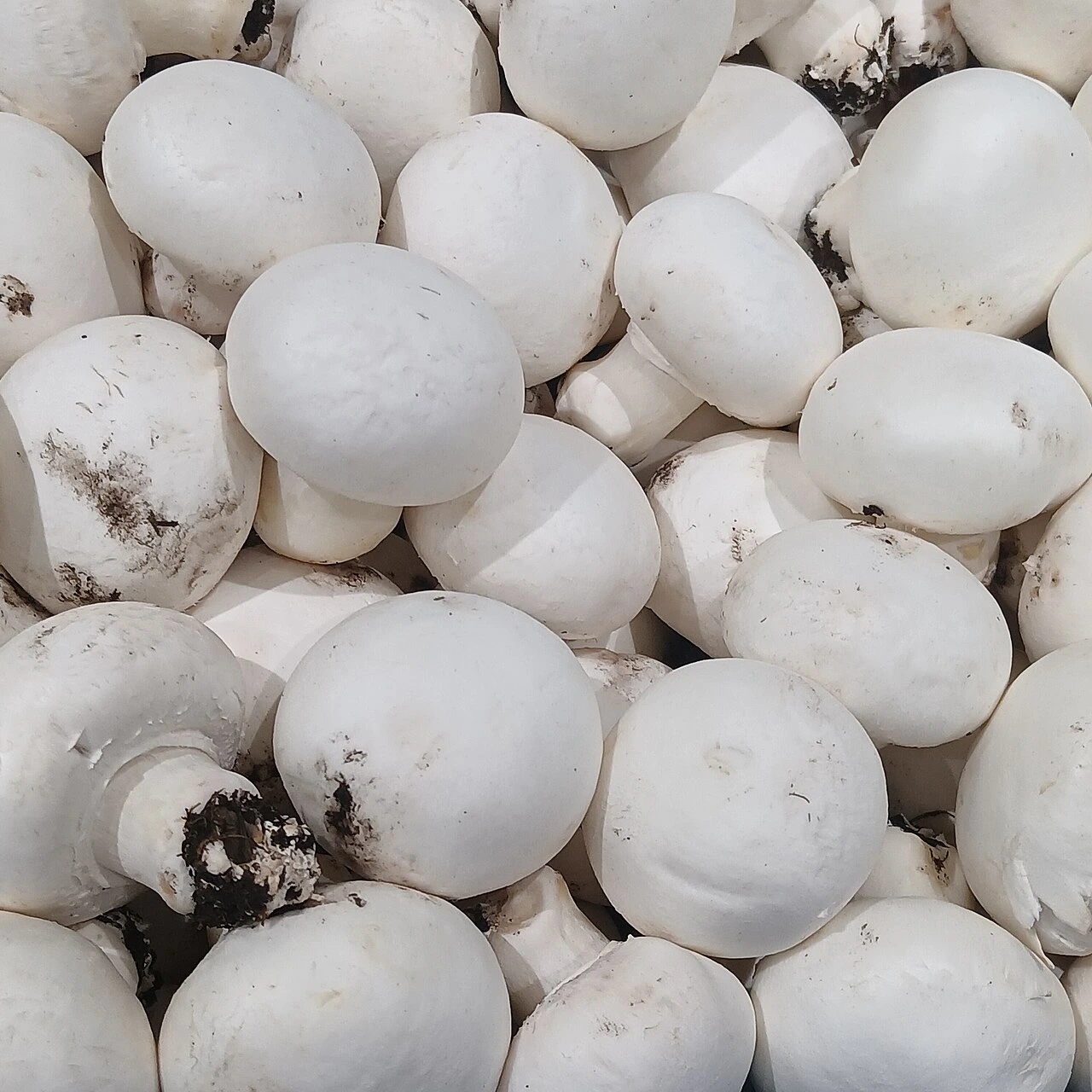
The cap is approximately 2.5–14 cm across. It begins nearly round or strongly convex and gradually opens to broadly convex or almost flat with maturity.
White cultivated strains have white to creamy caps, while brown strains range through tan, chestnut, and chocolate-brown. Wild material can also show either pale or brown coloration, so cap color alone does not distinguish the species.
The surface is generally dry and smooth to finely fibrillose. Older brown specimens can develop subtle flattened scales, but a strongly shaggy or dramatically scaly cap should prompt comparison with another Agaricus.
Gills
Gill color is one of the most important identification features. Young gills are pinkish to flesh-pink and progressively darken through brown toward dark chocolate-brown or almost black-brown as spores mature.
The gills are free from the stem, meaning they stop just before reaching it rather than running directly into the stem. This character becomes easier to see once the cap has opened.
Very young buttons can hide the gills behind the partial veil. This is why cutting or opening an immature wild specimen can be necessary for identification rather than judging only the closed exterior.
Stem
The stem is generally 2–7 cm long and 1–2.5 cm thick. It is white or pale, relatively firm, and often approximately equal in width from top to bottom.
A partial veil covers the young gills and later tears to leave a thin ring on the stem. The ring may become weak or disappear in older specimens, so its absence on a weathered mushroom does not automatically rule out A. bisporus.
The base lacks a true volva. This distinction is particularly important when comparing a pale Agaricus with dangerous white Amanita species.
Flesh and Bruising
The flesh is white, dense, and firm. When rubbed, cut, or bruised, it may develop pinkish to reddish coloration and later become brownish.
The staining is generally much less dramatic than the vivid chrome-yellow reaction characteristic of the Yellow Stainer group. A bright immediate yellow reaction, especially at the stem base, is a warning sign for another species.
Odor
The odor is usually mild and pleasant, resembling the familiar smell of cultivated mushrooms. There should not be a strong phenolic, medicinal, iodine-like, or ink-like smell.
Odor becomes especially useful when distinguishing Button Mushrooms from Agaricus xanthodermus. Yellow Stainers often produce a distinct phenolic odor that becomes even stronger when the mushroom is heated.
Spore Print
The spore print is dark brown. This is characteristic of the genus Agaricus, whose mature gills also become dark brown as spores accumulate.
Spore color is particularly useful when excluding white-spored Amanita. It is less useful for separating A. bisporus from other Agaricus, because many members of the genus share dark brown spores.
Why Is It Called Agaricus bisporus?
The name bisporus refers to the characteristic production of two spores on many basidia, rather than the four spores typical of many basidiomycete mushrooms. MushroomExpert notes that basidia in A. bisporus are predominantly two-spored.
This microscopic feature is useful when distinguishing difficult Agaricus species. It is not something that can normally be evaluated from ordinary field photographs.
Current Taxonomy
The accepted name is Agaricus bisporus (J.E. Lange) Imbach, published in its current combination in 1946. Species Fungorum places it in Agaricaceae within Agaricales and treats names such as Agaricus brunnescens as synonyms.
The basionym traces back to Psalliota hortensis f. bispora, described by J.E. Lange in 1926. The species therefore has a history of older horticultural and Psalliota names in cultivation literature.
Button Mushroom, Cremini, and Portobello
One of the most common misunderstandings is that White Button, Cremini, and Portobello are completely different mushroom species. They are all marketed forms of Agaricus bisporus.
White Button Mushrooms come from pale cultivated strains and are harvested while relatively young. Brown strains are sold as Cremini when harvested younger and as Portobello when allowed to expand into large mature mushrooms.
White Button Mushroom
White Buttons are the smallest and most familiar supermarket form. The cap remains closed or only slightly expanded, and the partial veil may still conceal much of the gill surface.
Their flavor is relatively mild and their flesh is firm. This young stage is especially suitable for commercial handling because the mushrooms remain compact.
Cremini Mushroom
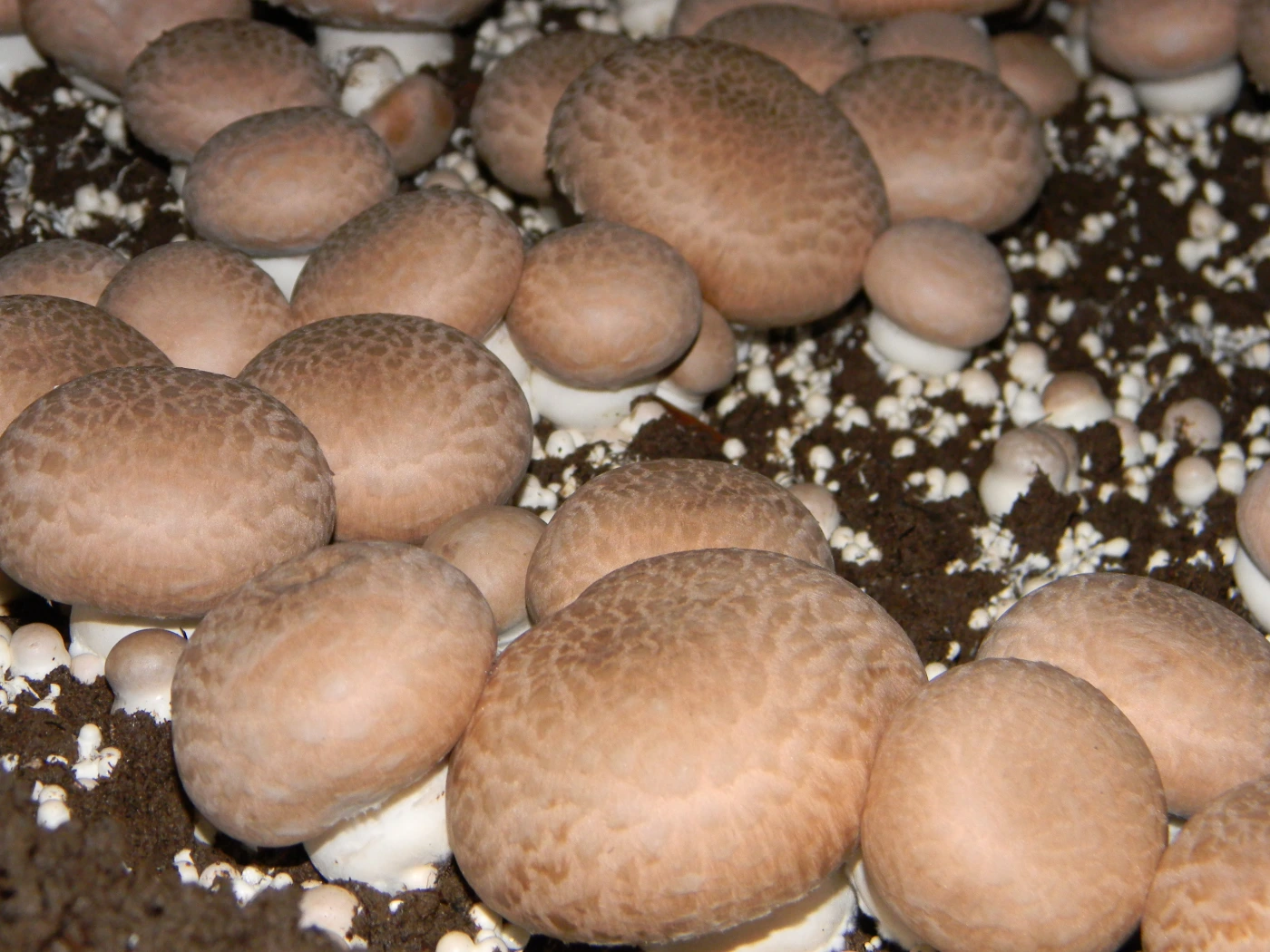
Cremini, also spelled Crimini, is the brown form of Agaricus bisporus harvested while still relatively young. It is sometimes marketed as a Baby Bella or Baby Portobello.
The brown cap reflects the cultivated strain rather than a different species. Penn State describes brown commercial strains as the source of both Crimini and Portabella mushrooms.
Portobello Mushroom
Portobello is the mature large form of the brown cultivated Button Mushroom. As the cap expands, the veil breaks and the dark chocolate-brown gills become fully exposed.
The expanded cap has a stronger flavor and different texture from a young Cremini. Biologically, however, it remains Agaricus bisporus.
Where Does Agaricus bisporus Grow?
Agaricus bisporus is saprobic, meaning it obtains nutrients from decomposing organic material rather than forming a mycorrhizal partnership with living trees. Wild specimens are associated with rich soil, compost, lawns, gardens, and other disturbed habitats.
MushroomExpert notes occurrences in lawns and compost piles, while commercial cultivation takes advantage of its ability to colonize carefully prepared composted substrates.
Because it is saprobic, the presence of a particular tree species is not necessary for identification. This differs from mycorrhizal genera such as Amanita, Boletus, and many Tricholoma.
Wild vs Cultivated Button Mushrooms
Cultivated mushrooms are selected for predictable color, size, yield, texture, and growth characteristics. Commercial strains therefore tend to look more uniform than naturally occurring fruit bodies.
Wild A. bisporus can show more variation in cap color, bruising, shape, and surface texture. A wild white Agaricus should never be assumed to be the same safe species simply because it resembles a supermarket button.
Commercial mushrooms are also grown under tightly controlled conditions. Penn State describes the cultivation process as involving compost preparation, spawning, colonization, casing, pinning, and cropping.
How Button Mushrooms Are Cultivated
Commercial production begins with a composted substrate prepared to support Agaricus mycelium. Growers inoculate the substrate with mushroom spawn, traditionally produced by growing pure mycelial cultures on sterilized cereal grain.
After the mycelium colonizes the substrate, a casing layer and environmental changes help trigger fruiting. Temperature, moisture, ventilation, and carbon dioxide must all be carefully controlled during commercial production.
Mushrooms then develop in successive flushes or breaks. Penn State notes that the first two flushes usually provide most of the crop yield, after which production gradually declines.
Why Store-Bought Buttons Stay Closed
Commercial growers often harvest Button Mushrooms before the cap fully expands. This produces the familiar compact mushroom with the veil still covering or partly covering the gills.
Closed mushrooms are easier to package and transport and have the visual appearance many consumers expect. Other buyers prefer mature mushrooms with opened caps and stronger flavor.
Opening of the cap is a normal developmental process rather than spoilage by itself. Once the veil tears, the pink gills become visible and later darken as spores mature.
How to Identify a Wild Button Mushroom Step by Step
Start by turning the mushroom over and checking the gills. Pink young gills becoming chocolate-brown strongly support Agaricus, while permanently white gills point elsewhere.
Next, check whether the gills are free from the stem and whether a ring is present. Dig out the complete stem base rather than cutting it off, because the absence of a volva is an important distinction from Amanita.
Finally, bruise or cut the stem base and smell the mushroom. Mild reddish or brownish staining and an ordinary mushroom odor fit A. bisporus, while immediate vivid yellow staining combined with a phenolic odor strongly argues for a Yellow Stainer.
Look-Alikes
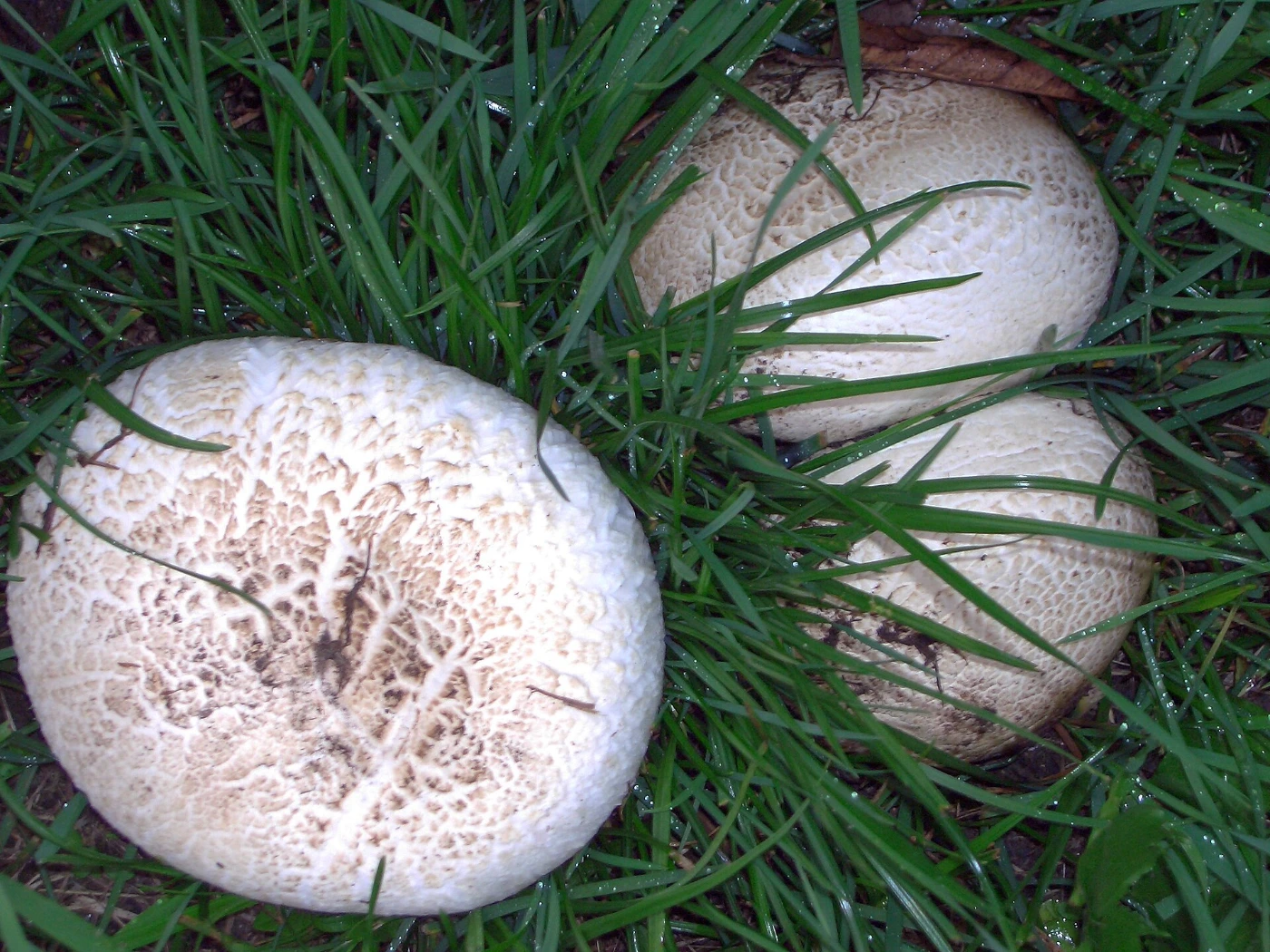
Several Agaricus species can resemble the Button Mushroom closely. The most important practical comparisons involve poisonous Yellow Stainers and superficially similar edible Agaricus, while white Amanita mushrooms require attention because the consequences of confusion can be much more serious.
Agaricus xanthodermus — Yellow Stainer
Identification
Yellow Stainer is a white to pale Agaricus with free gills that progress toward pink and brown and a prominent stem ring. From above, it can look extremely similar to a wild Button Mushroom.
The key reaction is rapid bright chrome-yellow staining, particularly when the base of the stem is cut or bruised. It also commonly produces an unpleasant phenolic, ink-like, iodine-like, or chemical odor, especially when heated.
Main Difference
Rapid vivid yellow staining at the stem base + phenolic smell favors Yellow Stainer. Mild pinkish/reddish bruising + pleasant mushroom odor fits Button Mushroom better.
Yellow Stainer causes gastrointestinal poisoning and should not be eaten. Because both species can occur in parks, gardens, and disturbed ground, habitat does not reliably separate them.
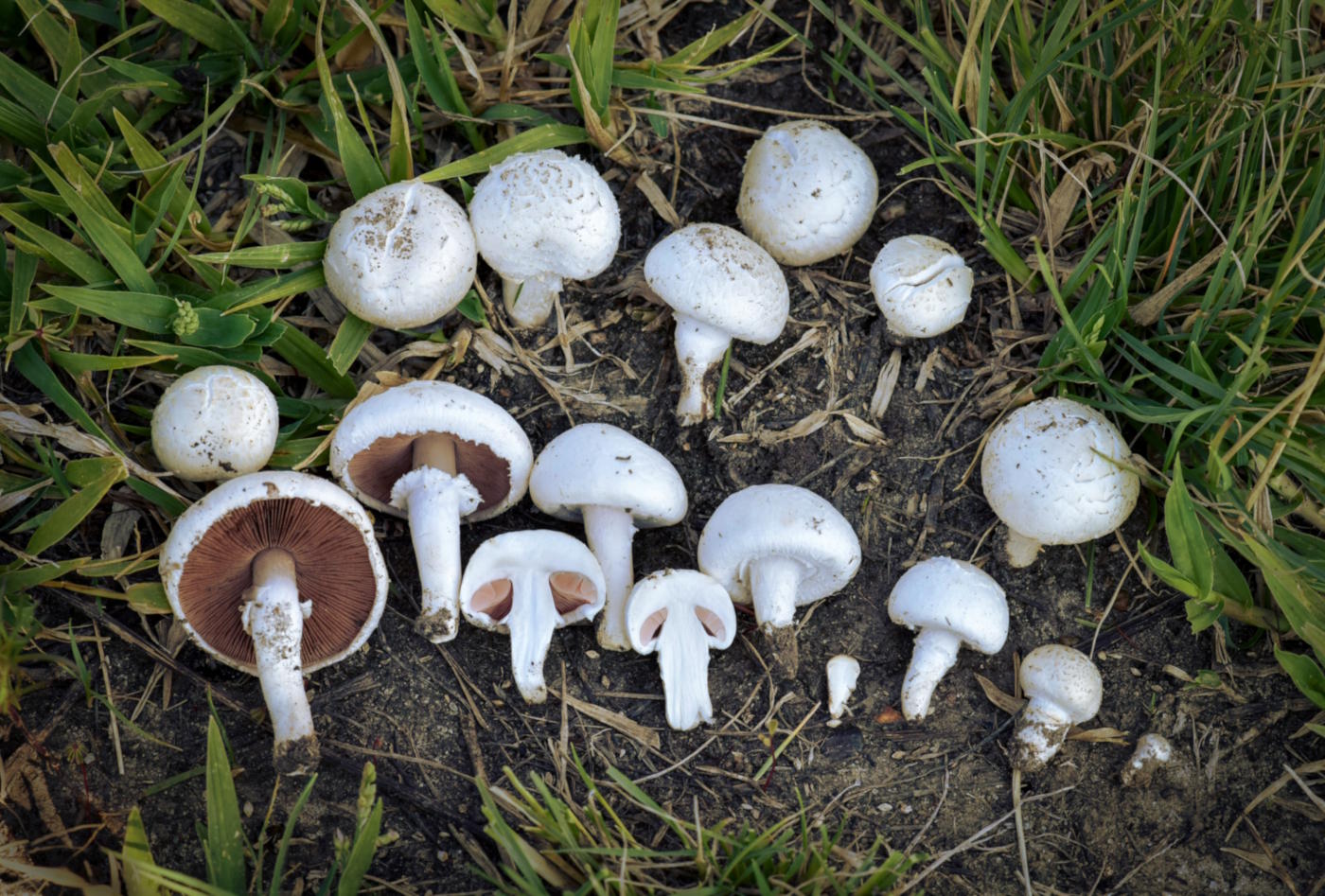
Agaricus campestris — Field Mushroom
Identification
Field Mushroom is another edible Agaricus with pink young gills, dark mature spores, and no volva. It commonly occurs in grassland and can overlap with A. bisporus in overall appearance.
Its cap is generally white to cream and the mushroom tends to have a more classic open grassland form. The ring is often relatively weak or short-lived compared with many cultivated Button Mushroom strains.
Main Difference
Field Mushroom is strongly associated with open grassland and generally has a less persistent ring, while A. bisporus is especially associated with rich disturbed soil and compost.
The distinction can be difficult from photographs alone. Microscopic characters and regional ecology may be needed for uncertain wild specimens.
Agaricus bitorquis — Pavement Mushroom
Identification
Agaricus bitorquis is a robust mushroom that often grows through compacted soil, paths, and pavement edges. It has firm flesh and a distinctive low double or sheathing ring.
Its gills eventually become brown, but MushroomExpert notes that they may bypass the obvious pink stage seen in A. bisporus. The flesh is also notably tougher.
Main Difference
A tough mushroom growing through hard-packed ground with a double or sheathing ring favors A. bitorquis. A softer mushroom with gills clearly progressing from pink to brown fits A. bisporus better.
Both can occur in human-disturbed environments, so cap color alone is not useful.
Amanita Species
Identification
Young white Amanita fruit bodies can superficially resemble closed Button Mushrooms before their cap has fully expanded. Some deadly species have white caps, white stems, rings, and relatively ordinary mushroom shapes.
Their gills and spores remain white, and many species possess a volva or other universal-veil structures at the stem base. Those features sharply distinguish them from mature Agaricus.
Main Difference
Agaricus bisporus has pink-to-brown gills and dark brown spores with no volva. Amanita typically has white gills and white spores, and dangerous species may have a volva at the stem base.
Never leave the stem base behind when collecting an unknown pale mushroom for identification. Missing the volva can remove one of the most important warning characters.
Button Mushroom vs Yellow Stainer
| Feature | Button Mushroom | Yellow Stainer |
|---|---|---|
| Scientific name | A. bisporus | A. xanthodermus |
| Young gills | Pink | Pale, then pink |
| Mature gills | Chocolate-brown | Gray-brown to dark brown |
| Ring | Present | Present, often prominent |
| Stem-base bruising | Pinkish/red-brown possible | Rapid chrome yellow |
| Odor | Mild, pleasant | Phenolic, chemical, iodine-like |
| Spore print | Dark brown | Very dark brown |
| Volva | None | None |
| Edibility | Edible | Poisonous |
The stem base is particularly useful. Yellow Stainer often produces its strongest yellow reaction there, so cutting through the complete base can reveal a clue that is not obvious from the cap.
Odor provides a second independent feature. Combining vivid yellow staining with a strong chemical smell is far more informative than either white cap color or habitat.
Button Mushroom vs Amanita
| Feature | Button Mushroom | Amanita |
|---|---|---|
| Young gills | Pink | Usually white |
| Mature gills | Chocolate-brown | Usually remain white |
| Spore print | Dark brown | White |
| Ring | Usually present | Often present |
| Volva | Absent | Present in many dangerous species |
| Ecology | Saprobic | Usually mycorrhizal |
| Main clue | Pink → brown gills | White gills + basal structures |
The gill-color progression is one of the simplest distinctions. A mature mushroom with genuinely white gills should not be identified as Agaricus bisporus.
Very young specimens require more caution because the gills may still be hidden. Exposing the underside and preserving the complete stem base are therefore essential.
Is Agaricus bisporus Edible?
Yes. Agaricus bisporus is one of the world’s major cultivated edible mushrooms and is the species behind White Button, Cremini, and Portobello mushrooms. Penn State describes it as the commercial mushroom crop that dominates U.S. production.
The important qualification is correct identification of wild specimens. A mushroom that merely resembles a supermarket Button Mushroom should not be treated as edible until poisonous Agaricus and other look-alikes have been excluded.
Commercially produced mushrooms do not present this identification problem because they are grown from controlled strains. The wild-foraging problem begins when an unknown white or brown Agaricus is assumed to be A. bisporus from appearance alone.
Can Button Mushrooms Be Eaten Raw?
Cultivated Button Mushrooms are commonly eaten raw in salads and other foods, although cooking changes texture and flavor. Individual digestive tolerance varies, and cooking is generally easier on the digestive system for many mushrooms.
This culinary use should not be generalized to wild Agaricus. A wild mushroom should first be identified independently of how familiar or supermarket-like it appears.
Why Do Button Mushroom Gills Turn Brown?
The gills darken because the mushroom is maturing and producing large numbers of brown spores. Young fruit bodies have pink gills, while older mushrooms develop progressively deeper chocolate-brown coloration.
This change is normal and is one of the defining features of the genus. It also explains why Portobello mushrooms have conspicuously dark exposed gills while young supermarket Buttons may show almost none.
Why Are Some Button Mushrooms White and Others Brown?
Commercial cultivation uses different strains of the same species. White strains produce the familiar pale Button Mushroom, while brown strains produce Cremini and mature Portobello mushrooms.
Color therefore does not indicate a separate species. A white Button and a brown Cremini can both be Agaricus bisporus despite looking substantially different.
Wild populations also show color variation. This is another reason identification should rely on gills, ring, bruising, odor, spore color, and ecology rather than cap color.
Common Identification Mistakes
One common mistake is assuming that every white Agaricus is a Button Mushroom. Several poisonous Yellow Stainers look extremely similar before the stem base is bruised or the odor is checked.
Another mistake is treating white gills as normal for A. bisporus. Very young gills can be pale, but they should develop pink tones and later become chocolate-brown; persistent white mature gills suggest another genus.
A third mistake is cutting off the stem base before identification. Doing this can hide a volva on an Amanita or remove the area where a Yellow Stainer shows its strongest chrome-yellow reaction.
A fourth mistake is treating Cremini and Portobello as separate species. They are commercial forms of A. bisporus, and the differences primarily reflect strain and maturity.
How to Photograph Agaricus bisporus
Take one photograph from above to document the cap color and texture. Then photograph the underside clearly enough to show gill color and whether the gills touch the stem.
Include the complete stem and stem base, with the ring visible. A photograph taken immediately after cutting or bruising the base can document color reactions that disappear or change after several minutes.
Habitat should also be photographed. Lawn, compost, garden soil, pavement edges, woodland, and nearby trees can help distinguish competing Agaricus species.
Can AI Identify a Button Mushroom?
AI can often recognize a typical Agaricus when photographs show the cap, pink-to-brown gills, ring, and overall shape. Species-level identification is considerably harder because many Agaricus share the same basic structure.
The most important information may not appear in a single image. Odor, rapid yellow staining at the stem base, bruising progression, and a complete view of the base can all change the identification.
For this reason, an AI system should first decide whether the specimen fits Agaricus and then explicitly test dangerous alternatives such as the Yellow Stainer group. It should not infer edibility merely because the mushroom resembles a supermarket Button.
Interesting Facts
Button, Cremini, and Portobello mushrooms demonstrate how strongly harvest stage can affect the appearance of a single species. A closed pale supermarket button and a large open brown Portobello can look like different mushrooms despite belonging to Agaricus bisporus.
The species name also records an unusual reproductive feature. Many basidia in A. bisporus produce two spores rather than the four commonly associated with basidiomycete fungi.
Commercial cultivation is far more complex than simply keeping mushrooms in a dark room. Modern production controls compost preparation, mycelial growth, casing, moisture, temperature, ventilation, carbon dioxide, pinning, and successive harvest flushes.
Frequently Asked Questions
What is the scientific name of the Button Mushroom?
The accepted scientific name is Agaricus bisporus. Species Fungorum currently lists this as the accepted name within Agaricaceae.
Are Button Mushrooms and Portobello the same species?
Yes. White Button, Cremini, and Portobello mushrooms are commercial forms of Agaricus bisporus, although white and brown cultivated strains differ in pigmentation and the mushrooms are harvested at different stages.
Is Cremini the same mushroom as Button Mushroom?
Yes. Cremini is the younger brown commercial form of Agaricus bisporus, while Portobello is the mature expanded form of the brown strain.
What color are Button Mushroom gills?
Young gills are pinkish or flesh-colored and become dark chocolate-brown as the mushroom matures. Permanently white mature gills are inconsistent with normal A. bisporus.
What color is the spore print?
The spore print is dark brown. This separates Agaricus from white-spored genera such as Amanita, although it does not distinguish A. bisporus from every other Agaricus.
Does Agaricus bisporus have a ring?
Yes, a thin ring is normally present after the partial veil breaks. It can become weak or disappear in older mushrooms.
Does Button Mushroom have a volva?
No. A sack-like volva at the stem base strongly argues against Agaricus bisporus and should raise concern for an Amanita or another genus.
How can I tell Button Mushroom from Yellow Stainer?
Bruise or cut the stem base and check the odor. Yellow Stainer develops a rapid vivid chrome-yellow reaction and commonly smells phenolic or chemical, while Button Mushroom more typically bruises pinkish or reddish-brown and has a pleasant mushroom odor.
Where does wild Agaricus bisporus grow?
It is saprobic and can occur in lawns, compost-rich areas, gardens, disturbed ground, and similar organic-rich habitats. Unlike mycorrhizal mushrooms, it does not require a specific host tree.
Can a supermarket Button Mushroom produce spores?
Yes. If allowed to mature and open fully, its dark gills produce very large numbers of spores. Commercial Buttons are simply often harvested before reaching this open mature stage.
Final Identification Notes
Agaricus bisporus, the Button Mushroom, is best identified by the combination of white to brown cap, free gills that progress from pink to chocolate-brown, a stem ring, dark brown spores, no volva, mild odor, and usually pinkish-to-reddish rather than vivid yellow bruising. These characters distinguish the familiar cultivated species from many superficially similar wild mushrooms.
The most important poisonous comparison is the Yellow Stainer (Agaricus xanthodermus), which typically produces rapid chrome-yellow staining at the stem base together with a phenolic or chemical odor. White Amanita species represent a different but potentially much more dangerous comparison and are separated by their white spores, persistently pale gills, and often a volva at the stem base.
The practical identification sequence is: pink-to-brown free gills → ring present → no volva → dark brown spores → check bruising → check odor → compare with Yellow Stainer. A supermarket Button Mushroom, Cremini, and Portobello may look very different, but all can belong to the same species, Agaricus bisporus.
Upload a photo and get possible matches in seconds.