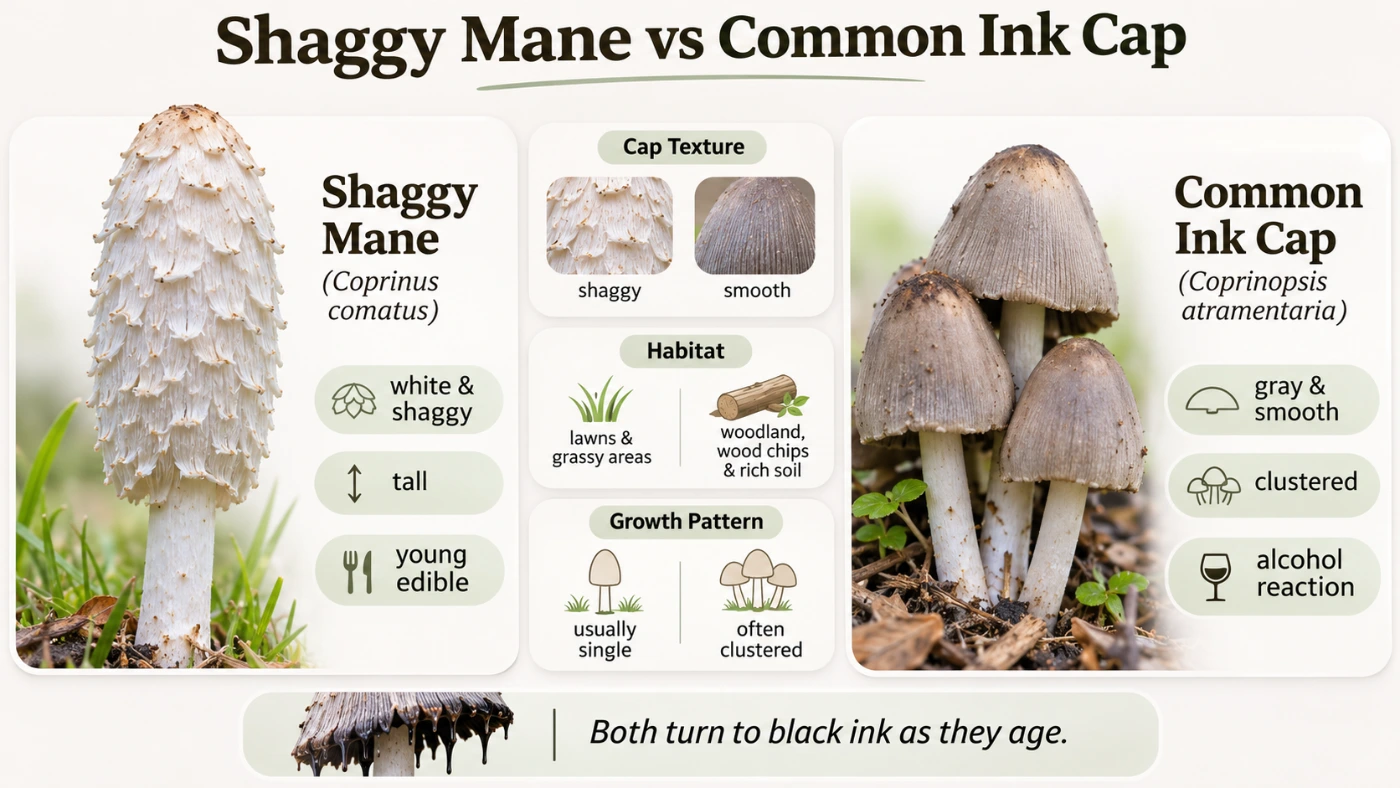
Shaggy Mane (Coprinus comatus) and Common Ink Cap (Coprinopsis atramentaria) are two familiar mushrooms that eventually dissolve into black, ink-like liquid as they mature. Despite this shared behavior, fresh specimens are usually quite different: Shaggy Mane is tall, white, and covered in shaggy scales, while Common Ink Cap is shorter, gray to gray-brown, smoother, and often grows in dense clusters.
The distinction matters for more than identification. Shaggy Mane is widely regarded as edible when very young and correctly identified, while Common Ink Cap contains coprine, a compound that can cause an unpleasant reaction when alcohol is consumed around the same period.
The fastest field rule is: white and shaggy = Shaggy Mane; gray and smooth in clusters = Common Ink Cap. Both species eventually blacken and liquefy, so identification is much easier before deliquescence begins.
⚠️ Important: Never identify an ink cap from the black liquid alone. Several unrelated or closely related mushrooms deliquesce, and important features disappear as the fruit body breaks down.
Quick Comparison
| Feature | Shaggy Mane | Common Ink Cap |
|---|---|---|
| Scientific name | Coprinus comatus | Coprinopsis atramentaria |
| Other common names | Shaggy Ink Cap, Lawyer’s Wig | Inky Cap, Tippler’s Bane |
| Young cap | Tall, cylindrical, white | Egg-shaped to bell-shaped, gray-brown |
| Surface | Strong shaggy scales | Smooth to finely fibrillose |
| Cap height | Often much taller than wide | Usually shorter and broader |
| Stem | Tall, white, hollow | White, smooth, relatively slender |
| Ring | Thin movable ring can be present | Usually no obvious persistent ring |
| Growth | Solitary, scattered, or groups | Often dense clusters |
| Typical substrate | Soil, lawns, disturbed ground | Buried wood, roots, stumps |
| Young gills | White | White to pale |
| Mature gills | Pink, then black | Gray-brown to black |
| Deliquescence | Strong | Strong |
| Spore print | Black | Black |
| Alcohol interaction | Not typical | Coprine reaction |
| Edibility | Edible young when correctly identified | Complicated by alcohol interaction |
The Three Fastest Differences
A young Shaggy Mane usually looks like a tall white cylinder or elongated egg standing on a long white stem. Its cap is covered with conspicuous shaggy, upturned scales that give the mushroom its common name.
A Common Ink Cap is normally gray, gray-brown, or dirty beige rather than bright white. The cap is smoother, shorter, and more bell-shaped, and fruit bodies frequently emerge in close-packed clusters around buried wood or old tree roots.
The third clue is ecological. Shaggy Mane commonly appears from open soil in lawns, roadsides, fields, gardens, and disturbed places, while Common Ink Cap is particularly associated with decaying wood, including wood hidden below the soil surface.
Cap: Shaggy White vs Smooth Gray
The cap is usually the quickest way to separate fresh specimens. Shaggy Mane has a distinctive elongated cap covered with white to cream scales, often with a tan or brownish central patch at the top.
The scales become increasingly loose and shaggy as the mushroom expands. Even from several meters away, mature but still intact specimens can resemble white brushes or old-fashioned wigs, which explains the common name Lawyer’s Wig.
Common Ink Cap looks much more restrained. The cap is usually gray, gray-brown, or pale brown and lacks the large upturned shaggy scales characteristic of Coprinus comatus.
Fine lines or shallow grooves may become visible toward the margin as the cap expands. A few small veil remnants may occur, especially near the center, but the surface never develops the strongly shaggy appearance of a typical Shaggy Mane.
Cap Shape
Young Shaggy Manes have unusually tall, cylindrical or barrel-shaped caps. The cap may be several times taller than it is wide, giving the whole mushroom a narrow vertical silhouette.
As it matures, the lower margin begins opening and curling outward while the gills darken. Deliquescence then progresses upward from the margin.
Common Ink Caps start more egg-shaped and expand into relatively broad bell-shaped or conical caps. Their proportions are much closer to the familiar “umbrella mushroom” shape than the elongated young Shaggy Mane.
Surface Texture
Texture is one of the strongest identification features. A Shaggy Mane should have obvious scales or fibrous patches peeling away from the cap surface.
Common Ink Cap is much smoother. The center may show fine fibers or subtle texture, but a specimen covered in large shaggy white scales is a poor match for Coprinopsis atramentaria.
Rain can flatten or remove some surface features. For that reason, cap texture should be combined with shape, color, habitat, and growth pattern rather than used alone.
Gills
Both mushrooms begin with pale gills and eventually develop black spores. This similarity becomes stronger as the mushrooms age, which is one reason old specimens are harder to separate.
Shaggy Mane gills begin white, develop pinkish tones, and then turn black as spores mature. Eventually the gills and surrounding cap tissue liquefy into black fluid.
Common Ink Cap gills also begin pale and progressively darken through gray-brown toward black. They then deliquesce from the cap margin inward, producing the same characteristic ink-like material.
Because both species do this, blackening gills are not a useful feature for separating them. Identification is strongest while the mushrooms are still young.
Stem
Shaggy Mane has a long, white, hollow stem that emphasizes the mushroom’s tall appearance. A small movable ring can sometimes be found on the stem after the cap expands.
The stem of Common Ink Cap is also pale or white but tends to look more ordinary in proportion to the shorter cap. A strong persistent ring is generally absent.
Stem characters are useful but less obvious than cap shape and texture. The complete mushroom should still be examined because old or damaged specimens can lose rings and other temporary structures.
Growth Pattern
Shaggy Manes can appear singly, scattered, or in groups. Large flushes are common, but individual fruit bodies usually retain enough space to show their separate tall forms.
Common Ink Caps are particularly well known for growing in dense groups or tufts. Several fruit bodies may emerge almost from the same point, especially around old roots or buried stumps.
A tight cluster of smooth gray ink caps should therefore strongly suggest Coprinopsis atramentaria. A loose group of tall white shaggy mushrooms in open grass is much more typical of Coprinus comatus.
Habitat
Shaggy Mane is common in lawns, grassy areas, roadsides, gardens, cemeteries, forest roads, hard-packed ground, and other disturbed habitats. It can appear in remarkably urban environments and is often found after rain.
Common Ink Cap also occurs in lawns and roadsides, but its ecology is more strongly connected with decaying wood. Old tree roots, buried stumps, rotting timber, and wood-rich soil are classic substrates.
This can be deceptive because the wood may be invisible. A cluster apparently growing directly from a lawn may actually be fruiting from a large root system below the surface.
Deliquescence: Why Both Turn Into Ink
Both species belong to groups commonly known as ink caps because their fruit bodies undergo deliquescence. Mature gills and cap tissue enzymatically break down into a dark liquid containing huge numbers of spores.
The process normally begins at the lower edge of the cap and progresses upward. A fresh mushroom can therefore transform from a recognizable fruit body into a black, collapsed mass within a remarkably short period.
This behavior helps distribute spores but is poor for distinguishing Shaggy Mane from Common Ink Cap. By the time both species have largely dissolved, the diagnostic cap texture and shape may already be lost.
Why Do Ink Caps Dissolve?
Deliquescence allows mature spores to be released without older parts of the cap blocking newly mature gills. As the margin breaks down, progressively higher sections become exposed.
The black liquid contains mature spores as well as liquefied mushroom tissue. This unusual process inspired the common name “ink cap,” and the material has historically been associated with use as writing or drawing ink.
Not every dark-spored mushroom behaves this way. Brittlestems and several other small brown mushrooms may darken with age without dissolving into liquid.
Why the Alcohol Difference Matters
This is the most important practical difference between the two species. Common Ink Cap contains coprine, while Shaggy Mane is not considered a typical coprine-containing mushroom.
Coprine interferes with normal alcohol metabolism. When alcohol is consumed around the same period as Common Ink Cap, acetaldehyde can accumulate and produce a reaction resembling the effect of disulfiram.
Symptoms can include flushing, headache, nausea, vomiting, sweating, dizziness, rapid or pounding heartbeat, and low blood pressure. The reaction can be extremely unpleasant even when the mushroom itself initially seemed harmless.
What Is Coprine?
Coprine is a naturally occurring compound found in Coprinopsis atramentaria and some related mushrooms. Its metabolite interferes with aldehyde dehydrogenase, an enzyme involved in the breakdown of acetaldehyde produced during alcohol metabolism.
When aldehyde dehydrogenase is inhibited, acetaldehyde accumulates. This is responsible for the characteristic flushing, nausea, headache, cardiovascular symptoms, and general feeling of acute alcohol intolerance.
This interaction explains the Common Ink Cap nickname Tippler’s Bane. The mushroom has historically even been associated with attempts to discourage alcohol consumption, although using mushrooms in this way is unsafe.
How Long Should Alcohol Be Avoided?
The alcohol interaction is not necessarily limited to drinking alcohol with the same meal. Reports and field guides warn that the sensitivity can persist after the mushrooms have been eaten, so alcohol may trigger symptoms later.
For practical safety, Common Ink Cap should not be treated as an ordinary edible mushroom. Avoiding it for food removes both the alcohol-interaction issue and the risk of confusing it with related gray ink caps.
Alcohol can also be present in products that are not obvious alcoholic drinks. The safest approach after suspected ingestion is to follow professional medical or poison-center advice rather than trying to calculate a personal “safe” interval.
Does Shaggy Mane React With Alcohol?
Shaggy Mane is not considered a typical coprine-containing species, and modern toxicology sources distinguish it from Common Ink Cap in this respect.
The widespread warning that all ink caps should never be eaten with alcohol largely comes from confusion between species. The classic coprine reaction is associated with Coprinopsis atramentaria and some related mushrooms, not with correctly identified Coprinus comatus.
That distinction does not make uncertain wild mushrooms safe to eat. If the identification between Shaggy Mane and a gray ink cap is uncertain, the specimen should not be used as food.
Is Shaggy Mane Edible?
Shaggy Mane is widely regarded as edible when it is young, fresh, and correctly identified. The best-known stage is before the gills have begun turning pink or black and before the cap has started liquefying.
The mushroom deteriorates exceptionally quickly after collection. Even specimens that look fresh in the field can begin darkening and dissolving during transport.
This extremely short usable period is one reason Shaggy Mane is rarely sold commercially. It is far better suited to immediate identification and preparation than storage.
Is Common Ink Cap Edible?
Some traditional and older references describe Common Ink Cap as edible when alcohol is completely avoided. The presence of coprine, however, makes its food status much more complicated than that description suggests.
For MushroomID, the more practical recommendation is not to recommend Common Ink Cap for consumption. Identification errors among gray ink caps are possible, and an alcohol reaction can occur if alcohol is consumed during the relevant period.
A mushroom does not need to cause poisoning by itself to represent a food risk. Interactions with alcohol are sufficient reason to treat this species conservatively.
Shaggy Mane
Identification
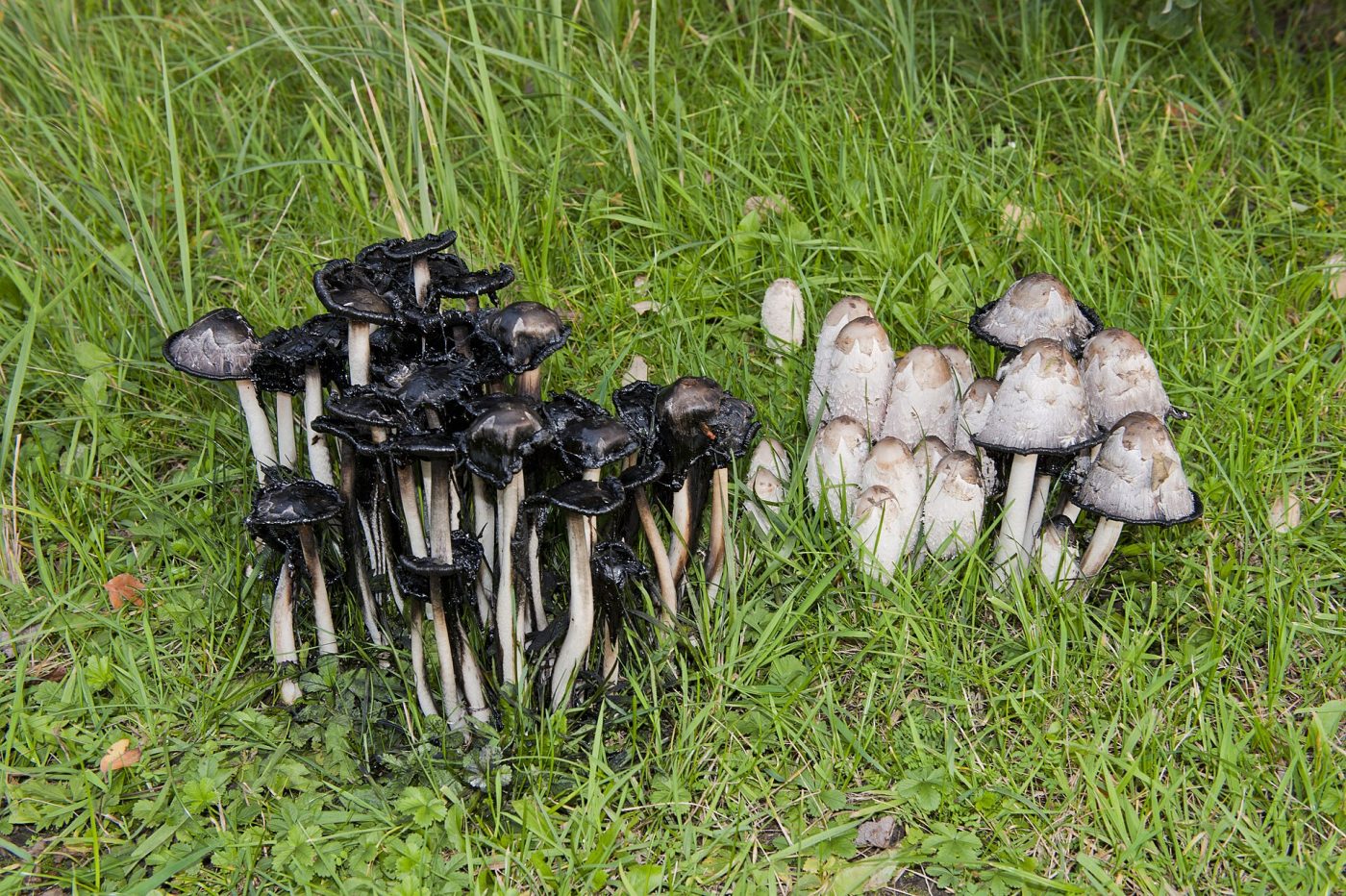
Coprinus comatus is a tall, conspicuous ink cap with a cylindrical white cap covered in brownish or cream shaggy scales. A brown or tan patch often remains at the top of the cap while the surrounding surface breaks into increasingly obvious scales.
The gills start white, become pinkish, and then black before dissolving. The stem is white, hollow, and elongated, sometimes with a thin movable ring.
Main Difference
Shaggy Mane is tall, white, and strongly shaggy. Common Ink Cap is shorter, gray-brown, and mostly smooth.
This difference is strongest in young specimens. Once deliquescence progresses, both become blackened and increasingly difficult to compare.
Common Ink Cap
Identification
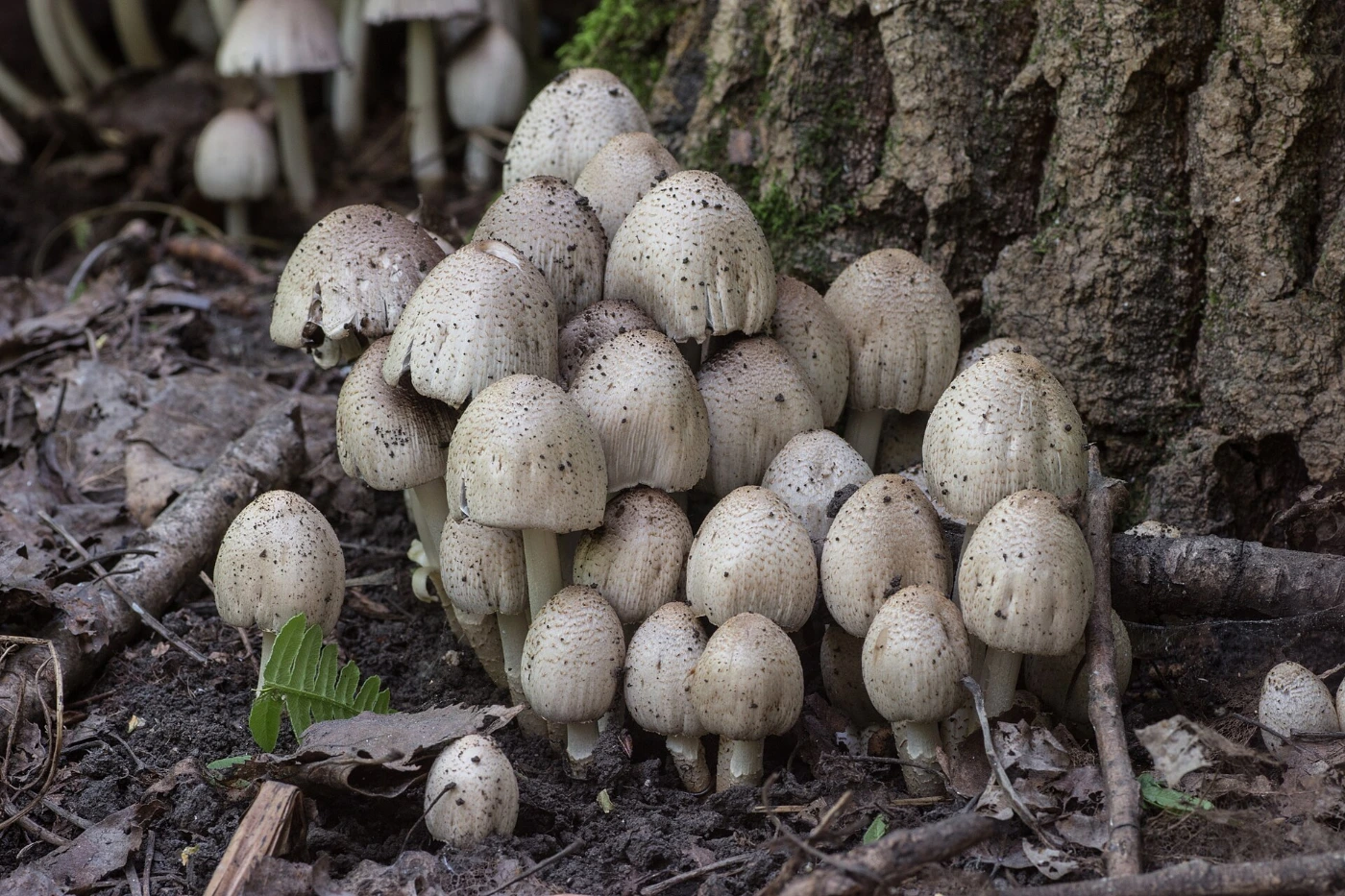
Coprinopsis atramentaria has a gray, gray-brown, or dirty pale-brown cap that expands from egg-shaped to bell-shaped. The cap is smooth to finely fibrous rather than covered with large shaggy scales.
The species frequently fruits in clusters around buried wood, old roots, or tree stumps. The gills progressively darken before dissolving into black liquid.
Main Difference
Common Ink Cap usually forms smooth gray clustered mushrooms associated with buried wood. It also contains coprine and can produce a clinically significant alcohol reaction.
Those ecological and toxicological differences are more useful than the shared ability to deliquesce.
Young Shaggy Mane vs Young Common Ink Cap
Very young specimens provide the clearest distinction. Shaggy Mane normally begins as a tall white elongated egg covered with scales.
Common Ink Cap is more compact and grayish. Even before the cap opens, it normally lacks the strongly shredded or shaggy white surface of Coprinus comatus.
The problem becomes greater when mushrooms are wet, damaged, or old. Rain can flatten cap surfaces, and blackening can obscure original coloration.
Mature Shaggy Mane vs Mature Common Ink Cap
Mature specimens of both species gradually become darker and less recognizable. Their gills turn black and their cap margins begin to dissolve.
Shaggy Mane often retains a conspicuously tall white upper cap and shaggy texture above the blackening margin for part of this process. Common Ink Cap tends to retain a shorter gray bell-shaped profile until more of the cap collapses.
Severely deliquesced specimens should generally not be identified to species from appearance alone. Too many useful characters have already disappeared.
Spore Print
Both species produce very dark to black spore prints. Spore color therefore does not provide an easy separation between them.
This is a good example of why spore prints are useful but not magical identification tools. A shared black print confirms an ink-cap-type mushroom but does not tell you whether it is Shaggy Mane or Common Ink Cap.
Cap surface, proportions, substrate, clustering, and microscopic features provide much more useful separation.
Taxonomy: Why They Are No Longer in the Same Genus
Older field guides often call the Common Ink Cap Coprinus atramentarius. Modern molecular studies resulted in the traditional large genus Coprinus being split into several genera, and the accepted name became Coprinopsis atramentaria.
Shaggy Mane retained the name Coprinus comatus. This means two mushrooms historically grouped together because of their ink-cap appearance are now placed in different genera.
Older photographs and identification books may therefore use Coprinus atramentarius. That name refers to the same Common Ink Cap discussed here.
Look-Alikes
Several other ink caps can complicate identification. The most useful approach is to recognize the entire pattern rather than assuming every mushroom that turns black belongs to one of these two species.
Coprinellus micaceus — Mica Cap
Identification
Mica Cap is generally smaller and more honey-brown than either Shaggy Mane or Common Ink Cap. Young caps often carry tiny glistening granules that resemble mica or sugar crystals.
It commonly forms clusters around stumps, roots, and buried wood. Rain can wash the mica-like granules away, making older specimens less distinctive.
Main Difference
Mica Cap is smaller, honey-brown, and often covered with glistening particles when young.
It lacks the tall white shaggy cap of C. comatus and usually appears warmer brown than the typical gray Common Ink Cap.
Coprinopsis picacea — Magpie Inkcap
Identification
Magpie Inkcap develops a dark brown to nearly black cap broken by striking white veil patches. This creates a high-contrast black-and-white pattern unlike the evenly pale Shaggy Mane.
It is usually found in woodland rather than typical open lawn habitat. Mature specimens can become large and conspicuous.
Main Difference
Magpie Inkcap has a dark cap with bold white patches rather than a white cap with shaggy scales.
A young specimen should therefore look patterned rather than uniformly pale.
Coprinopsis insignis
Identification
Coprinopsis insignis can resemble Common Ink Cap in size, color, clustering, and habitat. The two may be difficult to separate confidently using field characters alone.
Microscopic spore ornamentation provides an important distinction. C. insignis has rougher spores, while those of C. atramentaria are smooth.
Main Difference
This is not a reliable beginner field separation. If a gray clustered ink cap fits both species, microscopy may be required.
Common Identification Mistakes
One common mistake is assuming that every mushroom producing black liquid is a Shaggy Mane. Deliquescence occurs in multiple ink-cap genera, including Coprinopsis and Coprinellus.
Another mistake is relying only on color. Rain, aging, and blackening can significantly change the appearance of both species, so texture and proportions should be recorded while mushrooms are still fresh.
A third mistake is assuming that all ink caps have the same alcohol interaction. The classic coprine reaction is associated with Common Ink Cap and some relatives, while correctly identified Shaggy Mane is not considered a typical coprine-containing species.
A fourth mistake is ignoring hidden wood. Common Ink Cap may appear to grow from ordinary lawn soil while actually fruiting from buried roots or a decayed stump below the surface.
How to Photograph Them for Identification
Photograph fresh mushrooms before they begin turning black. The cap surface and original color provide much more information than an already liquefying specimen.
Include one image from the side showing overall proportions, another close-up of the cap texture, and one of the gills. A wider photograph showing whether the mushrooms are scattered or tightly clustered is also valuable.
Photograph the exact base and substrate. Visible stumps, old roots, buried wood, open grass, road edges, and disturbed soil can all help separate likely species.
Can AI Tell Shaggy Mane From Common Ink Cap?
These two mushrooms are relatively favorable for photo identification when fresh. A tall white shaggy cap is visually very different from a cluster of smooth gray Common Ink Caps.
Confidence drops sharply when specimens are old and deliquescing. Blackened caps lose the color, texture, and shape that provide the strongest identification clues.
AI should therefore use multiple features rather than simply recognizing “ink cap.” Cap texture, growth pattern, substrate, proportions, and alcohol-risk species should all be considered.
Which One Is Growing in My Lawn?
Both can appear in lawns, so grass alone does not settle the identification. Shaggy Mane is especially common in disturbed grassy ground and can grow without an obvious nearby woody substrate.
Common Ink Cap appearing in a lawn often suggests buried wood or old tree roots. Dense clustering around the former location of a tree is particularly characteristic.
The cap usually resolves the question quickly. Tall, white, and shaggy strongly favors Shaggy Mane, while shorter smooth gray caps favor Common Ink Cap.
Which One Grows Around Tree Stumps?
Common Ink Cap is much more strongly associated with stumps, old roots, and buried decaying wood. Dense groups around a stump are a classic growth pattern.
Shaggy Mane can occur in organic or disturbed soil but is not defined by tight clustering directly around old wood. Habitat should still be used together with cap structure.
A smooth gray cluster at a tree base therefore fits Common Ink Cap much better than Shaggy Mane.
Frequently Asked Questions
What is the easiest way to tell Shaggy Mane from Common Ink Cap?
Look at the young cap. Shaggy Mane is tall, white, and covered with conspicuous shaggy scales, while Common Ink Cap is usually shorter, gray to gray-brown, and relatively smooth.
Do both mushrooms turn into black ink?
Yes. Both undergo deliquescence, in which mature gills and cap tissue break down into a dark liquid containing spores.
Does Shaggy Mane contain coprine?
Shaggy Mane is not considered a typical coprine-containing mushroom. Modern toxicology sources specifically distinguish Coprinus comatus from the coprine-containing Common Ink Cap.
Does Common Ink Cap react with alcohol?
Yes. Coprinopsis atramentaria contains coprine, which interferes with alcohol metabolism and can cause flushing, nausea, headache, cardiovascular symptoms, and other unpleasant effects.
Can I drink alcohol with Shaggy Mane?
The classic coprine-alcohol reaction is not associated with correctly identified Shaggy Mane. The important qualification is correct identification, because confusing it with a coprine-containing ink cap changes the risk.
Is Common Ink Cap poisonous without alcohol?
The principal classic poisoning associated with the species is its interaction with alcohol. Because the timing of alcohol exposure can extend beyond the mushroom meal and gray ink caps can be difficult to identify confidently, MushroomID does not recommend it as a food species.
Is Shaggy Mane edible when it turns black?
Shaggy Mane is generally considered edible only while young and fresh, before significant pinking, blackening, or deliquescence has begun. Once the gills and cap start turning into black liquid, the fruit body deteriorates rapidly.
Why is Common Ink Cap called Tippler’s Bane?
The nickname refers to its ability to cause an unpleasant alcohol reaction. Coprine inhibits normal acetaldehyde metabolism, producing symptoms similar to alcohol intolerance.
Do both have black spores?
Yes. Both produce dark to black spore prints, so spore color is not an effective way to distinguish the two.
Can Common Ink Cap grow from grass?
It can appear to grow from grass, but buried wood, tree roots, or old stumps are often present below the soil. Checking the substrate and nearby history of trees can help.
Final Identification Notes
Shaggy Mane and Common Ink Cap share one spectacular feature: both eventually dissolve into black, spore-filled liquid. Before that happens, however, they are normally quite different mushrooms.
Coprinus comatus is best recognized by its tall cylindrical white cap, conspicuous shaggy scales, long white stem, disturbed-ground habitat, and eventual black deliquescence. Coprinopsis atramentaria is characterized by a shorter smooth gray to gray-brown cap, frequent dense clustering, association with buried wood or roots, and the same ink-like breakdown at maturity.
The practical identification rule is: tall + white + shaggy = Shaggy Mane; gray + smooth + clustered around wood = Common Ink Cap. The distinction is particularly important because Common Ink Cap contains coprine and can produce an alcohol interaction, whereas this is not a typical feature of correctly identified Shaggy Mane.
Upload a photo and get possible matches in seconds.