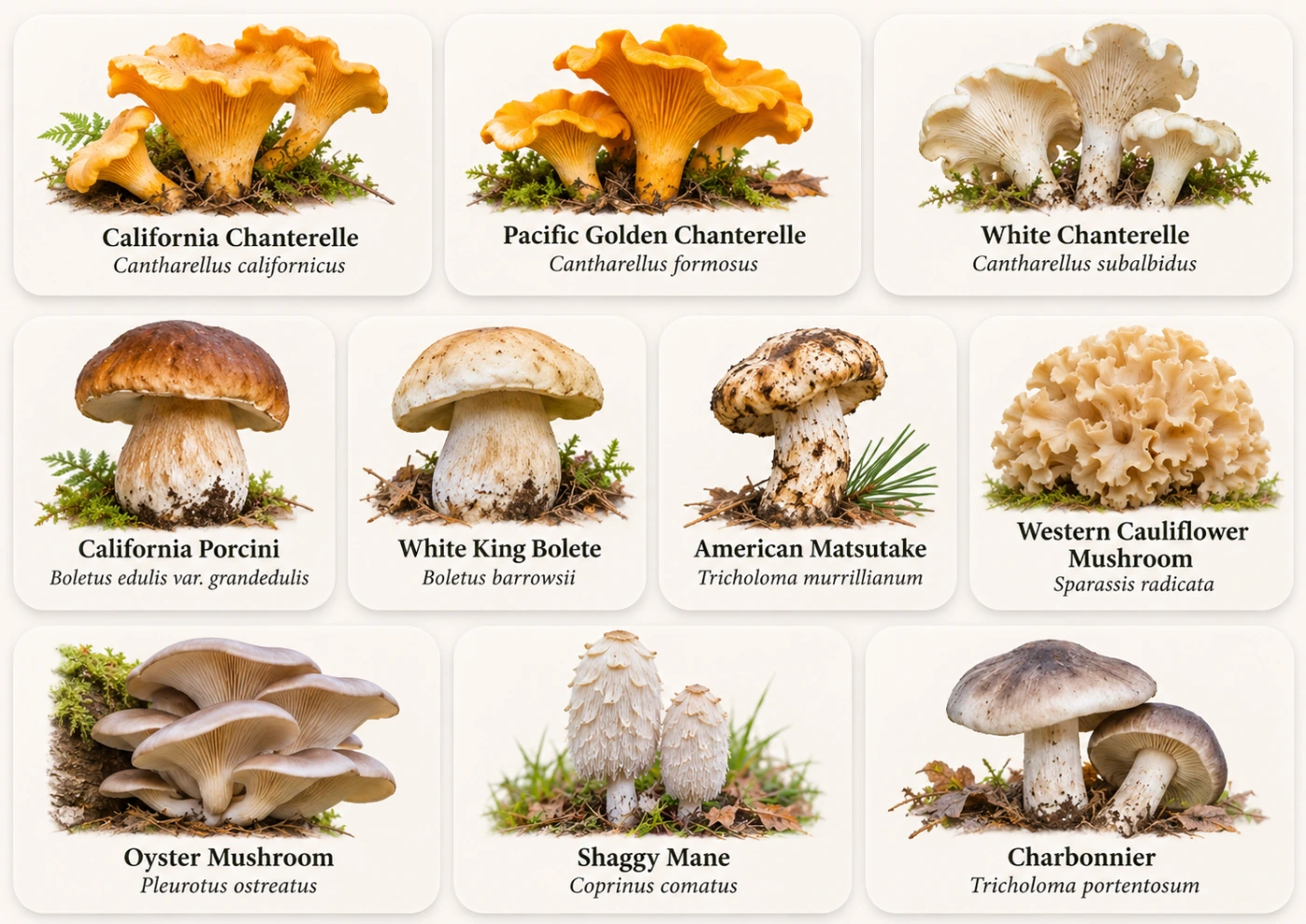
November can be one of the most productive mushroom months in California, especially after the first substantial autumn rains. Coastal forests, oak woodland, northern conifer forests, and even grassy urban areas can begin producing edible mushrooms as moisture returns after the long dry season.
California is large enough that November conditions vary dramatically by region. Along the North Coast and around the Bay Area, fall rains can trigger chanterelles, porcini, matsutake, and wood-growing mushrooms, while higher elevations may already be entering colder or snowy conditions.
⚠️ Important: Never eat a wild mushroom based only on a photograph or a list of edible species. Identify every collection independently, check all important look-alikes, and only eat mushrooms that have been confidently identified and are in good condition.
Quick Guide
| Mushroom | Best November Habitat | Main Identification Clue |
|---|---|---|
| California Chanterelle | Coast live oak woodland | Thick false gills + golden body |
| Pacific Golden Chanterelle | Northern coastal conifer forest | Golden-orange cap + false gills |
| White Chanterelle | Mixed hardwood/conifer forest | Cream-white body + false gills |
| California Porcini | Coastal pine forest | Thick bolete + white reticulation |
| White King Bolete | Oak woodland | Very pale bolete + no blue staining |
| American Matsutake | Pine, tanoak, madrone | Spicy odor + thick veil |
| Western Cauliflower Mushroom | Base of conifers | Large white cauliflower-like mass |
| Oyster Mushroom | Hardwood logs and stumps | Fleshy overlapping shelves |
| Shaggy Mane | Grass, roadsides, disturbed soil | Tall shaggy white cap |
| Tricholoma portentosum | Northern conifer forest | Gray streaked cap + yellow tones |
Why November Is Important in California
Unlike much of northern Europe or eastern North America, California’s main mushroom season is strongly controlled by rainfall rather than simply by falling temperatures. In many areas, autumn mushroom fruiting begins only after the first soaking rains.
California mountain forests have a recognized fall fruiting season extending roughly from September into November or December, with timing heavily dependent on precipitation. Along the coast, conditions can remain suitable well into winter.
This means November can be either excellent or relatively quiet. A wet October followed by mild November weather can produce substantial fruiting, while a delayed rainy season can push the main flush toward December.
1. California Chanterelle — Cantharellus californicus
The California Chanterelle is one of the state’s most characteristic edible mushrooms. It produces thick, fleshy golden-yellow fruit bodies and can grow surprisingly large.
Instead of thin true gills, the underside has blunt, forked ridges that run down the stem. These false gills are one of the most important features separating true chanterelles from several orange look-alikes.
Where to Find It
Cantharellus californicus is strongly associated with coast live oak, although it can also occur with tanoak and California bay. MykoWeb records it fruiting from fall through early spring, making November an excellent part of its potential season.
It is especially relevant in coastal and central California oak habitats. Productive colonies can return to the same general areas in suitable years.
Look-Alikes
The toxic Western Jack-O’-Lantern, Omphalotus olivascens, is the most important dangerous comparison. It has true blade-like gills and commonly grows directly from wood or buried roots.
False Chanterelle, Hygrophoropsis aurantiaca, also has true, repeatedly forked gills rather than the thick blunt ridges of a true chanterelle.
2. Pacific Golden Chanterelle — Cantharellus formosus
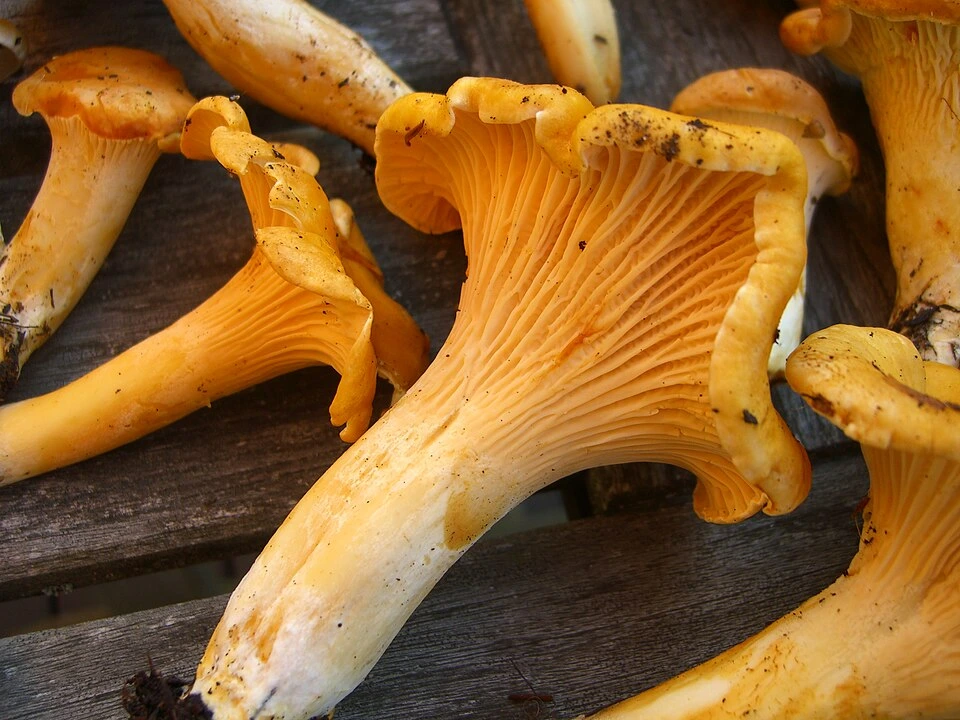
Pacific Golden Chanterelle is an important edible species of the Pacific Northwest and reaches northern coastal California. It should not simply be called Cantharellus cibarius, the European Golden Chanterelle.
The fruit body is yellow to orange-yellow, often with a somewhat more textured cap than the California Chanterelle. Its underside has the same characteristic blunt chanterelle ridges rather than true gills.
Where to Find It
It occurs in northern coastal forests in association with conifers, including Douglas fir, western hemlock, and Sitka spruce. Published regional information places its main fruiting period from September through November.
November is therefore particularly relevant in northern California rather than farther south. Moist forest and recent rainfall are much more important than the calendar alone.
Look-Alikes
Again, check carefully for true gills. Jack-O’-Lantern and False Chanterelle can both produce orange fruit bodies but have fundamentally different undersides.
3. White Chanterelle — Cantharellus subalbidus
White Chanterelle is one of the most distinctive western North American edible chanterelles. Its caps are white to cream rather than golden-yellow, although bruised areas can become yellow-brown or tawny.
The underside has thick, forked, decurrent ridges. The flesh is substantial and firm rather than thin and fragile.
Where to Find It
White Chanterelle occurs in mixed hardwood and conifer forest with trees including pine, Douglas fir, and madrone. In California it fruits from late fall through midwinter, making November an ideal time for the beginning of its season.
It is particularly relevant to northern and coastal California mushroom hunters.
Look-Alikes
American Matsutake can also be large and pale, but it has true gills, a well-developed veil, and a strong spicy odor. White Leucopaxillus species can also look superficially similar.
4. California Porcini — Boletus edulis var. grandedulis
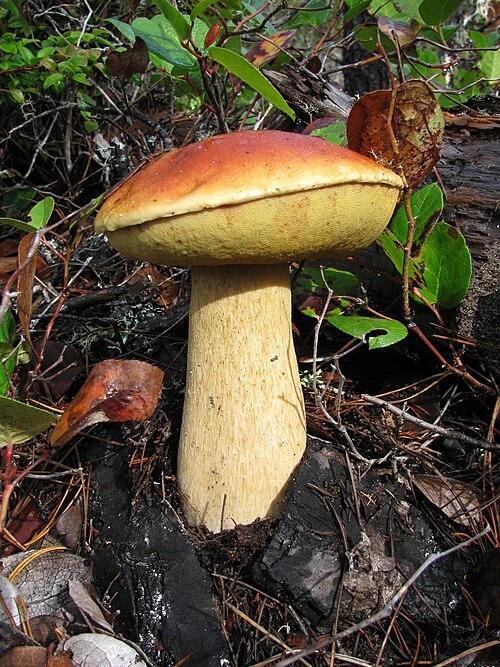
California Porcini is one of the most sought-after edible boletes in the state. It has a large brown cap, thick white flesh, pores rather than gills, and a stout stem with pale net-like reticulation near the top.
Young pores begin white and gradually become yellowish to olive with age. The flesh should remain white rather than rapidly staining blue.
Where to Find It
In coastal California, this porcini is strongly associated with Bishop pine and Monterey pine. Significant fruiting often begins after the first substantial soaking rains of autumn.
November can therefore be excellent when coastal pine forests have already received enough rain. Northern coastal areas are particularly productive in favorable years.
Look-Alikes
Bitter boletes can resemble porcini but may have darker reticulation and extremely bitter flesh. Red-pored or strongly blue-staining boletes belong to very different groups and should not be treated as porcini.
5. White King Bolete — Boletus barrowsii
Boletus barrowsii is a pale western North American bolete that can be locally abundant in California. It has a whitish to pale tan cap, pale pores when young, a reticulated stem, and flesh that does not normally turn blue.
It is considered a choice edible when correctly identified. Its pale coloration makes it visually quite different from the classic dark-brown porcini.
Where to Find It
In California, Boletus barrowsii is usually associated with oak and fruits in fall. It is not among the most common mushrooms statewide, but productive local patches can occur.
November is therefore a plausible month in suitable oak woodland following rainfall.
Look-Alikes
Pale boletes should be checked for bruising, pore color, stem reticulation, and bitterness. Never assume that every pale robust bolete is a White King.
6. American Matsutake — Tricholoma murrillianum
The western North American matsutake is Tricholoma murrillianum. Older books and websites may call western collections Tricholoma magnivelare, but modern taxonomy separates the western species.
It has a thick white to pale cap that can develop yellow-brown staining, white gills, a substantial cottony veil, and a dense firm stem. The powerful spicy odor is one of its most distinctive characteristics.
Where to Find It
California matsutake occurs in soil and forest duff beneath pine, tanoak, and madrone. Its season runs from late fall into midwinter.
Northern coastal forests are particularly important. Mushrooms can remain partly buried beneath duff, with only a raised patch of forest litter revealing their position.
Look-Alikes
White Amanita species are the most serious safety concern. Matsutake has no sac-like volva, while dangerous Amanitas may have one around the stem base.
Never cut off the underground stem base before identification.
7. Western Cauliflower Mushroom — Sparassis radicata
Western Cauliflower Mushroom is one of California’s easiest edible fungi to recognize when it appears in its classic form. It develops into a large rounded mass of pale, flattened, wavy branches.
The entire mushroom can resemble a giant cauliflower, pile of egg noodles, or tightly folded ribbons. Mature specimens can become very large.
Where to Find It
Sparassis radicata typically occurs at the base of conifers, particularly Bishop pine and Monterey pine in California. Its season extends from late fall into midwinter.
November is therefore a strong month to begin looking for it after adequate coastal rainfall.
Look-Alikes
Few mushrooms have the same large cauliflower structure. The main practical problem is quality rather than identification, because dirt and forest debris become trapped deep between the branches.
8. Oyster Mushroom — Pleurotus ostreatus
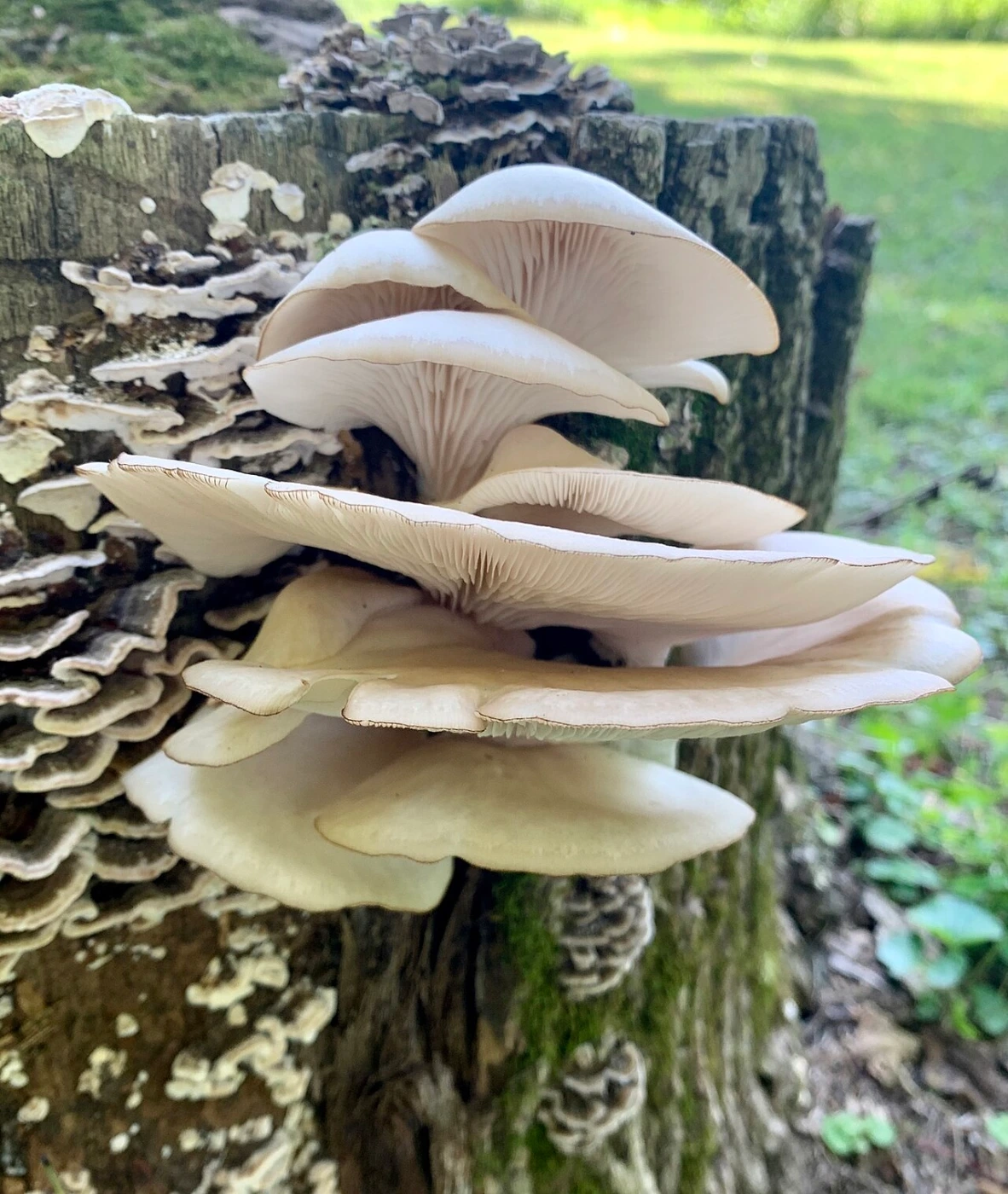
Oyster Mushrooms grow in overlapping clusters or shelves with broad fan-shaped caps. California specimens may range from nearly white to gray-brown.
The gills are white and strongly decurrent, running down toward the lateral attachment point. The mushroom is thick and fleshy rather than thin and delicate.
Where to Find It
In California, Oyster Mushrooms grow mainly on hardwood logs and stumps and fruit from early fall through midwinter.
November is therefore comfortably within their main season. Cottonwood, willow, oak, and other hardwoods are useful places to examine.
Look-Alikes
Angel Wings, Pleurocybella porrigens, are thinner, usually pure white, and associated primarily with conifer wood. They should not be treated as an edible substitute for Oyster Mushrooms.
9. Shaggy Mane — Coprinus comatus
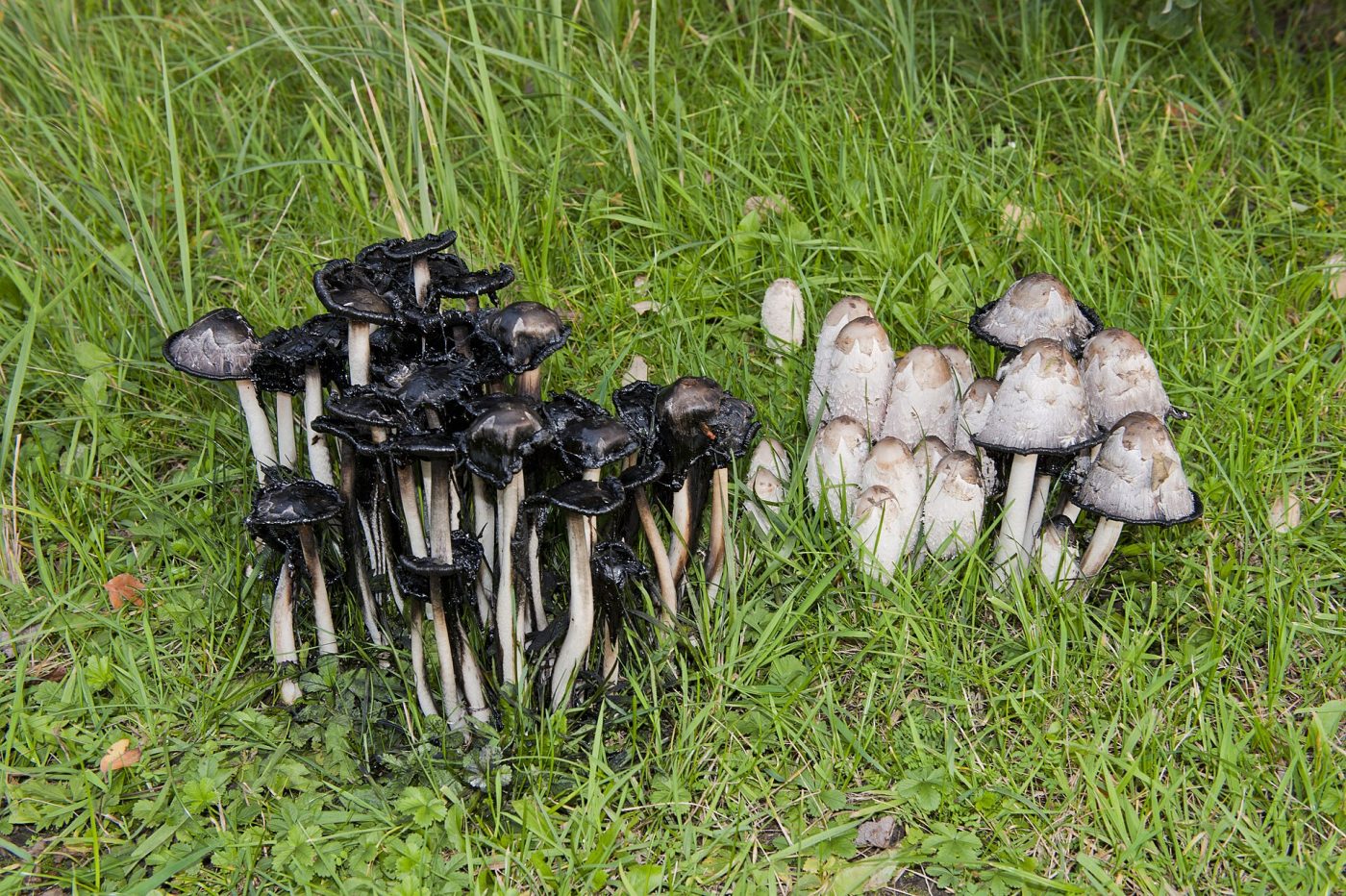
Shaggy Mane is an unusual edible mushroom with a tall cylindrical white cap covered in shaggy scales. As it matures, the gills turn from white to pink and finally black.
Eventually the entire cap begins dissolving into black ink. This process makes fresh timing especially important.
Where to Find It
Shaggy Manes occur in grassy or disturbed ground, including roadsides, paths, parks, playing fields, and landscaped areas. They can fruit during many months when moisture is available but are particularly abundant after autumn rains.
That makes November a good month even outside California’s major forest mushroom regions.
Look-Alikes
Other inkcaps can appear nearby, but Shaggy Mane has a distinctive elongated cap covered with large shaggy scales. Only young specimens should be considered for the table, before they begin turning black and dissolving.
10. Charbonnier — Tricholoma portentosum
Tricholoma portentosum is a less familiar but highly regarded edible species in northern California. It has a dark gray to gray-brown cap with obvious radial streaks and fibrils.
As it matures, yellow tones often develop in the gills, stem, or cap. The mushroom grows in association with conifers.
Where to Find It
In California it occurs in coastal forest and Sierra foothill conifer habitat from late fall to midwinter. MykoWeb notes that it is uncommon south of Humboldt County.
It is therefore primarily a northern California November target rather than a statewide mushroom.
Look-Alikes
The toxic Tricholoma pardinum is an important comparison. It typically has a dry pale-gray cap covered with darker scales rather than the smoother, strongly streaked cap of T. portentosum.
This is not a beginner species because gray Tricholoma identification can be difficult.
Best California Regions in November
North Coast
Mendocino, Humboldt, Del Norte, and nearby coastal forests can be among the most diverse regions once autumn rains begin. Pacific Golden Chanterelles, White Chanterelles, matsutake, Oyster Mushrooms, and several conifer-associated species become possible.
The exact start of the season varies considerably from year to year. Rainfall during the weeks before a trip matters more than simply choosing a November date.
San Francisco Bay Area and Central Coast
Coast live oak woodland can produce California Chanterelles, while Bishop and Monterey pine habitats can support California Porcini. Cauliflower Mushrooms may also begin appearing later in the month.
November conditions can range from dry to highly productive depending on the timing of the first major storms.
Sierra Nevada
Lower elevations and foothill conifer forest may still produce mushrooms in November, while higher elevations can become too cold or snow-covered. Elevation therefore matters as much as latitude.
Fall fruiting in California mountains commonly continues into November or December when conditions permit.
Southern California
Southern California mushroom fruiting is much less predictable in November because significant rain may not yet have arrived. Productive periods can nevertheless follow substantial storms.
Rather than planning around the calendar, watch recent rainfall and search suitable oak, pine, and urban habitats after enough moisture has reached the soil.
How Long After Rain Should You Look?
Mushrooms do not all respond at the same speed. Small saprotrophic mushrooms may appear quickly, while large mycorrhizal species such as porcini and chanterelles often require a longer sequence of suitable soil moisture.
Several days after substantial rain is often more useful than searching immediately after a short shower. Repeated rain that deeply wets forest soil can create a much better season than one isolated storm.
The Most Important November Look-Alikes
California’s edible mushroom season overlaps with several dangerous species. Chanterelles can be confused with Jack-O’-Lantern mushrooms, matsutake with white Amanitas, and edible Agaricus with toxic yellow-staining species.
A mushroom should therefore match its full identification pattern. Substrate, tree association, underside, stem base, bruising reactions, odor, and spore color can all matter.
Do Not Apply European Mushroom Names Automatically
California has many western North American species that were historically given European names. Modern taxonomy has shown that several are different species.
For example, California’s common golden chanterelles are not simply European Cantharellus cibarius, and western matsutake is Tricholoma murrillianum rather than eastern North American T. magnivelare.
Check Collection Rules Before Foraging
Rules for collecting mushrooms vary between parks, forests, preserves, and other public lands. Some areas permit limited personal collection, while others prohibit removing mushrooms completely.
Always check the rules for the specific property before collecting. Private land requires permission from the landowner.
Avoid Old and Waterlogged Mushrooms
Even an edible species is not automatically suitable for eating when it is old. Overmature fruit bodies can be insect-infested, moldy, waterlogged, or beginning to decompose.
Choose young, firm specimens in good condition. California bolete resources similarly recommend avoiding older fruit bodies, which are often less palatable and heavily insect-damaged.
November Foraging Strategy
A productive November trip starts by matching the habitat to the target species. Search coast live oak for California Chanterelles, coastal pine for porcini, mixed northern forest for White Chanterelles, and hardwood logs for Oyster Mushrooms.
Rain history is the next filter. Areas that received sustained autumn rain are usually much more promising than nearby regions that remained dry.
How to Photograph California Mushrooms for Identification
Photograph the mushroom in place before removing it. Include surrounding trees, leaves, needles, wood, or other habitat clues because California species are often strongly associated with particular hosts.
Then photograph the underside and complete stem base. For boletes, include the pores and stem pattern; for chanterelles, show the false gills; and for matsutake, preserve the buried base.
Can AI Identify California Edible Mushrooms?
AI can narrow identification considerably when the mushroom, underside, stem base, and habitat are all visible. California-specific ecological information is particularly valuable because many western species differ from superficially similar European fungi.
A photo identification should still be treated as evidence rather than permission to eat a mushroom. Edibility requires a confident identification based on all relevant features.
Interesting Facts
California’s mushroom season operates almost opposite to the state’s dry summer landscape. Many fungal colonies remain largely invisible through the dry season and produce fruit bodies rapidly once autumn moisture returns.
The state also contains several important western species that differ from famous European mushrooms with similar appearances. California Chanterelle and western matsutake are good examples of why regional taxonomy matters.
Some of the best November mushrooms occupy very different habitats within a relatively small geographic area. Oak woodland can produce chanterelles while nearby pine forest produces porcini, and fallen hardwoods support Oyster Mushrooms.
November is therefore not one uniform California mushroom season. It is a moving combination of rainfall, elevation, tree species, coastal influence, and temperature.
Frequently Asked Questions
What is the best edible mushroom to find in California in November?
California Chanterelles and California Porcini are among the most desirable targets where their habitats occur. Matsutake, White Chanterelles, and Cauliflower Mushrooms can also be excellent later-fall species.
Are chanterelles available in California in November?
Yes. Several California chanterelle species fruit during autumn, and some continue through winter or early spring depending on species and region.
Can you find porcini in California in November?
Yes. California Porcini can produce significant fruitings after the first soaking autumn rains, particularly in coastal pine habitat.
Where should I look for matsutake?
Western matsutake occurs beneath pine, tanoak, and madrone in suitable forests. Its California season generally begins in late fall and continues into midwinter.
Are there edible mushrooms in California cities in November?
Yes. Oyster Mushrooms can occur on urban hardwoods, while Shaggy Manes and various Agaricus species may appear in lawns and disturbed ground after rain.
Does one November rainstorm start the mushroom season?
Not always. A light shower may wet only the surface, while prolonged or repeated rainfall can provide the deeper soil moisture needed by many woodland fungi.
Are California chanterelles the same as European chanterelles?
Not generally. California has several native western species, including Cantharellus californicus, C. formosus, and C. subalbidus.
Is November good for mushroom hunting throughout California?
Not equally. Northern coastal areas may already be highly productive while southern regions remain dry, and high mountain areas may already be affected by snow.
Final Notes
November can be an excellent month for edible mushrooms in California once autumn rain has thoroughly moistened the soil. The strongest targets include California Chanterelles, Pacific Golden Chanterelles, White Chanterelles, California Porcini, White King Boletes, American Matsutake, Cauliflower Mushrooms, Oyster Mushrooms, Shaggy Manes, and Tricholoma portentosum.
Habitat is the most efficient way to narrow the search. Oak woodland favors California Chanterelles, coastal pine favors porcini, northern mixed and conifer forests produce chanterelles and matsutake, while hardwood logs are productive places for Oyster Mushrooms.
The practical November pattern is: watch the autumn rains → choose the right tree habitat → search several days after good moisture → identify every specimen completely → check dangerous look-alikes before considering any mushroom for food.
Upload a photo and get possible matches in seconds.