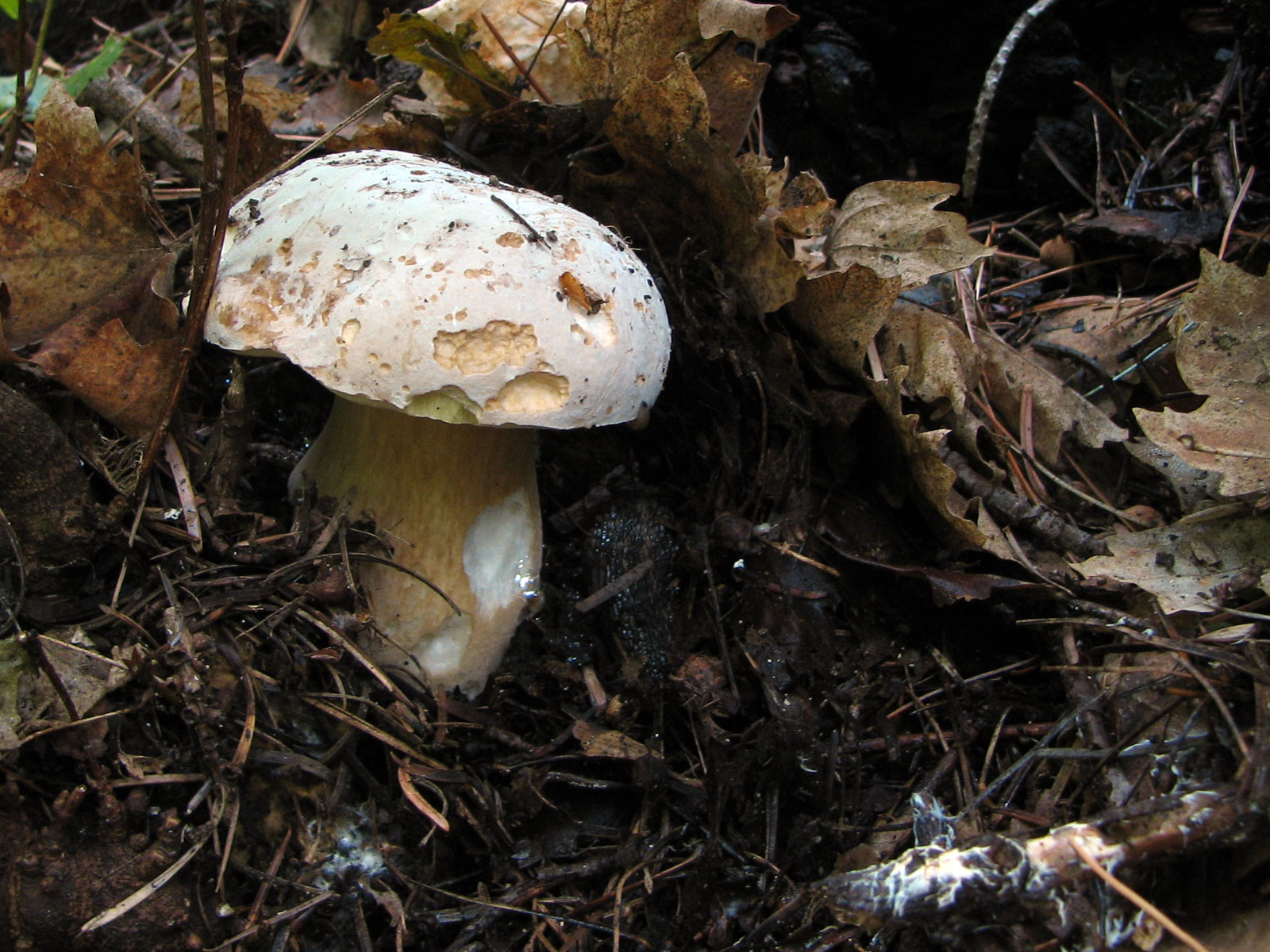
Boletus barrowsii, commonly known as the White King Bolete, is a pale, robust bolete native to western North America. It is especially associated with oak woodland and is known for its whitish to pale tan cap, thick stem, white young pores, and firm white flesh that usually shows little or no blue staining.
The most useful field pattern is large pale bolete + white young pores + thick reticulated stem + white non-bluing flesh + oak habitat. Because several pale boletes can look similar, pore color, stem reticulation, bruising reaction, and host trees are all important.
⚠️ Important: Do not confuse Boletus barrowsii with the European Butyriboletus regius, which is a different species. White King Bolete is a western North American mushroom and should be identified within that regional context.
Quick Identification
| Feature | Boletus barrowsii |
|---|---|
| Common name | White King Bolete |
| Cap color | White, cream, pale tan, light brown |
| Cap surface | Dry to slightly velvety |
| Pores when young | White |
| Pores with age | Cream to yellowish, later olive-yellow |
| Stem | Thick, pale, often club-shaped |
| Stem surface | Fine pale reticulation |
| Flesh | White, firm |
| Bruising | Usually little or no blue staining |
| Spore print | Olive-brown |
| Ecology | Mycorrhizal |
| Main hosts | Oaks |
| Habitat | Oak woodland and mixed woodland |
| Distribution | Western North America |
| Season | Summer to autumn, depending on region and rain |
| Edibility | Edible when correctly identified |
| Main look-alikes | Other king boletes, bitter boletes, pale blue-staining boletes |
What Does Boletus barrowsii Look Like?
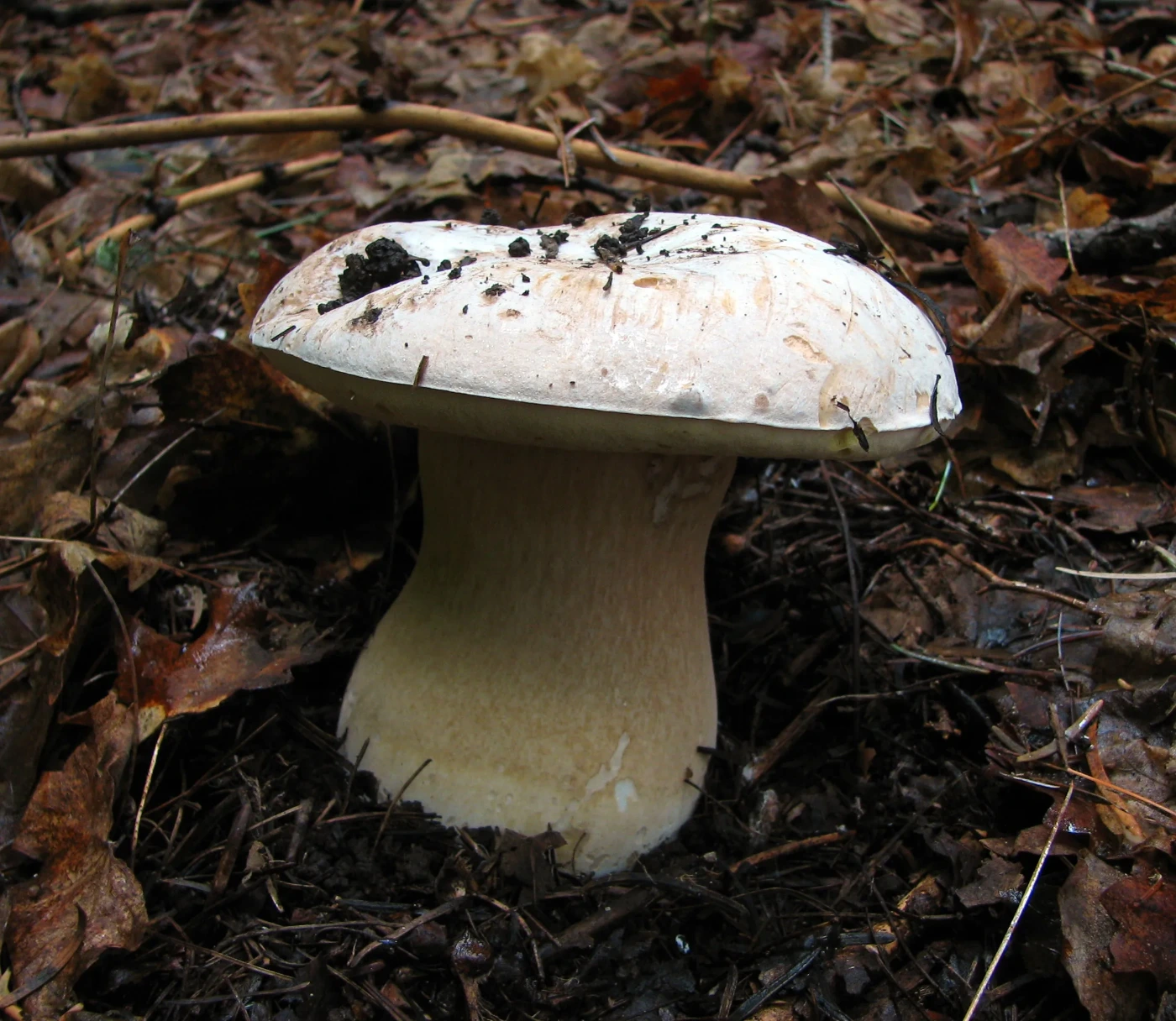
White King Bolete is a large, thick-fleshed bolete with a very pale overall appearance. Young specimens may be almost ivory-white, while older caps can become cream, tan, or light brown.
The mushroom has the classic king-bolete build: a broad fleshy cap, a stout stem, and a pore surface instead of gills. Its pale colors make it especially distinctive among western boletes.
Cap
The cap is usually white to cream when young and may become pale buff, tan, or light brown with age. The surface is dry to slightly velvety rather than strongly sticky.
Young caps are convex and gradually broaden. Mature specimens can become very large and heavy.
Cap Color
Cap color is one of the most noticeable features, but it varies with age and weather. Fresh young specimens can be strikingly pale, while sun-exposed or older mushrooms may darken considerably.
A pale cap alone is not enough for identification. The pore surface and stem pattern are more useful.
Pore Surface
The underside has pores rather than gills. In young specimens, these pores are white and dense.
As the mushroom matures, the pores gradually become cream, yellowish, and eventually olive-yellow. Rapid red or blue changes would point toward a different bolete group.
Stem
The stem is thick, pale, and often club-shaped or swollen toward the base. It may appear almost white in young specimens.
A fine net-like reticulation is usually visible, especially on the upper portion. This king-bolete style reticulation is an important feature.
Reticulation
Reticulation means the stem surface has a raised net-like pattern. In Boletus barrowsii, the reticulation is usually pale rather than dark.
This helps distinguish it from some bitter boletes, where the stem network may be darker and more contrasting.
Flesh
The flesh is white, dense, and firm. When cut, it generally remains white or shows only minimal discoloration.
Strong blue staining would be unusual for a classic White King Bolete. This is one of the more practical characters to check.
Smell
The odor is usually mild and mushroom-like. It does not normally have a strong chemical or unpleasant smell.
Odor is not the main identification feature. Structure, pores, reticulation, and host trees are much more useful.
Spore Print
The spore print is olive-brown, as expected for many boletes in this group. Mature pores also develop increasingly olive tones as spores accumulate.
A spore print can support the identification, but it usually is not necessary when the field characters are clear.
Where Does Boletus barrowsii Grow?
White King Bolete is a mycorrhizal species associated mainly with oaks. It grows from soil near living trees rather than directly from wood.
In western North America, it is especially associated with oak woodland and mixed habitats containing oaks. Fruiting depends strongly on seasonal moisture.
Oak Woodland
Oak habitat is one of the strongest practical clues. White King Boletes may appear beneath mature oaks after adequate rain.
In California and the Southwest, oak woodland can support local fruitings that return in favorable years. The exact timing varies considerably with rainfall and elevation.
Season
The fruiting season varies by region. In some areas, summer monsoon moisture can trigger mushrooms, while in Mediterranean-climate regions autumn rains are more important.
This means the calendar alone is less useful than recent precipitation. A wet period following warm conditions often produces the best flushes.
Distribution
Boletus barrowsii is a western North American species. It is known from California and other parts of the western United States, with a strong association with southwestern and western oak habitats.
It should not be treated as a European species. Regional identification is especially important in the king-bolete group because superficially similar taxa occur on different continents.
Is Boletus barrowsii Edible?
White King Bolete is generally regarded as edible when correctly identified and in good condition. Its firm flesh and mild flavor make it similar in culinary use to other king boletes.
Older specimens may become soft, insect-infested, or waterlogged. Young firm mushrooms are much better for cooking and preservation.
Look-Alikes
The main look-alikes are other pale or robust boletes. Exact separation depends on cap color, pore color, reticulation, bruising reaction, taste, and host tree.
Boletus edulis Group
Identification
Members of the Boletus edulis group can have brown caps, white young pores, thick reticulated stems, and white non-bluing flesh. Some pale individuals can resemble White King Bolete closely.
The main difference is usually regional ecology and cap coloration. B. barrowsii tends to be much paler and is strongly associated with western oak habitats.
Main Difference
A very pale cap plus oak association in western North America supports Boletus barrowsii. Darker classic porcini coloration may indicate another king bolete.
Boletus regineus — Queen Bolete
Identification
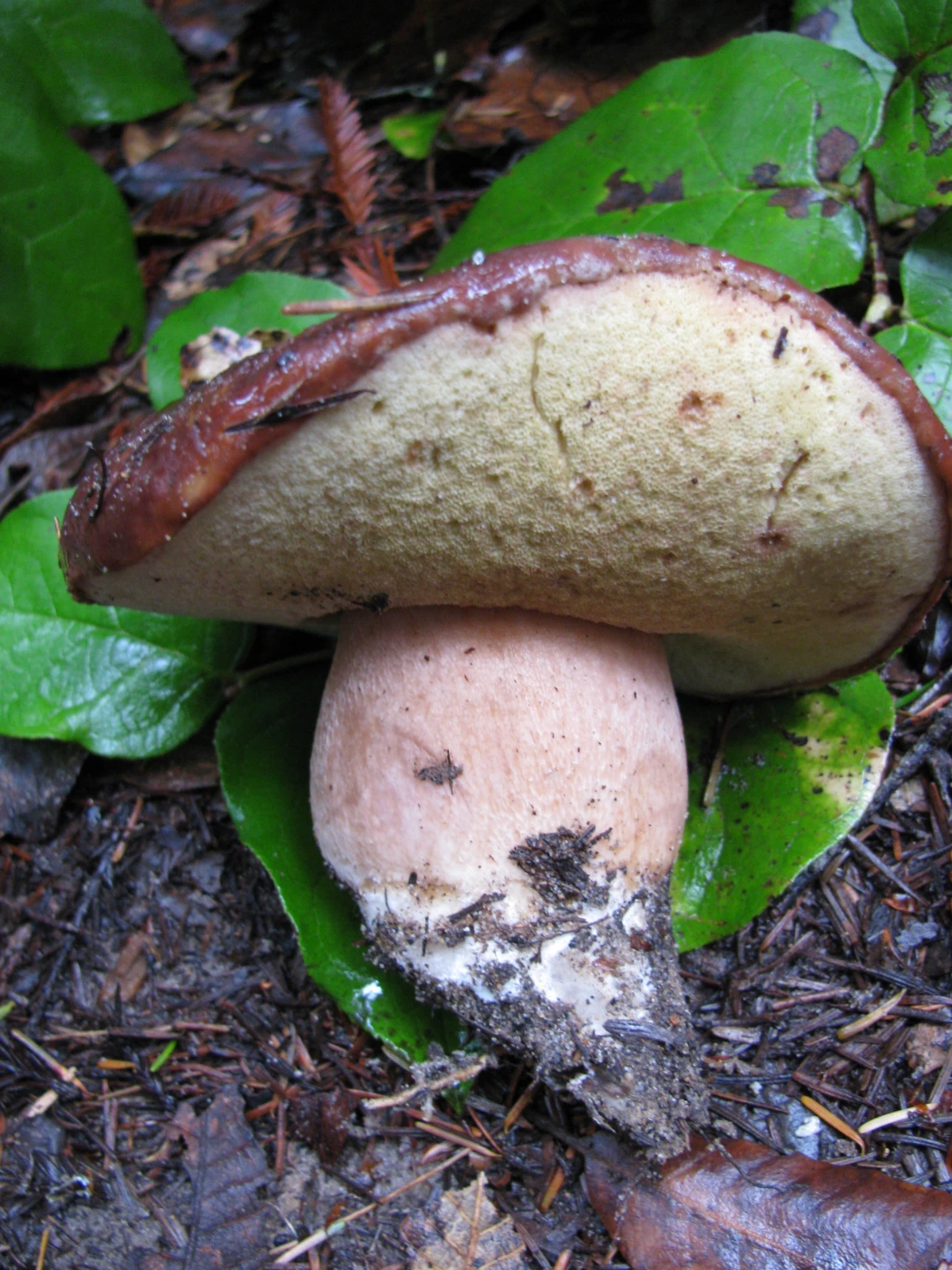
Queen Bolete is another western North American king bolete. It usually has a richer brown to reddish-brown cap and can show a whitish bloom when young.
The stem is pale and reticulated, and the flesh remains white with little or no bluing. It can grow in some of the same broad western regions.
Main Difference
The much paler overall coloration of B. barrowsii is the easiest field clue. B. regineus is usually darker and more strongly brown-capped.
Boletus rex-veris — Spring King Bolete
Identification
Spring King is another western king bolete with white pores and a thick stem. It is associated with conifer forests and often fruits in spring or early summer.
Its habitat and season differ significantly from White King Bolete. It also usually has a darker brown cap.
Main Difference
Oak habitat and pale cap favor B. barrowsii. Montane conifers and spring fruiting favor B. rex-veris.
Tylopilus felleus — Bitter Bolete
Identification
Bitter Bolete can have a stout reticulated stem and pale young pores. Mature pores become pinkish rather than olive-yellow.
The stem reticulation is often darker and more pronounced. The flesh is intensely bitter.
Main Difference
Pink mature pores and dark reticulation point toward Tylopilus felleus. White-to-yellow pores and pale reticulation fit White King Bolete better.
Pale Blue-Staining Boletes
Identification
Several western boletes can be pale or tan but develop blue staining when cut or bruised. Some also have yellow pores.
Blue staining does not automatically mean a mushroom is toxic, but it strongly argues against a classic White King Bolete identification.
Main Difference
White flesh that remains white strongly supports Boletus barrowsii. Rapid blue staining points to another group.
White King Bolete vs Queen Bolete
| Feature | Boletus barrowsii | Boletus regineus |
|---|---|---|
| Cap | White to pale tan | Brown to reddish-brown |
| Young pores | White | White |
| Mature pores | Yellow to olive-yellow | Yellow to olive |
| Stem | Pale, reticulated | Pale, reticulated |
| Flesh | White, little/no blue | White, little/no blue |
| Typical habitat | Oak woodland | Mixed hardwood and western forest |
| Best clue | Very pale cap | Darker richer cap |
These two can overlap in general structure. Cap color and habitat are the fastest practical differences.
White King Bolete vs Bitter Bolete
| Feature | Boletus barrowsii | Tylopilus felleus |
|---|---|---|
| Young pores | White | White |
| Mature pores | Yellowish to olive | Pinkish |
| Stem reticulation | Pale | Often darker |
| Flesh | Mild | Extremely bitter |
| Bruising | Little or no blue | Usually little blue |
| Edibility | Edible when correctly identified | Inedible because of bitterness |
| Best clue | Olive-yellow mature pores | Pink pores + bitter flesh |
Mature pore color is particularly useful. Pinkish pores should immediately shift attention toward Tylopilus.
How to Identify Boletus barrowsii
Start with the habitat. A large pale bolete growing beneath oak in western North America is a strong candidate.
Then inspect the pore surface and stem. White young pores, pale reticulation, and a thick club-shaped stem support the identification.
Finally, cut the mushroom. Firm white flesh that remains white or shows little staining fits the species well.
Young vs Mature White King Boletes
Young specimens are often extremely pale, with white caps, white pores, and thick compact stems. These are usually the most distinctive examples.
Older specimens become more tan and develop yellow to olive pores. Their flesh may soften and become more vulnerable to insects.
How Weather Changes the Appearance
Dry weather can make the cap paler, more matte, and sometimes cracked. Rain can deepen the color slightly and soften the surface.
Older mushrooms exposed to sun may become tan or brown enough to look less “white” than the common name suggests. This is another reason to rely on multiple features.
Common Identification Mistakes
One common mistake is calling every pale king bolete Boletus barrowsii. Several other western boletes can be pale, especially when young.
Another mistake is ignoring host trees. Oak association is one of the strongest ecological clues for this species.
A third mistake is confusing it with European taxa. White King Bolete is a western North American species and should be interpreted within that flora.
How to Photograph Boletus barrowsii
Take one photograph showing the cap, stem, and surrounding habitat. Include oak leaves or nearby trees if possible.
Then photograph the pore surface and reticulation on the upper stem. A cut section is useful for showing whether the flesh changes color.
Can AI Identify White King Bolete?
AI can often recognize a pale king-bolete form when the cap, pores, and reticulated stem are visible. Exact confidence improves significantly when oak habitat and western North American location are known.
A single cap photo is much less reliable. Pore color and a clear side view of the stem are especially important.
Interesting Facts
White King Bolete belongs to the same broad culinary group as porcini and other king boletes. Its pale color makes it one of the most visually distinctive western species.
Despite the name, mature specimens are not always truly white. Cream, tan, and pale brown caps are common with age.
The species is also a good example of why mushroom identification should be regional. A pale bolete in California may represent a completely different species from a superficially similar pale bolete in Europe.
Like other mycorrhizal boletes, Boletus barrowsii depends on living trees. Its underground mycelium forms a long-term association with oak roots, while the visible mushroom appears only temporarily.
Frequently Asked Questions
Why is Boletus barrowsii called White King Bolete?
The cap and stem are often very pale, especially in young specimens. It also has the stout structure typical of king boletes.
Does White King Bolete turn blue when cut?
Usually not. Strong blue staining would suggest another bolete group.
What color are the pores?
They begin white and become cream, yellowish, and eventually olive-yellow with age.
Does it have gills?
No. Like other boletes, it has a sponge-like pore surface under the cap.
What trees does it grow with?
It is especially associated with oaks. Oak woodland is one of the best habitats to search.
Is Boletus barrowsii edible?
Yes, it is generally regarded as edible when correctly identified and in good condition.
Is it the same as Boletus regius?
No. The European species historically called Boletus regius is now generally placed in Butyriboletus and is different from Boletus barrowsii.
Where is White King Bolete found?
It is a western North American species, especially associated with suitable oak habitats in the western and southwestern United States.
Final Identification Notes
Boletus barrowsii is best recognized by the combination of a very pale cap, white young pores, thick pale reticulated stem, firm white flesh with little or no blue staining, and oak habitat in western North America.
The main comparisons include other king boletes and Bitter Bolete. Mature pore color, stem reticulation, host tree, and bruising reaction are more reliable than cap color alone.
The practical field pattern is: large pale king bolete + oak woodland + white-to-yellow pores + pale reticulated stem + non-bluing white flesh = strong Boletus barrowsii candidate.
Upload a photo and get possible matches in seconds.