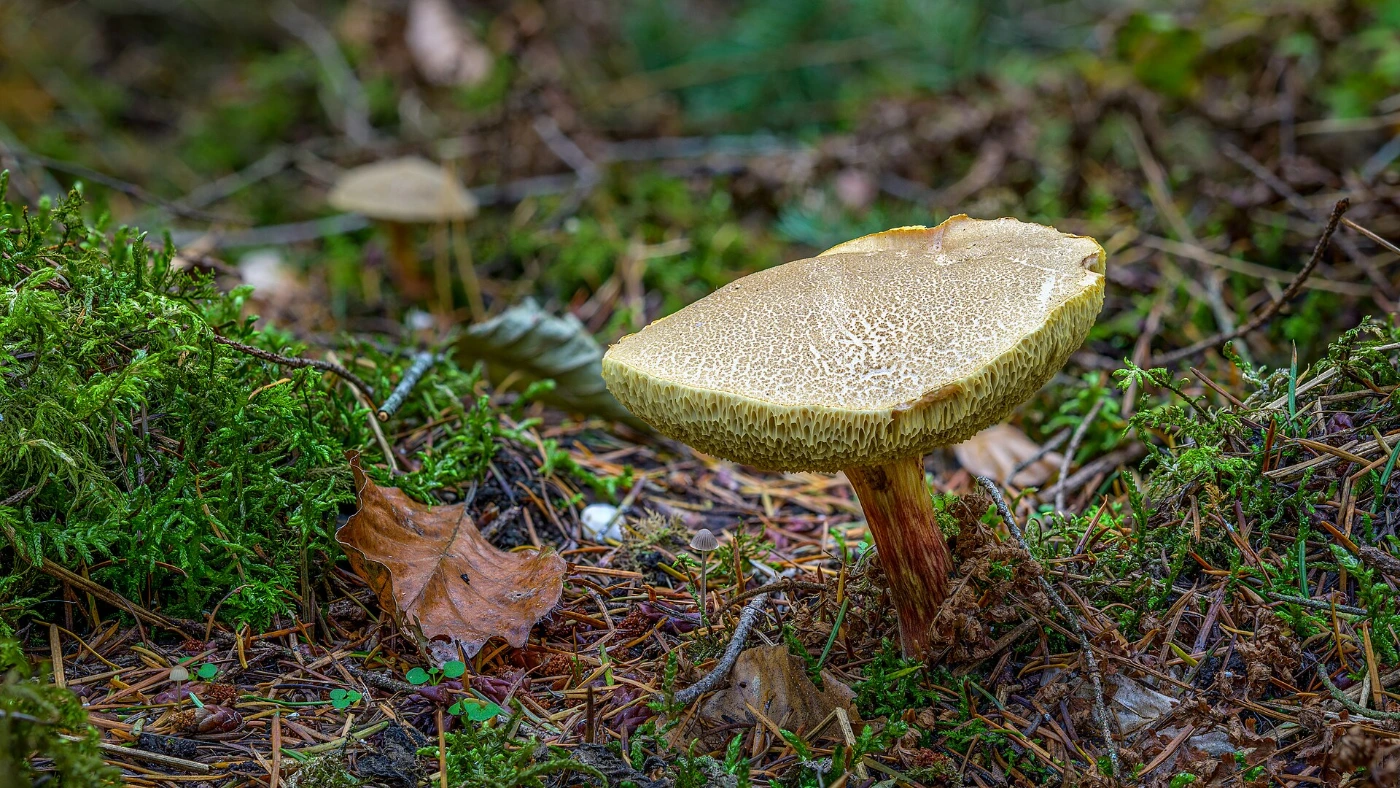
Xerocomellus chrysenteron, commonly known as the Red Cracking Bolete, is a small to medium-sized bolete with a brownish cap, yellow pores, and a yellow stem marked with reddish fibers. When the cap surface cracks, reddish tissue may become visible beneath the skin.
Despite its common name, a strongly cracked red cap is not always present. Several related Xerocomellus species can show even more obvious red cracking, so identification should be based on the entire mushroom rather than this feature alone.
The most useful field pattern is brown dry cap + occasional red cracks + yellow pores + yellow stem with coral-red fibers + weak blue staining.
⚠️ Important: Red cracking and blue bruising are not enough to identify this species safely. Xerocomellus is a difficult bolete group, and similar species may require microscopic examination for confident identification.
Quick Identification
| Feature | Xerocomellus chrysenteron |
|---|---|
| Common name | Red Cracking Bolete |
| Cap | Gray-brown to brown |
| Cap surface | Dry, finely velvety, sometimes cracking |
| Tissue beneath cap skin | Often reddish |
| Pores | Lemon yellow, later olive-yellow |
| Bruising of pores | Slow greenish-blue |
| Stem | Yellow with coral-red fibers |
| Reticulation | Absent |
| Ring | Absent |
| Flesh | Pale yellow to cream |
| Flesh bruising | Weak or limited blueing |
| Stem-base bruising | Usually not strongly blue |
| Spore print | Olive-brown |
| Ecology | Ectomycorrhizal |
| Habitat | Woodland |
| Season | Summer to autumn |
| Main look-alikes | X. cisalpinus, X. pruinatus, X. porosporus, Imleria badia |
What Does Xerocomellus chrysenteron Look Like?
Red Cracking Bolete is usually a relatively slender bolete rather than a heavy, thick-stemmed porcini-type mushroom. The cap is brown to gray-brown, the pore surface is yellow, and the stem often combines yellow and reddish tones.
Older specimens frequently look untidy. The cap can crack, the pore surface becomes dull olive-yellow, and the thin flesh may soften quickly.
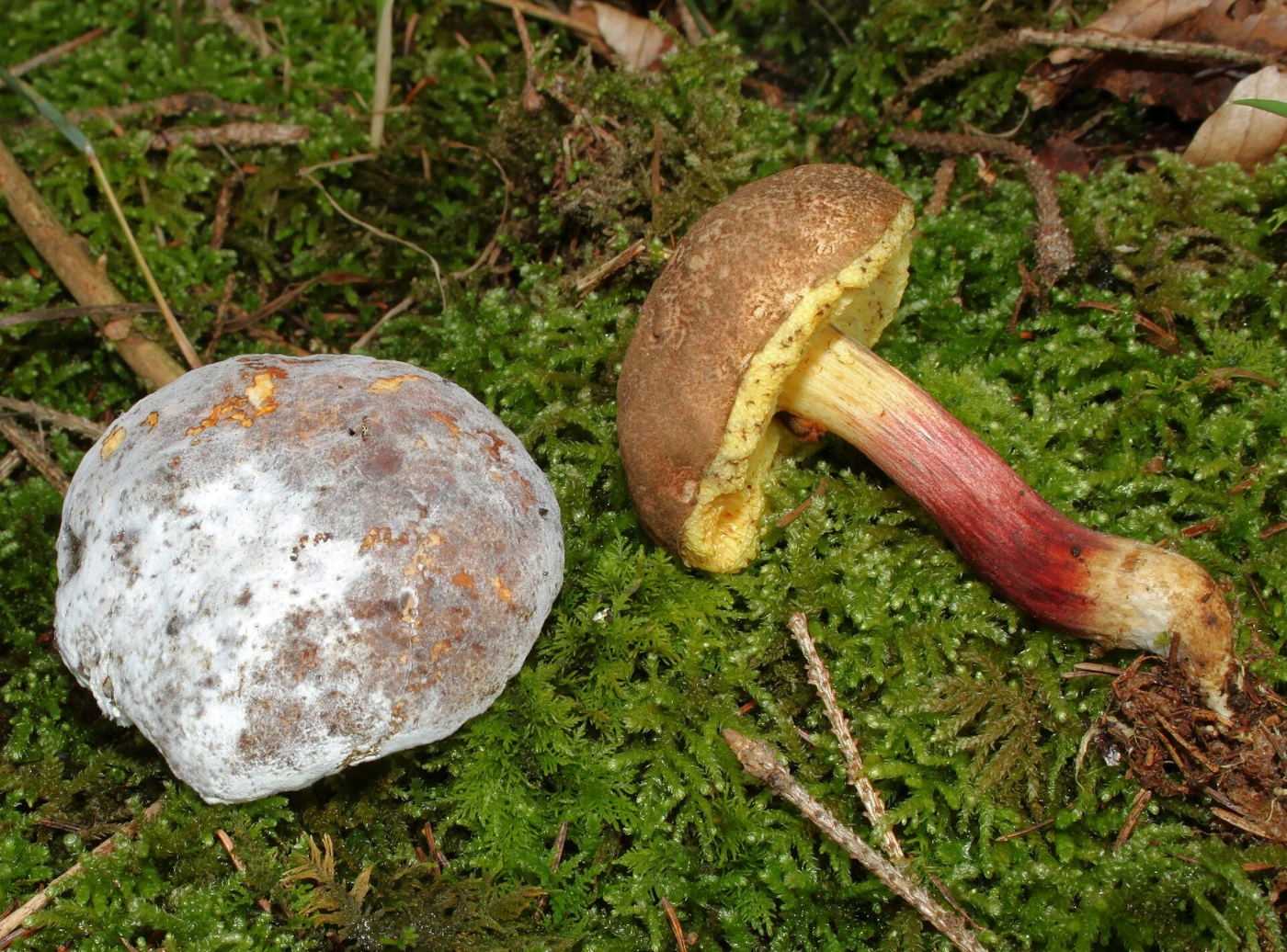
Cap
The cap is initially convex and generally remains relatively shallow compared with robust Boletus species. Mature caps are commonly around 4–10 cm across.
The surface is dry and may be finely velvety when young. Colors range from gray-yellow and olive-brown to medium brown.
Why Is It Called Red Cracking Bolete?
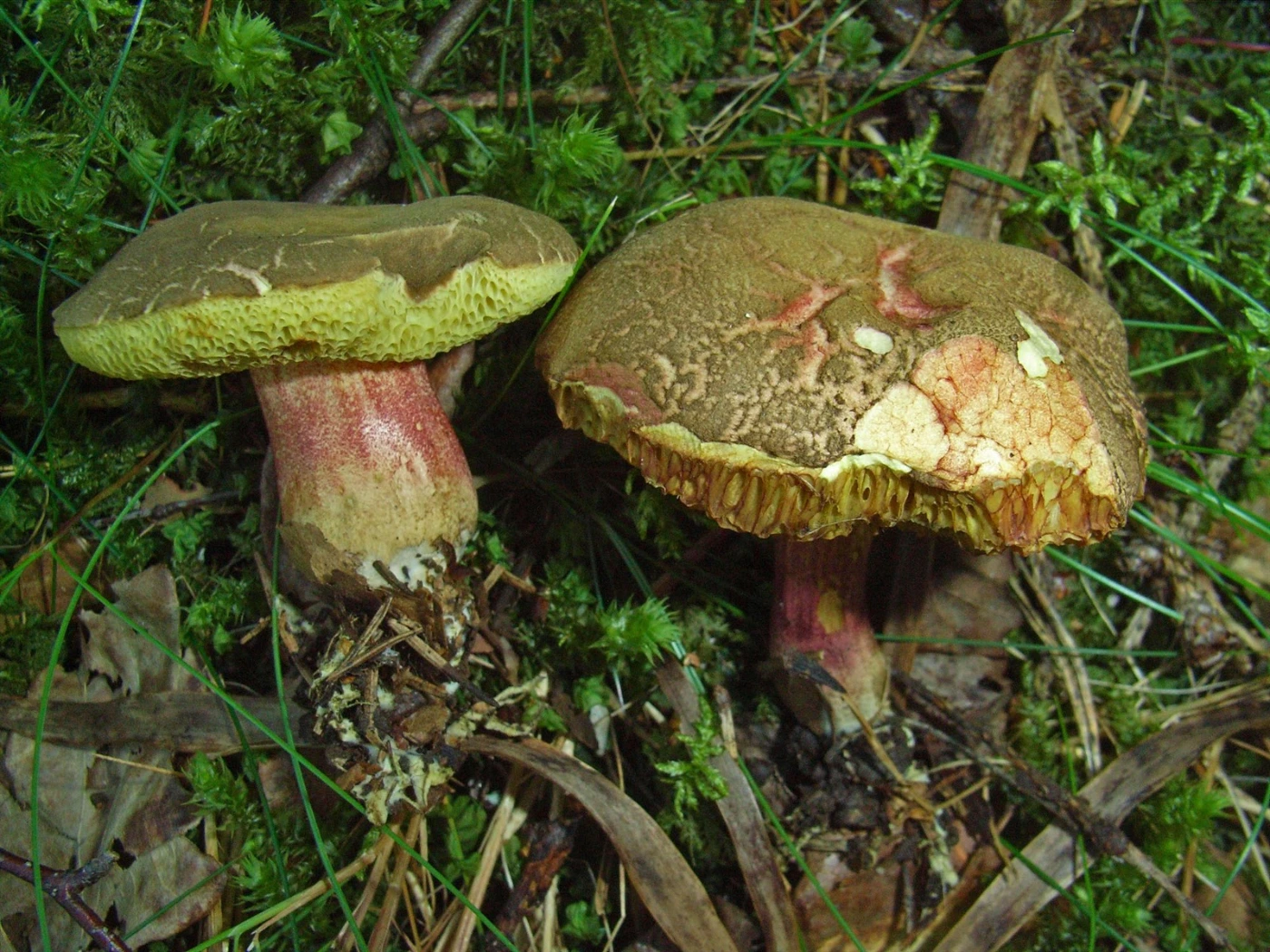
When the cap cuticle splits, reddish tissue beneath the brown surface can become visible. The resulting network of reddish cracks gives the mushroom its common name.
However, the name is slightly misleading because typical X. chrysenteron does not always crack strongly. Xerocomellus cisalpinus can show much more dramatic red cracking and was historically confused with it.
Pores
The pores begin bright lemon-yellow and become duller yellow or olive-yellow with age. They are relatively large and angular compared with the very fine pores of some other boletes.
Bruising can produce a slow greenish-blue reaction. The staining is generally less dramatic than in strongly blueing species such as Neoboletus luridiformis.
Tubes
The tubes beneath the pore surface are yellow and become increasingly olive with maturity. They can be removed from the cap flesh as a spongy layer.
When damaged, some blue-green discoloration may occur. The reaction should be observed together with the stem and internal flesh.
Stem
The stem is typically slender, yellow, and covered or flushed with reddish to coral-red fibers. This can create a distinctive yellow-and-red appearance sometimes compared with rhubarb.
There is no ring and no true net-like reticulation. The red coloration is formed by fibers or flushes rather than a raised mesh.
Red Fibers on the Stem
Close inspection often reveals separate red fibrils over a yellow background. This is an important character because a generally red stem can otherwise resemble several unrelated boletes.
The red coloration can be stronger in the middle or lower stem. Old specimens may become duller and less clearly patterned.
Flesh
The flesh is relatively thin and pale yellow to cream. A reddish layer may be visible just beneath the cap skin.
Cut flesh generally shows only weak blue staining. The stem base in particular does not normally develop the strong blue reaction characteristic of Xerocomellus cisalpinus.
Spore Print
The spore print is olive-brown. This is typical of many boletes and confirms that the mushroom belongs to a brown-spored bolete group.
Spore-print color is not sufficient to distinguish X. chrysenteron from its closest relatives. Microscopic spore shape may be necessary in difficult cases.
Where Does Xerocomellus chrysenteron Grow?
The species is ectomycorrhizal and grows from soil in association with living trees. It is reported particularly beneath conifers and sometimes with broadleaf trees such as beech.
Fruit bodies can occur singly or in small groups. Like other mycorrhizal boletes, they do not grow as decomposers directly from dead wood.
Season
Red Cracking Bolete is mainly a summer and autumn mushroom. Fruiting is particularly common from late summer into autumn.
In Britain and Ireland, records are concentrated from roughly August through November, although earlier specimens can occasionally occur.
Distribution
The species is reported from Europe and has historically been reported from North America. However, older records require caution because the name was applied broadly to a complex of similar boletes.
North American mushrooms once called X. chrysenteron may represent species such as Xerocomellus truncatus or other regional taxa. European records can also include X. cisalpinus and related species.
The Xerocomellus chrysenteron Species Complex
“Red Cracking Bolete” was historically treated as a fairly simple field species. Modern taxonomy has shown that several superficially similar mushrooms were grouped under this name.
This means old photographs, field records, and distribution maps can be unreliable. Species-level identification may require microscopic spores or molecular evidence when macroscopic features overlap.
Is Xerocomellus chrysenteron Edible?
The species is generally regarded as edible when correctly identified and thoroughly cooked. It is not usually considered a high-quality edible mushroom.
The flesh is thin and often becomes soft or soggy, particularly in older specimens. Insect damage is also common in mature fruit bodies.
Look-Alikes
The closest look-alikes are other Xerocomellus species. Cap cracking, blue staining, stem coloration, and microscopic spores are particularly useful.
Xerocomellus cisalpinus — Bluefoot Bolete
Identification
Xerocomellus cisalpinus can look extremely similar and often has a brown cap that cracks to reveal red tissue beneath. In fact, strong red cracking may be more typical of this species than of true X. chrysenteron.
The stem is yellow with reddish coloration. When cut or bruised, however, the lower stem and stem base tend to turn distinctly blue.
Main Difference
Strong blue staining in the stem base favors X. cisalpinus. Weak or absent blueing at the stem base favors X. chrysenteron.
Microscopic spores also differ and can be necessary for confirmation.
Xerocomellus pruinatus — Matte Bolete
Identification
Xerocomellus pruinatus generally has a darker brown to reddish-brown cap with a matte or finely frosted appearance. The cap surface usually remains firmer and less obviously cracked when young.
Yellow pores and reddish stem coloration can overlap with X. chrysenteron. Internal flesh and staining reactions provide additional clues.
Main Difference
A darker, firm, matte cap without the classic red-cracked pattern favors X. pruinatus. Typical X. chrysenteron is generally thinner and may reveal red tissue through cracks.
Xerocomellus porosporus — Sepia Bolete
Identification
Xerocomellus porosporus is another brown-capped bolete with yellow pores and possible cap cracking. It can be very difficult to separate visually.
Microscopic characters are particularly important. The spores of X. porosporus have a distinctive truncated appearance at one end.
Main Difference
Field characters may overlap too strongly for confident separation. Microscopy is often the most reliable distinction.
Imleria badia — Bay Bolete
Identification
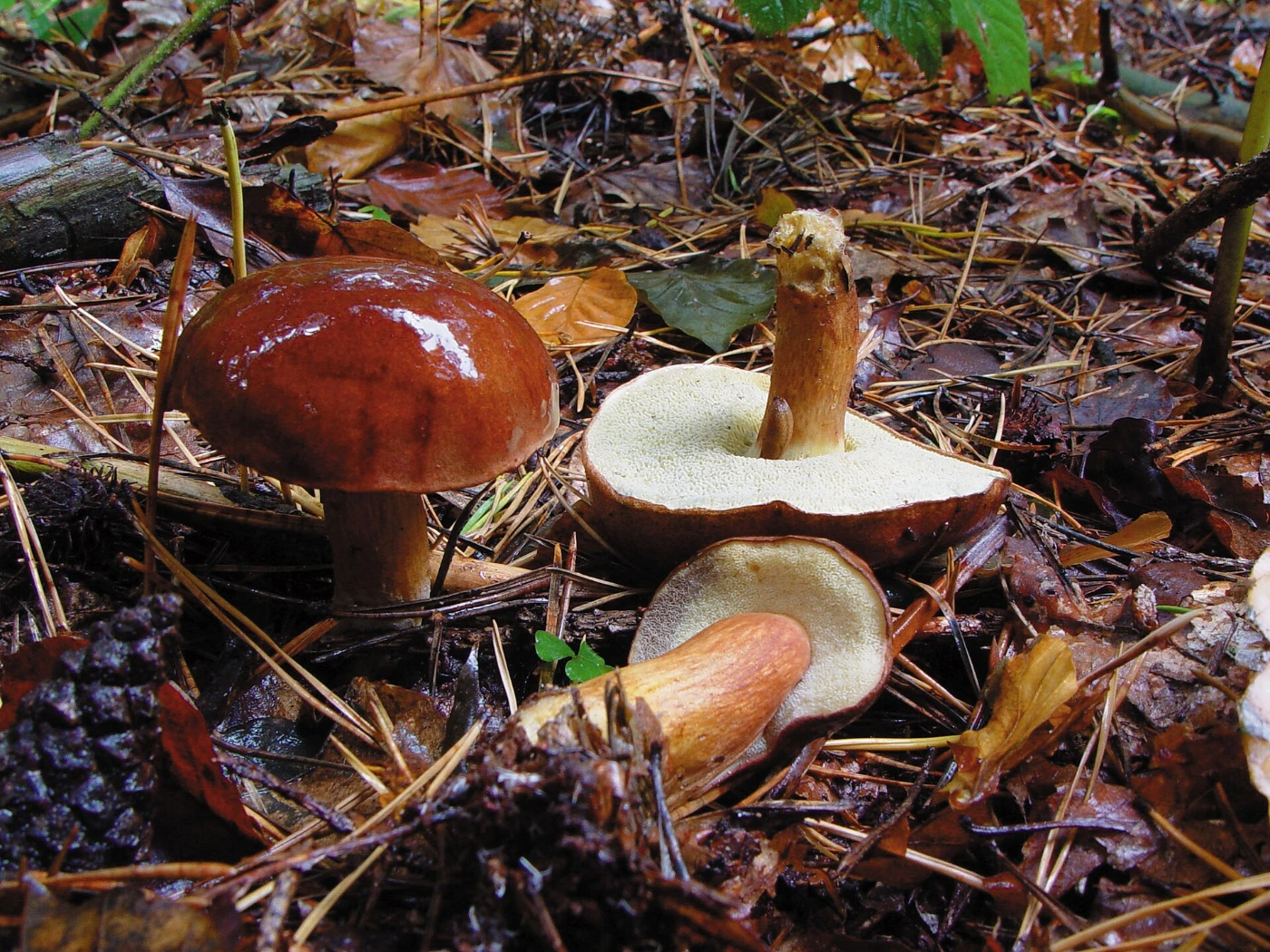
Young Red Cracking Boletes with dark uncracked caps can resemble Bay Boletes. Imleria badia usually has a deeper chestnut-brown cap and a differently colored stem without the characteristic coral-red fibrils.
The pores of Bay Bolete also bruise blue relatively readily.
Main Difference
Coral-red stem fibers support X. chrysenteron. A smoother brownish stem and chestnut cap favor Imleria badia.
Xerocomellus truncatus — no established common name
Identification
Xerocomellus truncatus is a North American species historically included within the Red Cracking Bolete complex. Macroscopically it can be extremely similar.
The most reliable distinction is microscopic. Its spores characteristically have truncated ends.
Main Difference
Geography raises suspicion, but microscopic examination is often required. North American material should not automatically be labeled X. chrysenteron.
Xerocomellus chrysenteron vs Xerocomellus cisalpinus
| Feature | X. chrysenteron | X. cisalpinus |
|---|---|---|
| Cap | Brown, sometimes cracked | Brown, often strongly cracked |
| Red beneath cracks | Present | Often very obvious |
| Pores | Yellow to olive-yellow | Yellow |
| Stem | Yellow with red fibrils | Yellow with red lower stem |
| Stem-base bruising | Weak / little blue | Distinctly blue |
| Spores | Smooth | Finely striated |
| Best clue | Weak stem-base blueing | Strong blueing at base |
This is probably the most important field comparison in Europe.
Xerocomellus chrysenteron vs Imleria badia
| Feature | Red Cracking Bolete | Bay Bolete |
|---|---|---|
| Cap | Gray-brown to brown | Chestnut to bay brown |
| Cap cracking | Sometimes | Usually not typical |
| Pores | Yellow, later olive | Pale yellow, later olive |
| Stem | Yellow with red fibers | Brownish to yellow-brown |
| Blue bruising | Weak to moderate | Often clearer on pores |
| Best clue | Red stem fibrils | Smooth brownish stem |
Young specimens can still be confusing, especially when X. chrysenteron has not yet cracked.
Does Every Red Cracking Bolete Have a Cracked Cap?
No. This is one of the most important points about the species.
Only some specimens develop obvious cracks exposing red tissue. Moisture, age, weather, and closely related species all influence how strongly the surface cracks.
A mushroom should therefore never be identified as X. chrysenteron simply because it has a red-cracked brown cap.
Does Xerocomellus chrysenteron Turn Blue?
Yes, but usually only weakly or slowly. The pores can develop a greenish-blue discoloration when bruised.
The internal flesh generally shows limited blue staining. Strong blueing at the stem base should raise X. cisalpinus as a more likely possibility.
Does Blue Staining Mean It Is Poisonous?
No. Blue staining in boletes is caused by oxidation reactions in damaged tissue and has no simple relationship with toxicity.
Both edible and poisonous boletes can turn blue. Bruising is useful for identification only when combined with other features.
Is the Red Color Under the Cap Skin Important?
Yes. Red tissue becoming visible through cap cracks is a classic character of the Red Cracking Bolete group.
However, it is not unique to X. chrysenteron. Several related species can show the same feature, sometimes much more strongly.
Why Stem Pattern Matters
A brown cracked cap immediately draws attention, but the stem can contain more useful information. Look closely at whether the red color forms fibers, dots, a net, or a general flush.
In X. chrysenteron, coral-red fibers over a yellow stem are typical. A raised reticulate network would suggest another bolete group.
Young vs Mature Red Cracking Boletes
Young specimens often have dark, finely velvety caps with little or no cracking. They can therefore resemble Bay Boletes or other small brown boletes.
As the cap expands and dries, cracks may appear and expose reddish tissue beneath. Mature pores become duller olive-yellow and the mushroom often develops a softer, less tidy appearance.
Why Old Specimens Are Difficult
Older fruit bodies lose many useful characters. Caps become faded, pores darken, insects damage the stem, and bruising reactions become less predictable.
The Xerocomellus group is already difficult when fresh. Very old specimens may be impossible to identify confidently without microscopy.
Common Identification Mistakes
One common mistake is treating every red-cracked bolete as Xerocomellus chrysenteron. Modern taxonomy has split the historical Red Cracking Bolete concept into several species.
Another mistake is ignoring the stem base. Strong blue staining there can point toward X. cisalpinus.
A third mistake is relying on cap cracking alone. True X. chrysenteron may show only weak cracking or none at all.
A fourth mistake is applying European species names automatically to North American mushrooms. Regional species such as X. truncatus can be extremely similar.
How to Photograph Xerocomellus chrysenteron
Photograph the mushroom before handling it, including nearby trees and surrounding habitat. Tree association can provide useful ecological evidence.
Then photograph the pore surface and entire stem at close range. Make sure the red fibrils are visible.
Finally, cut the mushroom vertically and photograph the stem base immediately and after several minutes. This documents whether strong blue staining develops.
Can AI Identify Xerocomellus chrysenteron?
AI can often recognize a Xerocomellus-type bolete from a brown cap, yellow pores, and reddish-yellow stem. Exact species identification is much more difficult.
The close similarity of X. chrysenteron, X. cisalpinus, X. porosporus, and regional taxa means that photographs may only support a species-group identification. Microscopy can still be necessary.
Interesting Facts
The name Red Cracking Bolete is somewhat ironic because true X. chrysenteron may crack less dramatically than some of its closest relatives. X. cisalpinus is often particularly good at producing the classic red-cracked cap.
The species epithet chrysenteron means approximately “golden inside,” referring to the yellowish internal flesh.
The species was formerly widely known as Xerocomus chrysenteron. Modern taxonomy places it in Xerocomellus, and Index Fungorum currently lists Xerocomellus chrysenteron as the accepted name.
Its history also shows how DNA and microscopic work can change familiar field-guide species. What once looked like one highly variable bolete is now understood as a complex containing several closely related taxa.
Frequently Asked Questions
What is Xerocomellus chrysenteron commonly called?
It is commonly known as the Red Cracking Bolete.
Does the cap always crack?
No. Some specimens show only limited cracking, and closely related species can crack more dramatically.
What color are the pores?
They begin lemon-yellow and become dull olive-yellow with age.
Does Xerocomellus chrysenteron bruise blue?
The pores may slowly turn greenish-blue when bruised, but the flesh usually shows only weak blue staining.
How can you distinguish it from Xerocomellus cisalpinus?
Check the stem base after cutting. X. cisalpinus usually develops much stronger blue staining there.
Is Xerocomellus chrysenteron edible?
It is generally considered edible when correctly identified and cooked, but its thin and often soft flesh makes it a relatively poor culinary mushroom.
Does it grow on wood?
No. It is an ectomycorrhizal mushroom that grows from soil in association with living trees.
Can North American Red Cracking Boletes be called Xerocomellus chrysenteron?
Not automatically. Similar North American species such as Xerocomellus truncatus can be very difficult to distinguish without microscopy.
Final Identification Notes
Xerocomellus chrysenteron is best recognized by the combination of a dry brown cap that may crack to expose reddish tissue, yellow pores, a yellow stem covered with coral-red fibers, olive-brown spores, and relatively weak blue bruising.
The most important comparison is Xerocomellus cisalpinus. Strong blue staining at the stem base favors X. cisalpinus, while typical X. chrysenteron shows much weaker blueing there.
The practical field pattern is: small brown bolete + yellow pores + red tissue beneath occasional cap cracks + yellow stem with red fibrils + weak stem-base blueing = strong Xerocomellus chrysenteron candidate. Because this is a difficult species complex, microscopy may still be needed for confident identification.
Upload a photo and get possible matches in seconds.