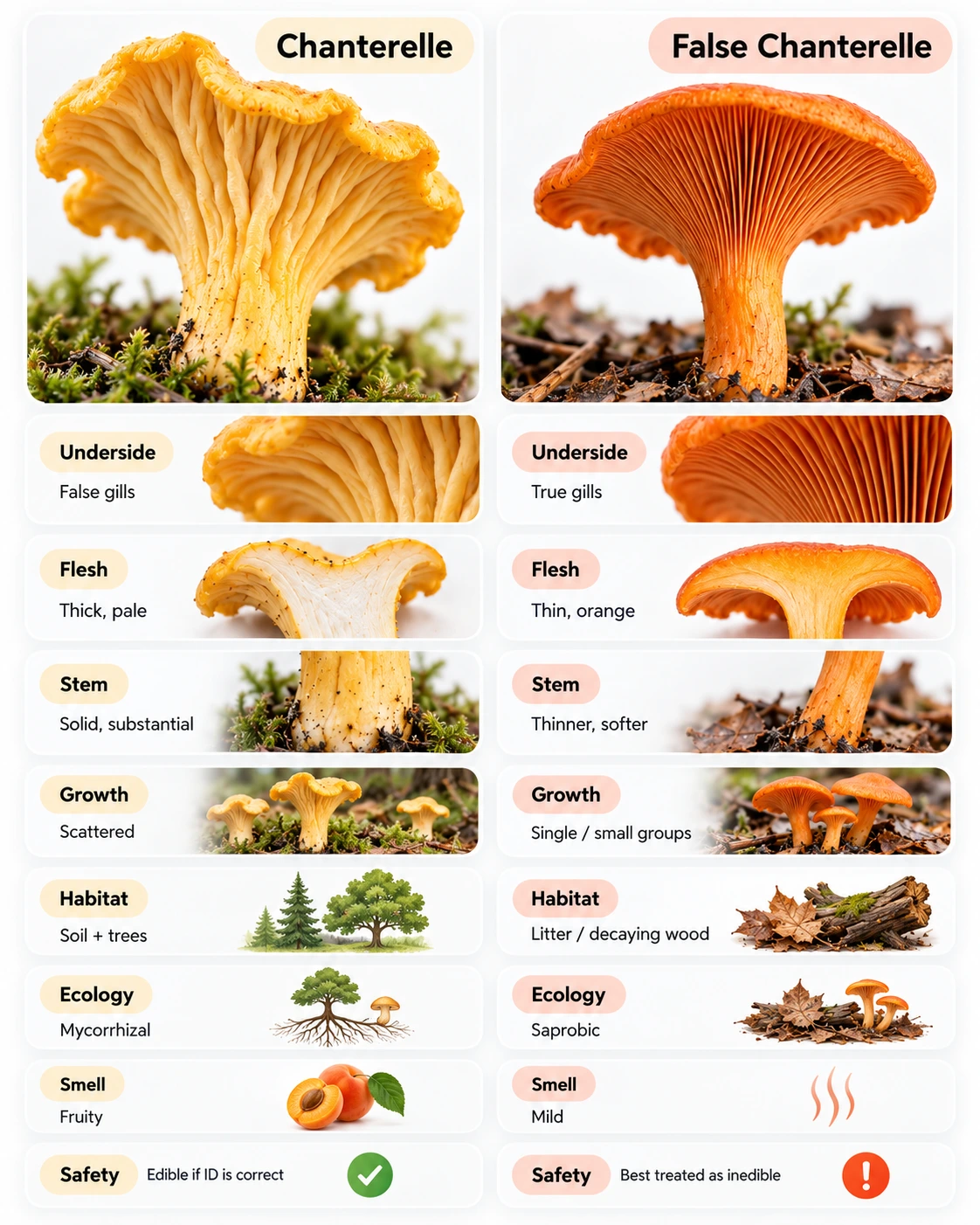
Chanterelles and False Chanterelles can look surprisingly similar when viewed from above. Both may have yellow-orange caps, funnel-shaped fruit bodies, and forked structures running down the stem, so color alone is a poor way to tell them apart.
The easiest difference is underneath the cap. True chanterelles have thick, blunt folds known as false gills, while False Chanterelles have thin, crowded, blade-like gills that can usually be separated from the cap flesh much more easily.
False Chanterelle, Hygrophoropsis aurantiaca, should also not be confused with the poisonous Jack-o’-Lantern mushroom. Jack-o’-Lantern is another orange chanterelle look-alike, but it belongs to a completely different group and usually grows in dense clusters from wood or buried roots.
⚠️ Important: This guide is for identification and education only. Never eat a wild mushroom based solely on photographs, AI identification, or a comparison with an online guide.
Chanterelle vs False Chanterelle: Quick Comparison
| Feature | True Chanterelle | False Chanterelle |
|---|---|---|
| Typical group | Cantharellus species | Hygrophoropsis aurantiaca |
| Cap color | Yellow to golden-orange | Yellow-orange to deep orange |
| Underside | Thick false gills / ridges | Thin true gills |
| Gill structure | Blunt, shallow, integrated with flesh | Narrow, crowded, blade-like |
| Forking | Often forked with connecting veins | Frequently and repeatedly forked |
| Flesh | Firm, thick, pale inside | Softer, thinner, often more orange |
| Stem | Solid and usually substantial | Often thinner and more flexible |
| Growth | From soil | Usually from soil or litter rich in decaying wood |
| Ecology | Mycorrhizal with living trees | Saprobic |
| Smell | Often fruity or apricot-like | Mild, mushroom-like |
| Spore print | Pale cream to yellowish | White |
| Edibility | Edible when correctly identified | Best treated as inedible |
| Main danger | Confusion with poisonous orange mushrooms | Confusion with true chanterelles |
What Is a True Chanterelle?
“Chanterelle” refers to several species in the genus Cantharellus. Golden chanterelles usually have yellow to orange fruit bodies, firm flesh, and a cap that becomes increasingly irregular or funnel-shaped as it matures.
Different chanterelle species occur in different parts of Europe, North America, Asia, and other regions. The familiar European Cantharellus cibarius is only one member of a much larger group, and North America contains numerous separate golden chanterelle species.
The Most Important Chanterelle Feature
The underside of a true chanterelle does not have conventional mushroom gills. Instead, it has thick wrinkles, folds, or ridges that are commonly called false gills.
These ridges are part of the cap itself rather than separate thin blades attached beneath it. They often fork, merge, and form cross-connections as they run down the stem.
What Chanterelle Flesh Looks Like
True chanterelles usually have thick, firm flesh that is noticeably paler inside than the outer surface. Cutting one vertically often reveals a pale cream or whitish interior beneath the yellow or orange exterior.
The flesh should feel substantial rather than thin and fragile. This contrast between colorful exterior and pale interior can provide another useful clue when comparing similar orange mushrooms.
What Is a False Chanterelle?
The False Chanterelle, Hygrophoropsis aurantiaca, is an orange woodland mushroom that can resemble a true chanterelle at first glance. Its funnel-like cap and decurrent orange gills make the resemblance especially convincing when the mushroom is photographed from a distance.
Despite its common name, it is not a true chanterelle and does not belong to the family Cantharellaceae. Its biology, underside structure, and texture are different enough that a close inspection usually separates the two.
What Does a False Chanterelle Look Like?
The cap is generally yellow-orange, orange, or orange-brown and often becomes darker toward the center. Mature mushrooms commonly develop a funnel-shaped form with a slightly rolled or wavy margin.
The fruit body is usually thinner and softer than a robust true chanterelle. Color can vary considerably, so some specimens may look pale while others are intensely orange.
The Gills of a False Chanterelle
The underside is covered with thin, narrow gills that run down the stem. These gills fork repeatedly, sometimes creating such an intricate pattern that they can initially resemble chanterelle ridges.
The important difference is their structure. False Chanterelle gills remain distinct blade-like structures, while true chanterelle ridges look like raised wrinkles molded directly from the mushroom flesh.
False Gills vs True Gills
This is the most useful comparison to learn because it works better than color, smell, or cap shape. Once the difference becomes familiar, many chanterelle identifications become much easier.
True chanterelle ridges are thick and blunt. False Chanterelle gills are much thinner, more numerous, and more sharply defined.
What Chanterelle False Gills Look Like
False gills look like low ridges running down the underside of the cap and onto the stem. They are often irregular, with forks, cross-veins, and sections that merge into one another.
If you cut through a ridge, it does not look like a separate blade attached to the cap. The ridge and the flesh beneath it form one continuous structure.
What False Chanterelle Gills Look Like
False Chanterelle gills are thin and densely packed. They branch repeatedly and may produce an elaborate orange pattern beneath the cap.
Viewed from the side, individual gills project clearly from the cap surface. Their edges are sharper than the rounded folds of a true chanterelle.
Chanterelle vs False Chanterelle Cap
Cap color is usually the first feature people notice, but it is not a reliable deciding factor. Both mushrooms can range through shades of yellow, orange, and orange-brown.
True chanterelle caps are often thick and fleshy with an irregular wavy margin. False Chanterelle caps tend to be thinner and may show stronger orange coloration toward the center.
Cap Shape
Young true chanterelles may begin convex or almost flat before developing a depressed center. Mature specimens frequently become strongly irregular, with twisted or lobed edges.
False Chanterelles also become funnel-shaped, so the overall silhouette can overlap considerably. Cap shape should therefore support an identification rather than determine it.
Cap Color
A bright golden mushroom is not automatically a chanterelle. Some true chanterelles are relatively pale, while False Chanterelles can range from yellow-orange to deep reddish orange.
Weather also changes appearance. Rain, sunlight, age, and dryness can make the same species appear quite different from one day to another.
Chanterelle vs False Chanterelle Flesh
Cutting a mushroom vertically can provide useful additional evidence. True chanterelles tend to have firm pale flesh that contrasts with the yellow or orange surface.
False Chanterelles are generally thinner and softer. Their flesh may show more orange coloration and does not usually have the same dense, substantial texture.
Is the Stem Hollow?
True golden chanterelles are generally solid rather than hollow. The stem blends gradually into the cap and feels like a continuation of the same firm fruit body.
False Chanterelles can feel less substantial and more flexible. Stem texture should still be combined with underside structure because condition and age can change how firm a mushroom feels.
Chanterelle vs False Chanterelle Smell
Many true chanterelles have a pleasant fruity aroma that people often compare with apricots. The smell may be obvious in a fresh group of mushrooms but very weak in individual specimens.
False Chanterelles usually have a more ordinary mushroom-like smell without the characteristic fruity quality. Because human perception of scent varies greatly, smell should never be used as the main identification feature.
Where Do True Chanterelles Grow?
True chanterelles are mycorrhizal fungi, meaning they form partnerships with living tree roots. They therefore grow from soil in forests rather than obtaining their nutrients by decomposing a log.
Different species associate with different trees. Oak, beech, birch, pine, spruce, Douglas-fir, hemlock, and other hosts can all be important depending on the chanterelle species and region.
Growth Pattern
Chanterelles often appear singly, scattered across an area, or in loose groups. Several may emerge close together because the underground fungal network can extend across a large section of forest floor.
They do not normally form tightly packed clusters emerging directly from a stump. Dense orange clusters attached to wood should immediately suggest another mushroom.
Where Do False Chanterelles Grow?
False Chanterelles are associated with forest litter and decomposing organic material, particularly in coniferous woodland. They may occur where buried woody debris, needles, and other decaying material have accumulated.
This ecological difference is useful, but it is not always obvious in the field. A mushroom growing among needles can appear to be simply growing from soil even when decomposing organic material is present underneath.
Can False Chanterelles Grow Near True Chanterelles?
Yes, similar-looking mushrooms can occur in the same general forest environment. Finding genuine chanterelles nearby does not prove that every orange mushroom in the area is also a chanterelle.
Each fruit body should be checked independently. The underside remains more reliable than assumptions based on the surrounding mushrooms.
Chanterelle vs False Chanterelle Spore Print
True chanterelle spore prints are generally pale and may appear cream, pale yellow, or slightly pinkish depending on species. False Chanterelle produces a white spore print.
The colors are close enough that spore printing is not the easiest way to separate these two mushrooms. The false-gill-versus-true-gill distinction is much more useful in most field situations.
Spore prints become more important when comparing chanterelles with other look-alikes. They should be considered one clue among several rather than a standalone test.
Is False Chanterelle Poisonous?
The edibility of Hygrophoropsis aurantiaca has been described inconsistently in mushroom literature. It is not generally placed in the same severe toxicity category as Jack-o’-Lantern mushrooms or deadly Amanitas, but reports of adverse reactions and its limited culinary value make it a poor choice for consumption.
For practical identification purposes, False Chanterelle is best treated as inedible. More importantly, believing that an orange mushroom is “probably just a False Chanterelle” can be risky because other orange look-alikes include clearly poisonous species.
Is True Chanterelle Edible?
True chanterelles are widely collected edible mushrooms when correctly identified. Their firm texture and distinctive aroma make them among the most sought-after wild mushrooms in many regions.
The word “chanterelle,” however, covers multiple species, and a yellow-orange cap alone does not establish that a mushroom belongs to Cantharellus. The complete fruit body should be checked before considering edibility.
False Chanterelle vs Jack-o’-Lantern
False Chanterelle and Jack-o’-Lantern are sometimes treated as though they were the same mushroom, but they are completely different look-alikes. Hygrophoropsis aurantiaca is the False Chanterelle, while Jack-o’-Lantern mushrooms belong to the genus Omphalotus.
Jack-o’-Lantern mushrooms are poisonous and typically produce more substantial orange fruit bodies in dense clusters on wood or buried roots. They have true gills that run down the stem and can cause severe gastrointestinal illness.
The Three-Way Comparison
| Feature | True Chanterelle | False Chanterelle | Jack-o’-Lantern |
|---|---|---|---|
| Underside | Blunt false gills | Thin forked true gills | Thin true gills |
| Flesh | Thick and pale | Thinner, often orange | Orange-yellow |
| Growth | Usually scattered | Single or small groups | Often dense clusters |
| Substrate | Soil near living trees | Forest litter / decaying material | Wood or buried roots |
| Ecology | Mycorrhizal | Saprobic | Wood decomposer |
| Safety | Edible when correctly identified | Best treated as inedible | Poisonous |
The underside separates true chanterelles from both look-alikes. Habitat and growth pattern then become particularly useful for distinguishing False Chanterelle from Jack-o’-Lantern.
Chanterelle vs Jack-o’-Lantern
Jack-o’-Lantern mushrooms typically have numerous sharp, closely spaced true gills. These gills are much more similar to conventional mushroom gills than the thick wrinkles of a chanterelle.
Growth pattern is another major clue because Omphalotus often forms conspicuous clusters from tree bases, stumps, or buried roots. True chanterelles grow from soil in association with living trees and are usually more scattered.
Why Buried Wood Can Be Misleading
A Jack-o’-Lantern cluster may sometimes appear to grow from the ground. Buried roots or decaying wood can hide the actual substrate beneath the soil.
For this reason, “growing from soil” should not override obvious true gills or dense clustered growth. Multiple features should always agree before an identification is considered reliable.
Chanterelle vs False Chanterelle by Texture
Texture can be surprisingly useful after you have handled both types. True chanterelles tend to feel dense, firm, and almost sculpted from a single piece of flesh.
False Chanterelles are often thinner and more flexible, especially around the cap. Their crowded gills also give the underside a much more delicate appearance.
Texture is difficult to judge from photographs, so it works best as an additional field characteristic rather than an online identification feature.
Chanterelle vs False Chanterelle by Color
True chanterelles often appear yellow or golden, while False Chanterelles can be more strongly orange. This difference is common enough to be useful but far too variable to function as a reliable rule.
Some chanterelle species are deeply orange, and some False Chanterelles are surprisingly pale. Lighting and camera processing can exaggerate these differences even further in photographs.
Color should therefore be one of the last features considered rather than the first.
How to Identify a Chanterelle Step by Step
The best approach is to begin underneath the mushroom. Thick blunt ridges that fork and merge strongly support a true chanterelle, while thin individual blades point toward a gilled look-alike.
Next, inspect the flesh and stem. A true chanterelle should generally feel firm and solid, with pale interior flesh and no ring or volva.
Finally, consider habitat and growth pattern. A mushroom growing from forest soil near living trees fits chanterelle ecology, while dense clusters attached to wood strongly suggest another species.
Step 1: Check the Underside
Look closely enough to decide whether you are seeing folds or actual gills. Do not simply ask whether the structures are forked because both chanterelles and False Chanterelles can show branching.
Instead, examine thickness and attachment. Chanterelle folds are blunt parts of the fruit body, while False Chanterelle gills are thin separate blades.
Step 2: Cut the Mushroom
A longitudinal cut reveals the internal structure. True chanterelles generally have solid pale flesh from the cap through the stem.
This also provides a chance to check for insect damage and hidden structures. The interior should support what you observed on the outside rather than contradict it.
Step 3: Examine the Habitat
Determine whether the mushroom is growing from soil, woody debris, or directly from wood. Then identify the nearby trees whenever possible.
Habitat is especially helpful once the mushroom has already been narrowed to a few possibilities. It should not be used to dismiss obvious structural differences.
Step 4: Look at the Entire Group
Observe whether mushrooms are scattered individually through the forest or packed tightly together. Chanterelles often occur across an area without forming one dense bouquet.
A large tightly connected orange cluster deserves additional attention. That pattern is much more typical of Jack-o’-Lantern mushrooms than true chanterelles.
The Fastest Field Check
If you have only a few seconds, turn the mushroom over. A chanterelle should show thick wrinkles or ridges rather than thin conventional gills.
Then check whether it is growing directly from wood. The combination of true gills and clustered growth from wood should immediately move the identification away from chanterelles.
This rapid check is useful for narrowing possibilities, but it is not a substitute for examining the entire mushroom.
Common Chanterelle Identification Mistakes
The most common mistake is identifying by color alone. An orange mushroom is no more automatically a chanterelle than a brown mushroom is automatically a Porcini.
Another mistake is assuming that anything with forked structures underneath must be a chanterelle. False Chanterelle gills can branch repeatedly, so the important question is whether they are thick folds or thin blades.
A third mistake is ignoring the substrate. Jack-o’-Lantern mushrooms can imitate chanterelle color extremely well, but their clustered wood-associated growth provides an important warning.
Can You Identify Chanterelles From a Photo?
A good set of photographs can often distinguish a likely chanterelle from False Chanterelle. The underside must be visible clearly enough to judge whether the structures are ridges or true gills.
A photograph showing only the cap is much less useful. Orange cap color, wavy edges, and funnel shape occur in several unrelated mushrooms.
Images of the cut interior, complete stem, habitat, and nearby trees can improve identification further. Species-level identification within Cantharellus may still require geographic and ecological information.
How to Photograph a Chanterelle for Identification
Start with a photograph of the entire mushroom in its original habitat. This preserves information about growth pattern, substrate, surrounding vegetation, and nearby trees.
Next, take a sharp close-up of the underside. Position the camera so the thickness and shape of the ridges or gills can be judged rather than simply photographing them straight on.
A third image should show a mushroom cut vertically through the cap and stem. The pale solid interior provides useful additional evidence when distinguishing true chanterelles from several orange look-alikes.
Chanterelle Identification in Europe and North America
European golden chanterelles are often discussed using Cantharellus cibarius, but even Europe contains multiple related species. Geography, habitat, and subtle morphology can matter when moving beyond the basic genus-level identification.
North American taxonomy is even more important to treat carefully because numerous distinct golden chanterelle species occur across the continent. Pacific Golden Chanterelle, Cantharellus formosus, is an important western species, while different taxa occur across eastern forests.
For practical field identification, recognizing a mushroom confidently as a true Cantharellus is usually more important than forcing an uncertain species name from appearance alone.
Frequently Asked Questions
What is the main difference between a Chanterelle and a False Chanterelle?
The easiest difference is the underside. True chanterelles have thick blunt false gills or ridges, while False Chanterelles have thin, crowded, forked true gills.
Does a False Chanterelle have true gills?
Yes. Its underside consists of narrow blade-like structures that fork repeatedly and run down the stem. Their complex branching can resemble chanterelle ridges until they are examined closely.
Do true chanterelles have gills?
No, not in the conventional sense. They have thick folds or ridges that are part of the mushroom flesh and are commonly called false gills.
Are False Chanterelles poisonous?
Hygrophoropsis aurantiaca is not generally treated like a deadly poisonous mushroom, but its edibility is disputed and adverse reactions have been reported. The safest practical approach is to regard it as inedible and avoid consuming uncertain specimens.
Is False Chanterelle the same as Jack-o’-Lantern?
No. False Chanterelle is Hygrophoropsis aurantiaca, while Jack-o’-Lantern mushrooms belong to Omphalotus. Jack-o’-Lantern mushrooms are poisonous and commonly grow in dense clusters associated with wood.
What does a real Chanterelle look like inside?
A true chanterelle usually has firm, solid flesh that is pale cream or whitish inside. The colorful outer surface therefore contrasts with the paler interior.
Do False Chanterelles smell like apricots?
They generally lack the characteristic fruity aroma often associated with true chanterelles. Smell varies between individual mushrooms, however, so it should be used only as a supporting feature.
Do Chanterelles grow on wood?
True chanterelles are mycorrhizal and grow from soil in association with living tree roots. An orange mushroom visibly growing directly from a stump or log should suggest another species.
Can Chanterelles grow in clusters?
Several chanterelles can occur close together, and their bases may occasionally be near one another. Dense bouquets emerging from one woody point are much more characteristic of mushrooms such as Jack-o’-Lantern.
What is the safest way to tell Chanterelles apart from look-alikes?
Use several features together rather than relying on a single trick. Check for false gills, pale solid flesh, growth from soil near living trees, and an appropriate scattered growth pattern before considering a mushroom a chanterelle.
Final Identification Notes
The fastest way to separate Chanterelle from False Chanterelle is to examine the underside. True chanterelles have thick, blunt folds integrated into the mushroom flesh, while Hygrophoropsis aurantiaca has thin, crowded, repeatedly forked true gills.
Color is much less useful because both mushrooms can be yellow or orange, and cap shape overlaps considerably. Flesh texture, ecology, smell, substrate, and growth pattern provide additional evidence once the underside has been checked.
Jack-o’-Lantern should also remain part of the comparison whenever an orange mushroom has true gills. Its dense clustered growth on wood or buried roots, combined with its true gills and poisonous nature, makes it the more important dangerous chanterelle look-alike to rule out.
Upload a photo and get possible matches in seconds.