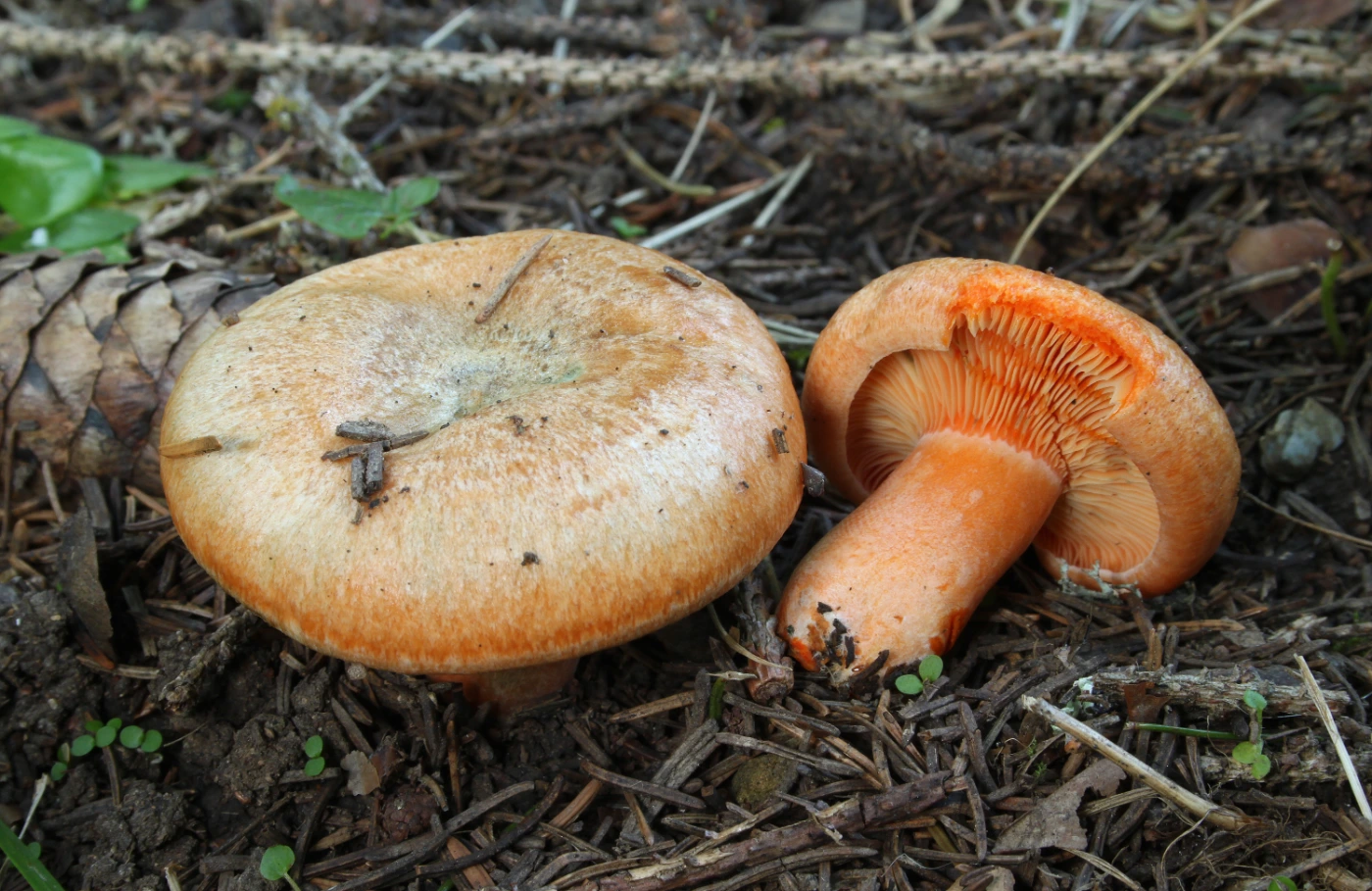
Lactarius deterrimus, commonly known as the False Saffron Milk Cap, is an orange milkcap associated especially with spruce. It closely resembles Lactarius deliciosus and other saffron milk caps, but host tree, latex behavior, cap zoning, and green staining help separate it.
The species often develops extensive green discoloration as it ages or becomes bruised. Because several orange milkcaps are edible when correctly identified but differ in ecology and regional identity, identification should rely on more than cap color alone.
⚠️ Important: Lactarius deterrimus should not be identified for eating from photographs or orange latex alone. Confirm the host tree, latex reaction, gills, stem markings, and regional context before considering edibility.
Quick Identification
| Feature | Lactarius deterrimus |
|---|---|
| Scientific name | Lactarius deterrimus |
| Common name | False Saffron Milk Cap |
| Family | Russulaceae |
| Cap color | Orange to carrot-orange |
| Cap shape | Convex, later depressed or funnel-shaped |
| Cap pattern | Often faintly zoned |
| Gills | Orange to salmon, decurrent |
| Latex | Orange, may change with exposure |
| Bruising | Often green to blue-green |
| Stem | Orange, sometimes spotted or pitted |
| Ring | Absent |
| Volva | Absent |
| Flesh | Pale orange, brittle |
| Spore print | Cream to pale ochre |
| Ecology | Mycorrhizal |
| Main host | Spruce |
| Season | Summer to autumn |
| Edibility | Edible when correctly identified and properly prepared in some traditions |
| Main look-alikes | Lactarius deliciosus, L. salmonicolor, L. sanguifluus, L. semisanguifluus |
What Does Lactarius deterrimus Look Like?
False Saffron Milk Cap is usually orange to carrot-colored, with a depressed cap and orange gills that run slightly down the stem. Young specimens can be fairly clean and bright, while older ones often become heavily marked with green patches.
The overall structure is typical of milkcaps. The flesh is brittle rather than fibrous, and fresh gills release colored latex when damaged.
Cap
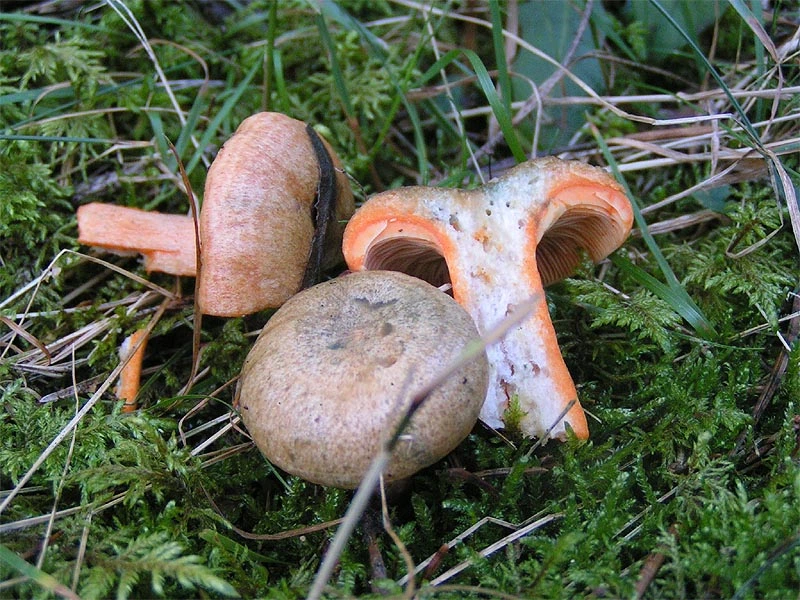
The cap begins convex and later becomes flatter with a depressed center. Mature specimens may develop a shallow funnel shape, especially when the margin lifts and becomes irregular.
Color ranges from vivid orange to duller carrot-orange or salmon-orange. Older fruit bodies often lose some intensity and may become extensively green-stained.
Cap Zoning
The cap can show concentric bands of slightly darker and lighter orange. These zones are usually less striking than in some classic Lactarius deliciosus specimens.
Zoning is useful but not decisive. Weather, age, and moisture can make the rings appear much weaker or nearly absent.
Green Staining
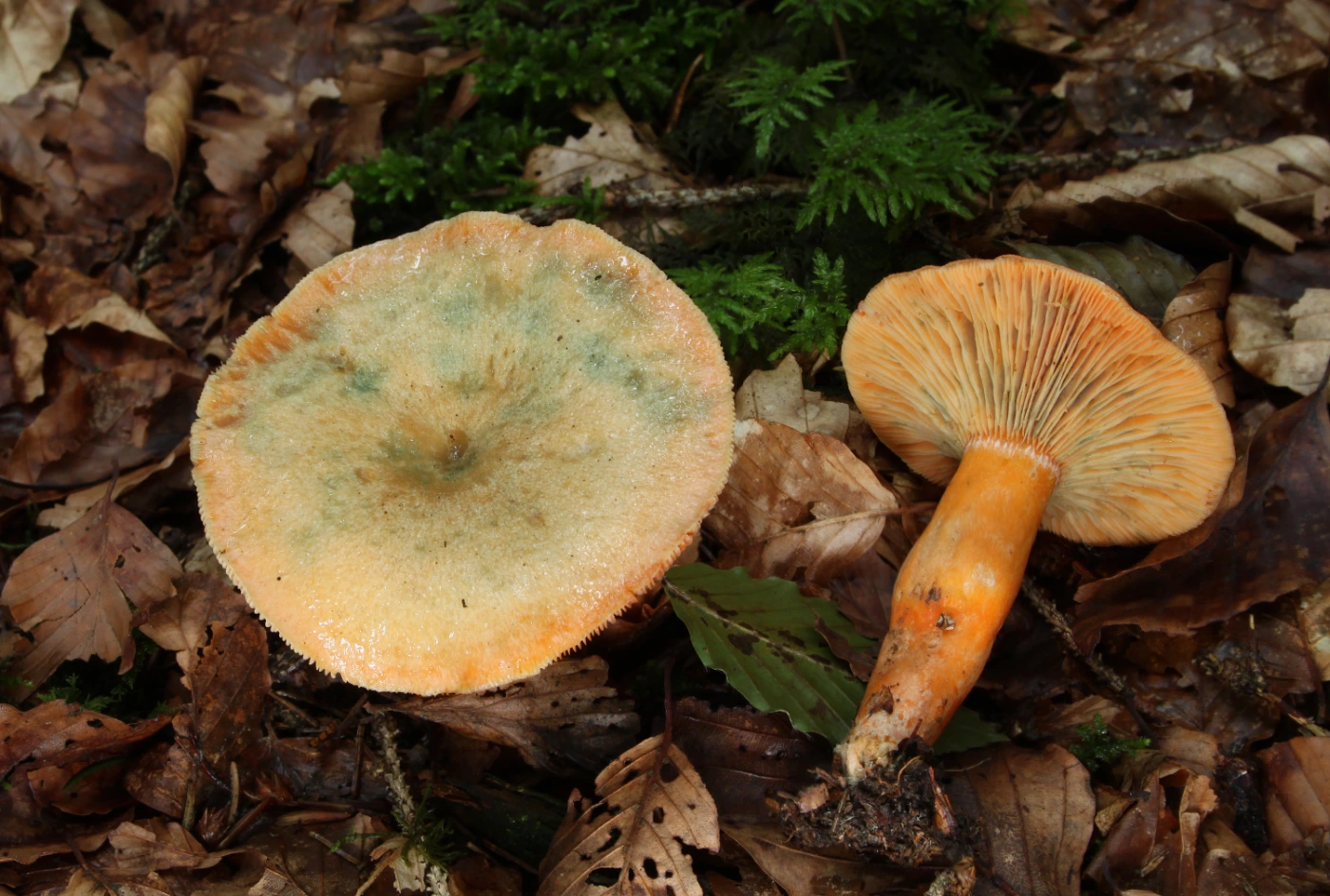
Green staining is one of the most noticeable features of Lactarius deterrimus. It can appear on the cap, gills, stem, or cut flesh after bruising, insect damage, or aging.
Older specimens may become strongly mottled with green or blue-green patches. This reaction can be more extensive than in many Lactarius deliciosus specimens, though staining intensity still varies.
Why Does It Turn Green?
The green color results from chemical changes in pigments after tissue damage or exposure to air. It is not simply mold or decay.
Fresh bruising can therefore create green marks even on otherwise healthy mushrooms. The reaction should be interpreted together with latex color and host tree.
Gills
The gills are orange to salmon and usually run slightly down the stem. They are relatively close together and can develop green discoloration where damaged.
Cutting the gills is one of the best ways to reveal latex. A fresh underside photograph is therefore especially useful for identification.
Latex
The latex begins orange to carrot-colored. Depending on age and exposure, it may darken or contribute to later green staining in the surrounding tissue.
This orange latex immediately places the mushroom within the saffron milk cap group, but it does not identify L. deterrimus by itself.
Why Latex Color Is Not Enough
Several related species produce orange or reddish latex. The host tree is therefore essential for separating them.
A spruce-associated orange milkcap is much more suggestive of Lactarius deterrimus than of L. deliciosus sensu stricto.
Stem
The stem is usually orange to pale orange and may have darker spots, shallow pits, or green-stained areas. It lacks a ring or volva.
Young stems are firm and full, while older ones may become more hollow or chambered inside. This age-related change is common in milkcaps.
Flesh
The flesh is pale orange to cream-orange and breaks rather than tearing into long fibers. This brittle texture reflects the species’ placement in Russulaceae.
After cutting, green discoloration may develop, especially in older or damaged material. Fresh sections are more informative than weathered outer tissue.
Smell
The smell is generally mild and mushroom-like. It is not one of the best features for separating this species from other orange milkcaps.
Odor should therefore be treated as supporting information only. Host tree and latex reaction are much more useful.
Spore Print
The spore print is cream to pale ochre. This is typical of many Lactarius species.
Spore print color is useful for confirming the broader group but usually does little to distinguish L. deterrimus from close relatives.
Where Does Lactarius deterrimus Grow?
The species is strongly associated with spruce. It forms mycorrhiza with spruce roots and grows from soil rather than wood.
This host relationship is one of the most important identification clues. A nearly identical orange milkcap under pine may belong to a different species.
Spruce Association
In Europe, Lactarius deterrimus is especially linked with Norway spruce and related spruce hosts. It can appear in plantations, mixed woodland, or natural spruce forest.
When several conifers grow together, host identification becomes harder. Looking at needles, cones, bark, and the immediate root zone can help.
Habitat
The species often grows in mossy or needle-covered soil beneath spruce. It may appear singly, scattered, or in small groups.
Moist, cool forest conditions favor fruiting. Dense spruce litter can partially hide younger mushrooms.
When Does False Saffron Milk Cap Grow?
The main season is summer through autumn. Fruiting often increases after sustained rain and cooler weather.
In mild years, fruit bodies may continue relatively late into the season. Timing varies with altitude, region, and moisture.
Distribution
Lactarius deterrimus is primarily a European and Eurasian species associated with spruce. It is especially familiar in regions where Norway spruce is common.
Similar orange milkcaps in North America should not automatically be assigned this name. Regional taxonomy can differ significantly.
Is Lactarius deterrimus Edible?
The species is considered edible when correctly identified and properly prepared in some European traditions. However, culinary reputation is generally lower than that of the classic Saffron Milk Cap.
Identification confidence matters more than culinary classification. Several close relatives look very similar, and host tree remains one of the best ways to separate them.
Lactarius deterrimus Look-Alikes
The main look-alikes are other saffron milk caps with orange or reddish latex. They can overlap strongly in cap color and general shape.
Tree association, latex color changes, and intensity of green staining provide the most useful separation.
Lactarius deliciosus — Saffron Milk Cap
Identification
Lactarius deliciosus has an orange to carrot-colored cap, orange latex, and green staining after damage. It often shows stronger concentric zoning than L. deterrimus.
In the strict European sense, L. deliciosus is especially associated with pine.
Main Difference
The host tree is the easiest practical clue. Pine favors Lactarius deliciosus, while spruce favors Lactarius deterrimus.
Cap pattern and staining can support the distinction, but ecology is usually stronger.
Lactarius salmonicolor — Salmon Milk Cap
Identification
Lactarius salmonicolor is salmon-orange and often appears smoother and more uniformly colored. It is strongly associated with fir.
Green staining may be less dramatic than in L. deterrimus. The overall appearance can nevertheless be very similar.
Main Difference
Fir association strongly supports Lactarius salmonicolor. Spruce points instead toward L. deterrimus.
Lactarius sanguifluus — Bloody Milk Cap
Identification
Lactarius sanguifluus differs most clearly in latex color. The milk tends toward reddish or wine-red rather than ordinary carrot-orange.
The cap can also be darker, duller, or more reddish-brown. Green staining may still occur.
Main Difference
Dark red or wine-colored latex strongly points away from L. deterrimus. Fresh gill damage is therefore particularly useful.
Lactarius semisanguifluus
Identification
This species may begin with orange latex that later turns wine-red. That color change can be subtle if only one moment is observed.
The cap is orange to gray-orange and can develop green staining. Exact identification can be difficult without watching the latex over time.
Main Difference
The key clue is the transition from orange to red-wine tones. L. deterrimus does not typically show the same pattern.
Lactarius deterrimus vs Lactarius deliciosus
| Feature | Lactarius deterrimus | Lactarius deliciosus |
|---|---|---|
| Main host | Spruce | Pine |
| Cap | Orange, often less strongly zoned | Orange, often clearly zoned |
| Latex | Orange | Orange |
| Green staining | Often strong | Common |
| Stem | Orange, may green with damage | Orange, often pitted |
| Geography | Europe / Eurasia | Europe and related regional taxa |
| Best clue | Spruce | Pine |
The two can be nearly impossible to separate confidently if the host tree is unknown.
False Saffron Milk Cap vs Salmon Milk Cap
| Feature | Lactarius deterrimus | Lactarius salmonicolor |
|---|---|---|
| Main host | Spruce | Fir |
| Color | Orange to carrot-orange | Salmon to peach-orange |
| Green staining | Often strong | Usually less pronounced |
| Zoning | Weak to moderate | Often weak |
| Latex | Orange | Orange |
| Best clue | Spruce association | Fir association |
Ecology is again more reliable than small differences in orange shade.
False Saffron Milk Cap vs Bloody Milk Cap
| Feature | Lactarius deterrimus | Lactarius sanguifluus |
|---|---|---|
| Latex | Orange | Red to wine-red |
| Cap | Orange | Orange-brown to reddish |
| Green staining | Common | Possible |
| Gills | Orange | Orange to reddish |
| Main clue | Spruce + orange latex | Dark red latex |
Latex color is especially useful in this comparison.
How to Identify Lactarius deterrimus Step by Step
Start with the tree rather than the cap. If the mushroom is under spruce, then check latex, green staining, and overall milkcap structure.
This approach is more reliable than starting with the assumption that every orange milkcap is Lactarius deliciosus.
Step 1: Confirm Spruce
Look for spruce needles, cones, and bark. In mixed woodland, make sure pine or fir is not the more likely mycorrhizal partner.
A clear spruce association strongly supports L. deterrimus.
Step 2: Cut the Gills
Fresh damaged gills should release orange latex. Photograph the liquid immediately because the initial color is important.
If the latex is distinctly wine-red from the start, another species is more likely.
Step 3: Watch for Staining
Observe the gills, cap, stem, and flesh over several minutes. Green discoloration strongly supports the saffron milk cap group.
Extensive green staining fits L. deterrimus especially well.
Step 4: Examine the Cap
Look for orange coloration, shallow depression, and weak to moderate zoning. Do not reject the species because the rings are faint.
Older specimens may have so much green staining that the original orange pattern becomes difficult to see.
Step 5: Check the Stem
Look for orange coloration, small pits or spots, and green bruising. There should be no ring or volva.
A strongly fibrous stem or completely different spore-bearing structure points away from Lactarius.
How to Photograph Lactarius deterrimus
Take one wide photograph that clearly shows the spruce habitat. Including needles, cones, or the tree base can be extremely useful.
Then photograph the cap, underside, and stem separately. Scratch or cut fresh gills and take one image immediately and another after a few minutes to document latex and staining.
A cross-section can also help show the brittle pale-orange flesh and internal color changes.
Can AI Identify Lactarius deterrimus?
AI can often recognize an orange milkcap, but exact separation from Lactarius deliciosus is much harder from appearance alone. Spruce habitat is often the decisive missing clue.
Results improve substantially when the user provides both the mushroom and the nearby conifer. Without tree information, “saffron milk cap group” may be more accurate than forcing one species.
For a broader guide to the group, see Mushrooms With Orange Latex: How to Identify Saffron Milk Caps.
Common Identification Mistakes
The most common mistake is calling every orange milkcap Lactarius deliciosus. This ignores one of the strongest features in the group: tree association.
Another mistake is treating green staining as proof of Lactarius deterrimus. Several related saffron milk caps can also turn green.
A third mistake is checking latex only after the mushroom has dried out. Old specimens may produce little visible milk and can be much harder to identify.
Interesting Facts About Lactarius deterrimus
The species name deterrimus reflects its historical reputation as a less desirable relative of Lactarius deliciosus. That older naming tradition says more about culinary comparison than about how easy the species is to identify.
Its close relationship with spruce is one of the clearest examples of how mushroom identification can depend on plants. Two orange milkcaps can look nearly identical but belong to different species because one forms mycorrhiza with spruce and the other with pine.
The green staining is a chemical reaction in damaged tissues rather than a sign that the mushroom is moldy. Older specimens can become so green that they look dramatically different from fresh orange fruit bodies.
The species also shows why field photographs should include habitat. A single close-up of the cap may lose the most valuable identification clue if the surrounding spruce forest is cropped out.
Frequently Asked Questions
Can Lactarius deterrimus grow under pine?
Its classic association is with spruce. An orange milkcap clearly associated with pine should be compared carefully with Lactarius deliciosus and other pine-associated taxa.
Can the cap become almost completely green?
Yes. Older or heavily bruised fruit bodies can develop extensive green discoloration that hides much of the original orange surface.
Why does one specimen produce more latex than another?
Age, moisture, temperature, and freshness all affect latex production. Young hydrated mushrooms usually provide the clearest reaction.
Can the stem become hollow?
Yes. Older milkcaps may develop hollow or chambered stems as they mature.
Can two orange milkcap species grow in the same mixed forest?
Yes. If spruce, pine, and fir occur together, more than one saffron milk cap species may be present in a relatively small area.
Why are some caps barely zoned?
Zoning intensity varies between specimens and changes with age and moisture. Weak rings do not exclude L. deterrimus.
Can the gills turn green without being cut?
Yes. Natural aging, insect damage, and pressure can produce green stains before the mushroom is collected.
Is the common name “False Saffron Milk Cap” a sign that the species is not a true milkcap?
No. It is a genuine Lactarius and part of the saffron milk cap group. The word “false” refers mainly to its resemblance to the classic Lactarius deliciosus.
Final Identification Notes
Lactarius deterrimus is best recognized by the combination of spruce habitat, orange latex, orange-to-salmon gills, frequent green staining, brittle flesh, and a ringless orange stem.
Its closest look-alikes are other saffron milk caps, especially Lactarius deliciosus, L. salmonicolor, L. sanguifluus, and L. semisanguifluus. Host tree and latex behavior are usually more useful than subtle differences in cap color.
The simplest field pattern is: orange milkcap + orange latex + strong green staining + spruce = strong False Saffron Milk Cap candidate.
Upload a photo and get possible matches in seconds.