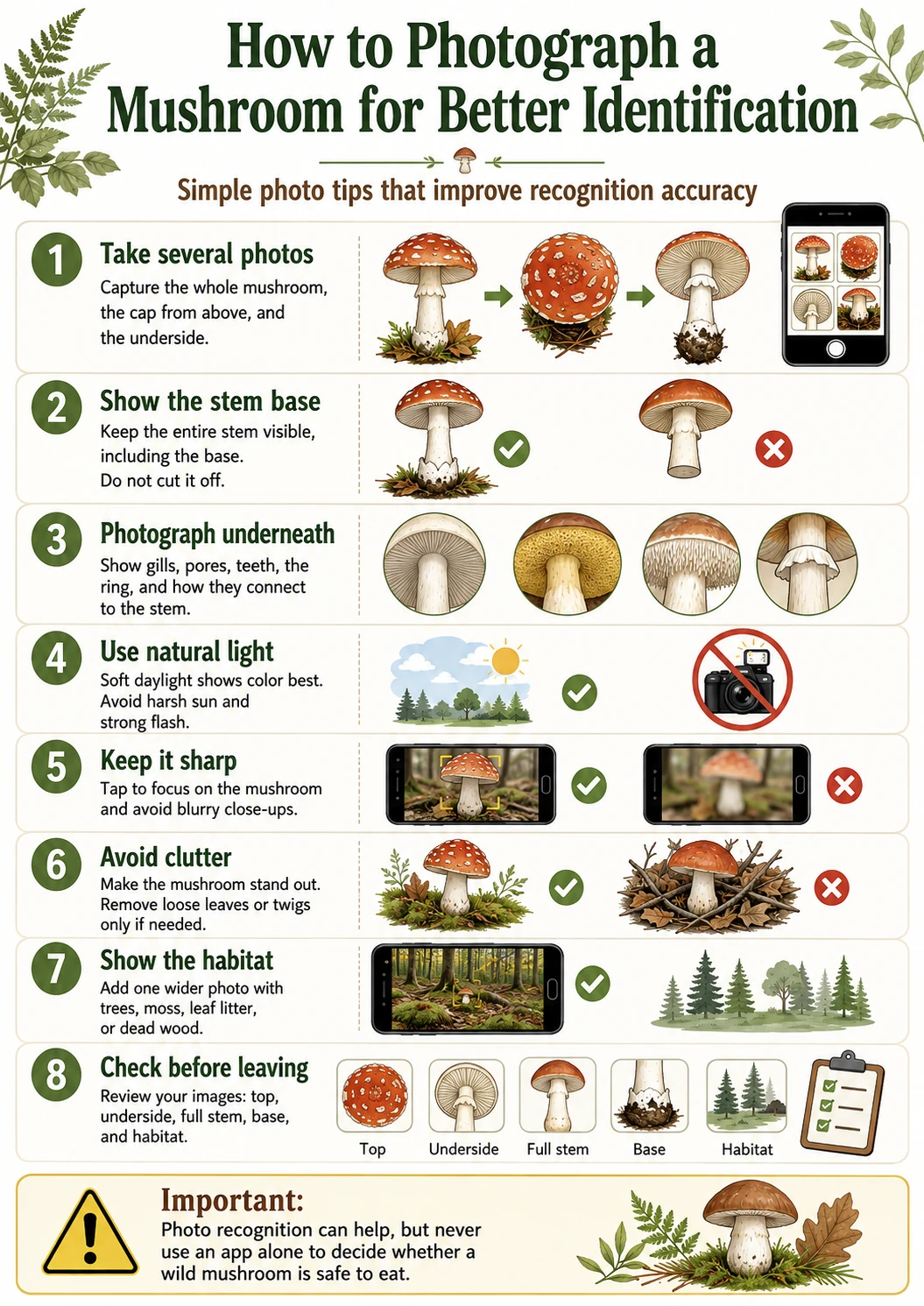
If you are using a mushroom identification app or trying to identify a mushroom from a photo, image quality matters. A clear set of photos can significantly improve recognition accuracy because many mushroom species look similar from only one angle.
For the best results, photograph the mushroom from several sides and include the features that are most useful for mushroom identification.
Take Multiple Photos of the Same Mushroom
One photo is often not enough for accurate mushroom identification.
Try to take several images showing different parts of the mushroom:
- the whole mushroom from the side;
- the cap from above;
- the underside of the cap;
- the complete stem and its base;
- the surrounding habitat.
These different views give a mushroom identification tool much more information than a single photo of the cap.
Photograph the Whole Mushroom
Start with a clear photo showing the entire mushroom.
The cap, stem, base, and overall proportions should all be visible. Try not to crop out important parts of the mushroom.
Make sure the mushroom fills a reasonable part of the frame without being cut off.
Always Show the Base of the Stem
The base of the stem can be extremely important when identifying mushrooms.
Some species have a swollen base, bulb, cup-like structure, distinctive fibers, or other features near the ground.
Do not cut the mushroom off at soil level before taking a photo.
If you remove the mushroom for identification, lift it carefully so the entire stem base remains intact.
Take a Clear Photo of the Underside
When people try to identify a mushroom from a photo, one of the most commonly missing images is the underside of the cap.
This area may contain gills, pores, teeth, folds, or other structures.
Their shape, color, spacing, and connection to the stem can help distinguish between similar mushroom species.
For better mushroom recognition, take a close but sharp photo of the underside whenever possible.
Capture Important Identification Features
Small details can make a major difference.
Pay attention to features such as the ring around the stem, scales on the cap, texture of the stem, cap margin, bruising, discoloration, and any remains of a veil.
If you notice an unusual feature, take an additional close-up photo.
Use Natural Daylight
Natural light usually produces the most accurate colors for mushroom photos.
Soft daylight or open shade is ideal. Strong direct sunlight can create deep shadows and bright highlights, while flash may change the apparent color of the mushroom.
Accurate color can be important when comparing your photo with possible mushroom species.
Make Sure the Mushroom Is in Focus
A blurry image can make identification much harder.
Tap the mushroom on your smartphone screen before taking the photo so the camera focuses on it instead of the background.
Do not move too close if your camera cannot focus at that distance. A slightly wider sharp image is more useful than a very close blurry one.
Avoid Distracting Backgrounds
Leaves, grass, branches, and other objects can hide important parts of the mushroom.
Try to photograph from an angle where the mushroom is clearly separated from its surroundings.
If a loose leaf or twig is covering the cap or stem, you can carefully move it aside without disturbing the mushroom unnecessarily.
Include One Photo of the Habitat
Habitat can also provide useful clues for mushroom identification.
Take one wider photo showing where the mushroom is growing.
Useful environmental details may include nearby trees, moss, grass, leaf litter, dead wood, stumps, or soil type.
Some mushroom species are strongly associated with particular trees or habitats, so this information can help narrow down possible matches.
Photograph More Than One Specimen
If several similar mushrooms are growing together, include more than one specimen in your photos.
Young and mature mushrooms can look very different. A young mushroom may have a rounded cap and intact veil, while an older specimen may become flat, cracked, faded, or damaged.
Photos of different growth stages can make identification easier.
Check Your Photos Before You Leave
Before leaving the location, quickly review the images on your phone.
For a good mushroom identification photo set, make sure you have captured:
- the whole mushroom;
- the top of the cap;
- the underside;
- the full stem;
- the stem base;
- the surrounding habitat.
If one image is blurry or incomplete, take another while the mushroom is still in front of you.
Can a Mushroom Be Identified From a Photo?
Many mushrooms can be narrowed down to a species or group using good photographs, but photo identification has limitations.
Some species require information that cannot be seen in an image, such as smell, spore print color, microscopic features, chemical reactions, or changes in color after bruising.
For this reason, an AI mushroom identifier or mushroom identification app should be treated as a helpful identification tool rather than a guarantee.
Never rely only on photo recognition to decide whether a wild mushroom is safe to eat.
Better Photos Mean Better Mushroom Identification
The most useful mushroom photos are clear, sharp, well-lit, and taken from several angles.
Instead of uploading only one picture of the cap, photograph the whole mushroom, underside, stem base, and habitat.
Providing more visual information gives a mushroom identification system a better chance of finding the correct species and can also make identification easier for experienced mushroom enthusiasts.
Для SEO этой версии естественно используются запросы вроде mushroom identification, identify mushroom from photo, mushroom identification app, mushroom photo identification и how to photograph mushrooms.
Leave a Reply